Numerical Based on Multiplexer Type 5 (Example 2) | Number System and Code | Digital Electronics
TL;DR
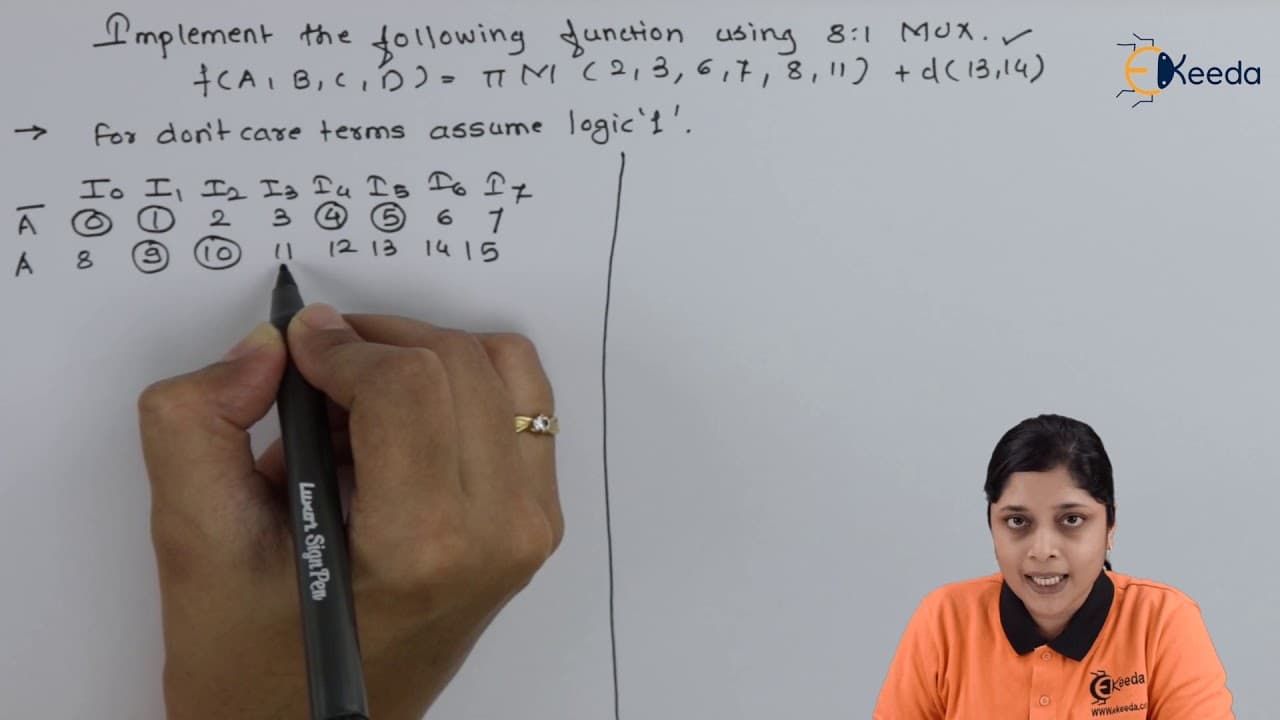
This video discusses how to implement a four-variable function using an 8-to-1 MUX, considering both max terms and don't care conditions.
Transcript
click the bell icon to get latest videos from akira hello friends we are going to see the numerical based on multiplexers let's discuss the numerical so your caution is implement the four lengths function using it is to 1 MUX and your given expression is f of ABCD equals to product of max terms 2 3 6 7 8 11 plus don't care terms are there 13 and 14... Read More
Key Insights
- 😨 Implementing a four-variable function using an 8-to-1 MUX requires considering both max terms and don't care conditions.
- 🍉 Don't care terms are assumed as logic 1, while max terms are kept as they are in the logical table.
- 😑 By making the necessary connections based on the logical table, the given expression can be realized using the 8-to-1 MUX.
- 🎮 Converting the 8-to-1 MUX to a 2-to-1 MUX is possible by following the steps outlined in the video.
- 😒 The use of an 8-to-1 MUX allows for more flexibility and enables complex functions to be implemented using a single component.
- 🍉 Understanding how to handle don't care terms and max terms is crucial in implementing functions with multiplexers.
- 😑 Careful consideration must be given to the logical connections in order to accurately realize the given expression.
Install to Summarize YouTube Videos and Get Transcripts
Explore YouTube Video Summarizer or Get YouTube Transcript Extractor
Questions & Answers
Q: How can we implement a four-variable function using an 8-to-1 MUX?
To implement a four-variable function using an 8-to-1 MUX, we assume don't care conditions as logic 1 and keep the max terms as they are. By drawing a logical table and making connections based on the table, we can realize the expression using the 8-to-1 MUX.
Q: What should we do with don't care terms in the given expression?
In the given expression, don't care terms should be assumed as logic 1. This means that when determining the connections for the 8-to-1 MUX, these terms will be treated as if they evaluate to logic 1.
Q: How do we handle max terms in implementing the four-variable function?
The max terms in the given expression should be kept as they are in the logical table. When making connections for the 8-to-1 MUX, these terms will be considered in the appropriate positions, based on their values.
Q: How can we convert the 8-to-1 MUX to a 2-to-1 MUX?
In the video, the 8-to-1 MUX is converted to a 2-to-1 MUX by drawing the logical table and making the appropriate connections. This conversion allows for implementing the given expression using the 8-to-1 MUX.
Summary & Key Takeaways
-
The video demonstrates how to implement a four-variable function using an 8-to-1 MUX.
-
The solution involves assuming don't care conditions as logic 1 and keeping max terms as they are.
-
By drawing a logical table and making the appropriate connections, the given expression can be realized using the 8-to-1 MUX.
Read in Other Languages (beta)
Share This Summary 📚
Summarize YouTube Videos and Get Video Transcripts with 1-Click
Try YouTube Summary with ChatGPT & Claude or YouTube Transcript Generator
Explore More Summaries from Ekeeda 📚



Summarize YouTube Videos and Get Video Transcripts with 1-Click
Try YouTube Summary with ChatGPT & Claude or YouTube Transcript Generator