What Is the Forward-Backward Algorithm?
TL;DR
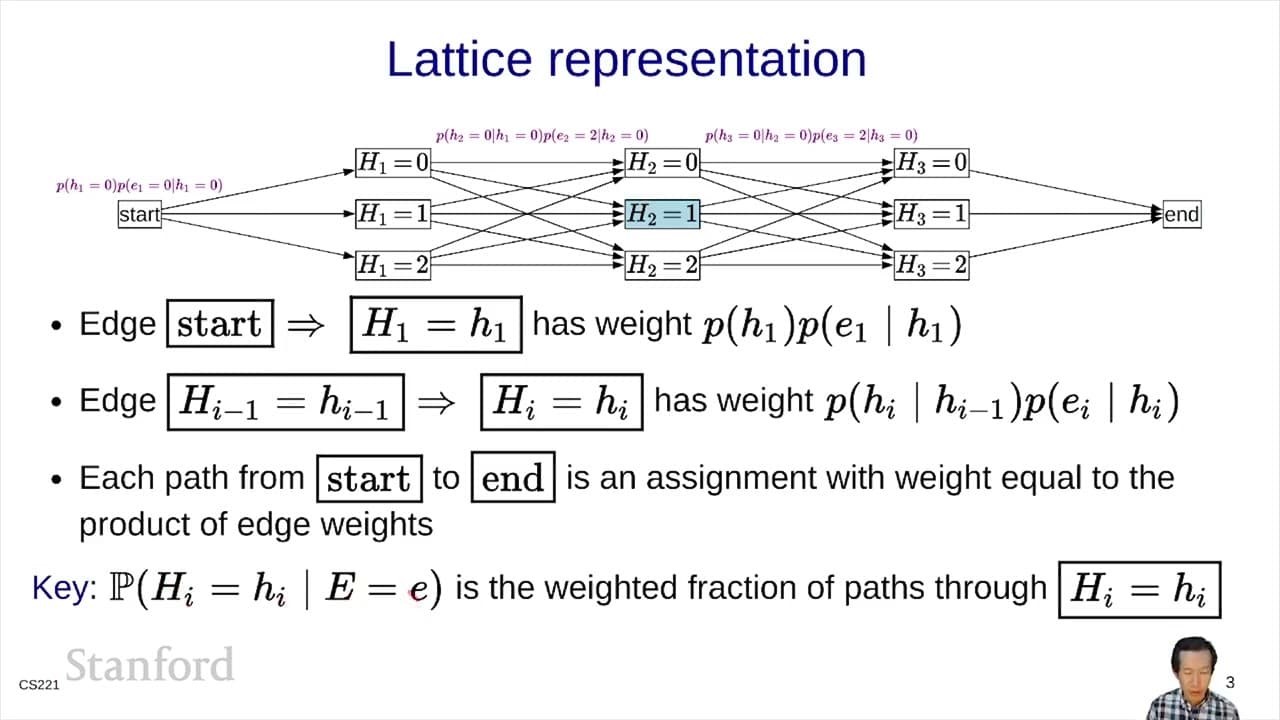
The forward-backward algorithm is a powerful technique for efficient inference in hidden Markov models, specifically designed to address smoothing queries. By using a lattice representation, it computes probabilities by calculating forward and backward messages, ultimately normalizing them to derive the probabilities of hidden states given observed data.
Transcript
hi in this module i'm going to introduce the forward backward algorithm for performing exact and efficient inference and hidden markov models which are an important special case of bayesian networks so let's revisit our object tracking example now through the lens of hidemak recall that at each time i there's an object that is at a position particu... Read More
Key Insights
- 🎭 The forward-backward algorithm provides an exact and efficient method for performing inference in hidden Markov models.
- ❓ The algorithm leverages a lattice representation to compactly represent exponentially many assignments in a polynomial-sized object.
- 💁 Filtering and smoothing are the two common types of queries in hidden Markov models, with smoothing incorporating information from future observations.
- ▶️ The forward and backward messages play a crucial role in the computation of joint probabilities and the smoothing queries.
- 🙈 The forward-backward algorithm can be seen as a dynamic programming approach that exploits shared computation to efficiently compute probabilities.
- ▶️ By normalizing the product of forward and backward messages, smoothing probabilities can be obtained.
- #️⃣ The computational complexity of the forward-backward algorithm is affected by the number of time steps and the number of possible assignments for each variable.
Install to Summarize YouTube Videos and Get Transcripts
Explore YouTube Video Summarizer or Get YouTube Transcript Extractor
Questions & Answers
Q: What are the two common types of questions in hidden Markov models?
The two common types of questions are filtering, which involves determining the probability of an object location at a specific time step given previous sensor readings, and smoothing, which incorporates information from future sensor readings in addition to the past.
Q: How is the forward-backward algorithm different from filtering?
Filtering is a special case of smoothing where future sensor readings are not observed. By marginalizing unobserved leaves, filtering queries can be transformed into smoothing queries by conditioning on the evidence up to the current time step.
Q: How is the lattice representation used in the forward-backward algorithm?
The lattice represents all possible assignments of values to variables using paths. Each path corresponds to an assignment, and the weights of the edges on the path represent the probabilities of the assignments. Multiplying the weights along a path gives the joint probability of that assignment and the evidence.
Q: What is the computational complexity of the forward-backward algorithm?
The forward-backward algorithm has a runtime complexity of O(nD^2), where n is the number of time steps and D is the number of potential assignments for each variable. The shared computation between forward and backward messages helps in reducing the computational burden.
Summary & Key Takeaways
-
The content introduces the probabilistic story of an object tracking example, where the position of an object and noisy sensor readings are modeled using a hidden Markov model.
-
The forward-backward algorithm uses a lattice representation to efficiently compute probabilities for smoothing queries in hidden Markov models.
-
The algorithm involves calculating forward and backward messages to determine the joint probabilities of assignments and evidence, which can be normalized to obtain the desired probabilities.
Read in Other Languages (beta)
Share This Summary 📚
Summarize YouTube Videos and Get Video Transcripts with 1-Click
Try YouTube Summary with ChatGPT & Claude or YouTube Transcript Generator
Explore More Summaries from Stanford Online 📚

Summarize YouTube Videos and Get Video Transcripts with 1-Click
Try YouTube Summary with ChatGPT & Claude or YouTube Transcript Generator