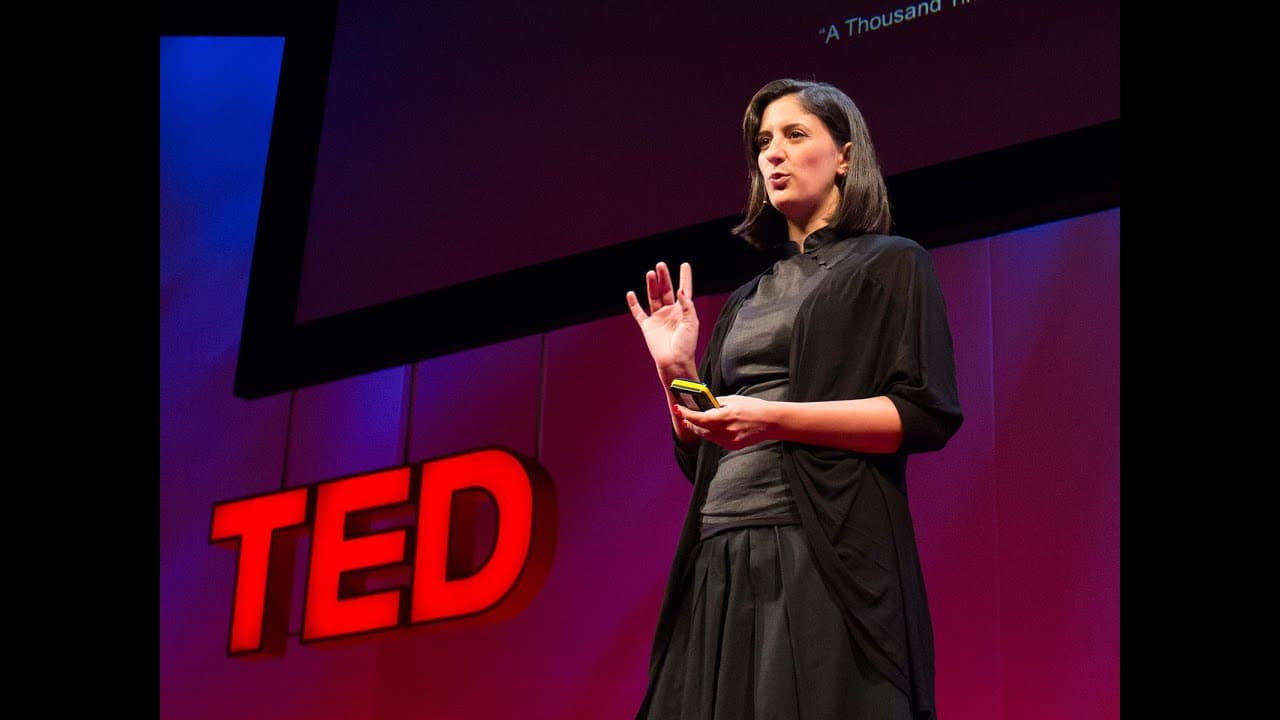
Bahia Shehab: A thousand times no
TL;DR
An artist reflects on her journey of using Arabic script in her artwork and her involvement in the revolution in Cairo.
Transcript
Translator: Joseph Geni Reviewer: Morton Bast Two years ago, I was invited as an artist to participate in an exhibition commemorating 100 years of Islamic art in Europe. The curator had only one condition: I had to use the Arabic script for my artwork. Now, as an artist, a woman, an Arab, or a human being living in the world in 2010, I only had one... Read More
Key Insights
- 💔 The artist collected a thousand different "noes" from Islamic and Arab history and showcased them in a book and installation in Munich to express her defiance against using Arabic script.
- ✊ The artist joined the revolution in Cairo and sprayed messages of resistance on the streets, starting with a "no" to military rule, inspired by an image of violence in her newsfeed.
- 🎸 A musician who sang in Tahrir Square during the revolution was later brutally attacked, highlighting the need for a "no" to violence.
- 🗨️ A man lost both his eyes during the revolution, illustrating the atrocities that occurred and the necessity of saying "no" to killing.
- 🔥 The burning of the Institute of Egypt was a significant cultural loss, emphasizing the importance of rejecting the "no" to burning books.
- 👙 A veiled woman being stripped and beaten on the street symbolized the nation's shame, calling for a resounding "no" against stripping the people.
- 🧱 Concrete roadblocks were set up to divide protesters from the Ministry of Defense, prompting a "no" to barrier walls that sought to suppress the revolution.
- 🖌️ The story of the painted wall with changing messages reflects the ongoing battle between artists and authority, with the artist using stencils to assert her voice and maintain the message of resistance.
- 💐 The final "no" states that even though the flowers may be crushed, spring can't be delayed, serving as a hopeful message that change and progress will ultimately prevail.
Install to Summarize YouTube Videos and Get Transcripts
Explore YouTube Video Summarizer or Get YouTube Transcript Extractor
Questions & Answers
Q: What was the condition set by the curator for the artist to participate in the exhibition commemorating 100 years of Islamic art in Europe?
The curator required the artist to use the Arabic script for their artwork.
Q: What did the artist decide to do in response to this condition?
The artist decided to look for a thousand different "noes" on everything ever produced under Islamic or Arab patronage in the past 1,400 years, and collected their findings in a book.
Q: Where was the artist's installation located?
The artist's installation, which stood three by seven meters, was located in Munich, Germany.
Q: What led the artist to start spraying messages in Tahrir Square?
The artist was motivated to act after seeing an image on their newsfeed of people being killed and thrown like garbage on the streets of Cairo during the revolution. They took one "no" off a tombstone from the Islamic Museum in Cairo, added a message to it ("no to military rule"), and started spraying it on the streets.
Q: What message did the blue bra and footprint represent?
The blue bra and footprint were used as a symbol to remind the people of their shame as a nation when a veiled woman was stripped and beaten on the street. The message also emphasized the importance of a peaceful revolution and the refusal to retaliate with violence.
Q: Why did the artist take action to paint and preserve the wall with the tank and various messages?
The artist took action to resist the authorities' attempts to hide and erase the messages painted on the wall. By spray painting their own stencils on the suit, tank, and the entire wall, the artist sought to maintain the visual representation and keep the messages visible.
Q: What was the final "no" message found by the artist?
The artist found a message scribbled by Neruda on a piece of paper in a field hospital in Tahrir. They decided to pair it with a "no" taken from a Mamluk Mausoleum in Cairo. The combined message reads, "You can crush the flowers, but you can't delay spring."
Summary & Key Takeaways
-
The speaker was invited to an exhibition and had to use the Arabic script for their artwork, leading them to search for a thousand different "noes" in Islamic and Arab art.
-
The speaker joined the revolution in Egypt and began spraying messages on the streets, expressing their opposition to military rule, violence, killing, burning of books, oppression, and barrier walls.
-
The speaker tells the story of a wall in Cairo that became a canvas for different artists, each painting over the previous work in a battle of messages and imagery. The speaker adds their own stencils to the wall.
Read in Other Languages (beta)
Share This Summary 📚
Summarize YouTube Videos and Get Video Transcripts with 1-Click
Try YouTube Summary with ChatGPT & Claude or YouTube Transcript Generator
Explore More Summaries from TED 📚
Summarize YouTube Videos and Get Video Transcripts with 1-Click
Try YouTube Summary with ChatGPT & Claude or YouTube Transcript Generator