Nucleophilicity vs. Basicity
TL;DR
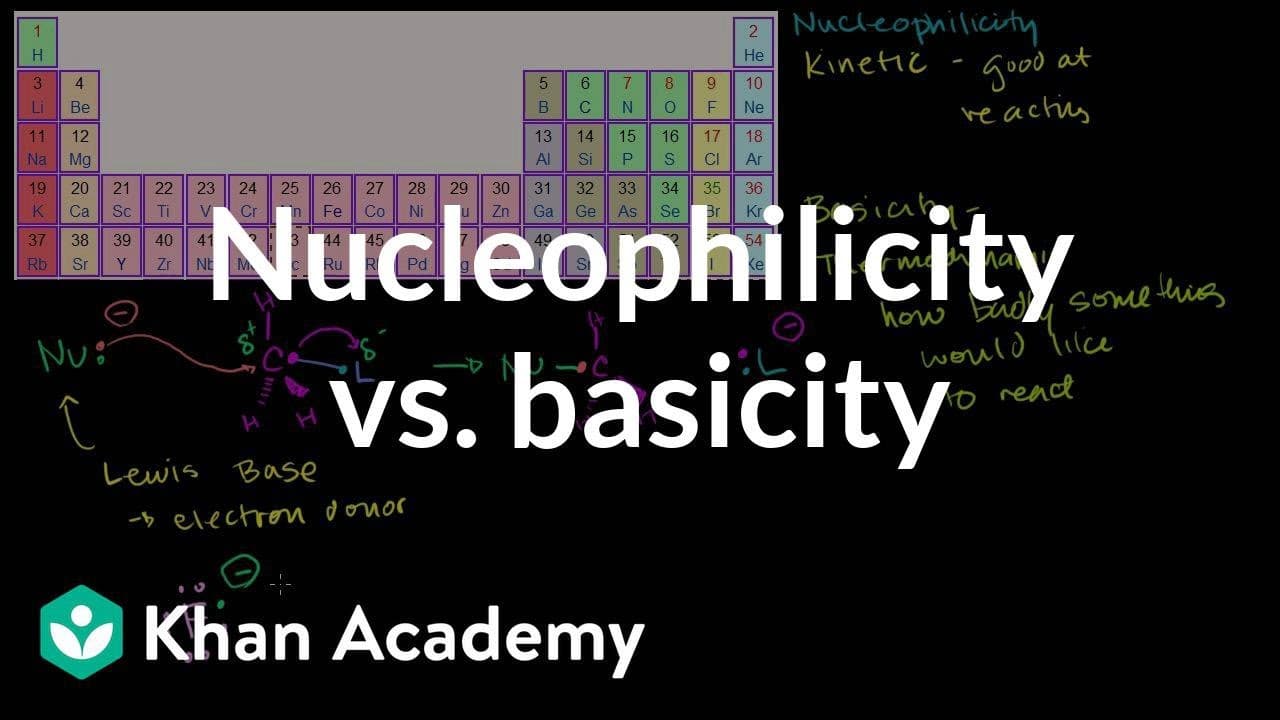
Nucleophilicity measures how well a species reacts, while basicity determines the stability of the reactants or products.
Transcript
What I want to do in this video is differentiate between the ideas of nucleophilicity or how strong of a nucleophile something is, and basicity. The difference is at one level subtle, but it's actually a very big difference. And I'll show you why it's kind of confusing the first time you learn it. When we studied Sn2 reactions, you have a nucleophi... Read More
Key Insights
- ❓ Nucleophilicity and basicity are two different concepts in chemistry that measure different aspects of reactivity.
- ❓ Nucleophilicity is a kinetic concept, whereas basicity is a thermodynamic concept.
- 🧑🏭 Nucleophiles act as Lewis bases by donating electron pairs.
- ❓ Solvents can influence nucleophilicity, with protic solvents hindering and aprotic solvents enhancing reactivity.
- ❓ Basicity is independent of the solvent and reflects the stability of the reactants or products.
- 🌥️ Steric hindrance can impact nucleophilicity, with larger molecules being more hindered.
- ❓ Basicity and nucleophilicity are not always directly correlated, as nucleophilicity also depends on how hindered the species is.
Install to Summarize YouTube Videos and Get Transcripts
Explore YouTube Video Summarizer or Get YouTube Transcript Extractor
Questions & Answers
Q: What is the difference between nucleophilicity and basicity?
Nucleophilicity measures how good a species is at reacting, specifically concerning how fast it can react. In contrast, basicity refers to the stability of the reactants or products formed during a reaction.
Q: How does nucleophilicity relate to Lewis bases?
Nucleophiles act as Lewis bases because they donate electrons to the reacting carbon. Nucleophiles have an extra electron and are attracted to partial positive charges.
Q: What determines basicity?
Basicity is determined by the ability of a species to accept or donate electrons. It is independent of the solvent and reflects how badly a species wants to react.
Q: How does the solvent affect nucleophilicity?
In protic solvents, nucleophilicity is hindered due to the formation of hydrogen bonds. Aprotic solvents enhance nucleophilicity as there are no significant interactions with the solvent.
Summary & Key Takeaways
-
Nucleophilicity is a kinetic concept that describes how fast a species can react, while basicity is a thermodynamic concept that determines the stability of the reactants or products.
-
Nucleophiles, such as negatively charged species, donate electrons to the reacting carbon and act as Lewis bases.
-
Basicity is determined by the ability of a species to accept or donate electrons and is independent of the solvent.
-
Solvents can affect nucleophilicity, with protic solvents hindering nucleophilic reactions, while aprotic solvents enhance nucleophilicity.
-
Steric hindrance can also impact nucleophilicity, with larger molecules being more hindered.
Read in Other Languages (beta)
Share This Summary 📚
Summarize YouTube Videos and Get Video Transcripts with 1-Click
Try YouTube Summary with ChatGPT & Claude or YouTube Transcript Generator
Explore More Summaries from Khan Academy 📚



Summarize YouTube Videos and Get Video Transcripts with 1-Click
Try YouTube Summary with ChatGPT & Claude or YouTube Transcript Generator