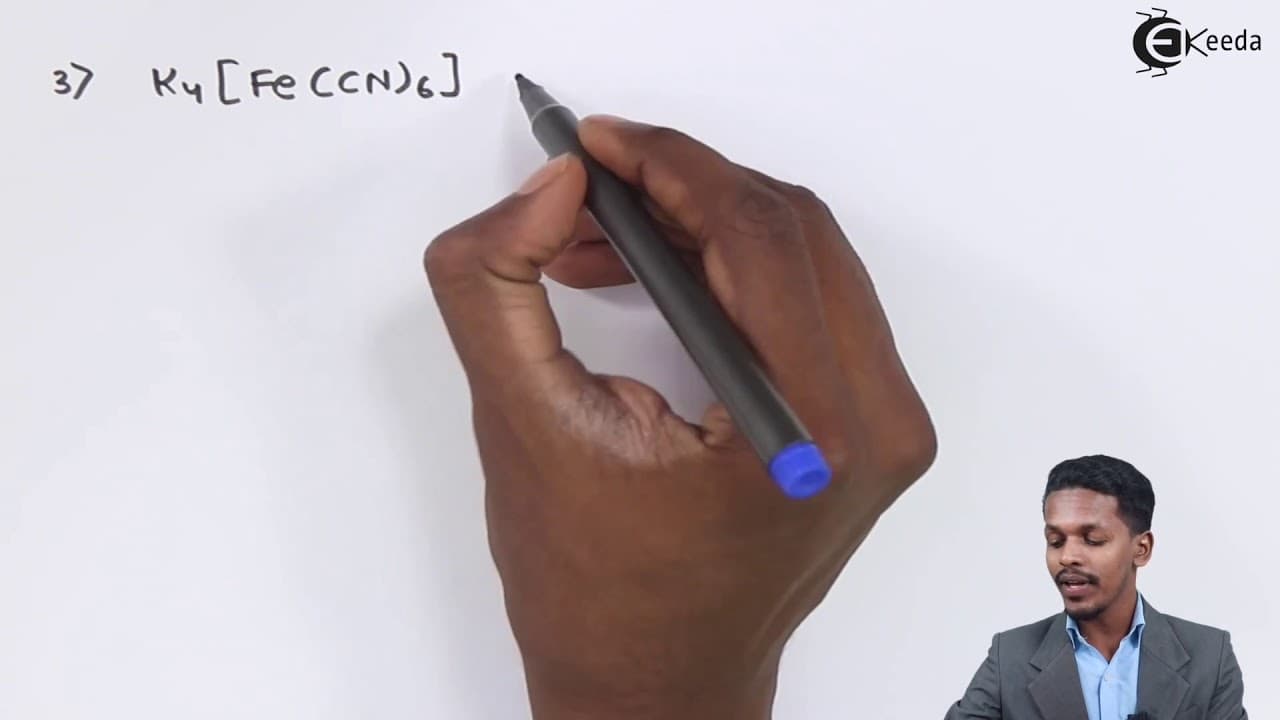
Calculation of Oxidation no of Central Metal Atom in a Complex
TL;DR
This video explains how to calculate the oxidation number of the central metal atom in various complexes.
Transcript
click the bell icon to get latest videos from equator health else in the previous topic we have discussed about the oxidation number of the central metal atom in a complex and now in this case we are going to talk about the calculation of the central metal atoms oxidation number in the complex so now let us understand how we can calculate it so fri... Read More
Key Insights
- 🤘 Calculation of the central metal atom's oxidation number in a complex involves considering the charges of primary and secondary entities.
- 🈂️ Ligands with negative charges decrease the oxidation number, while ligands with positive charges increase it.
- 🈂️ The overall charge of the complex is determined by balancing the charges of the ligands and the central metal atom.
Install to Summarize YouTube Videos and Get Transcripts
Explore YouTube Video Summarizer or Get YouTube Transcript Extractor
Questions & Answers
Q: How do you calculate the oxidation number of the central metal atom in a complex?
To calculate the oxidation number, you need to consider the charges of the ligands and the overall charge of the complex. Based on the primary and secondary entities, you assign charges to the ligands and solve for the oxidation number of the central metal atom.
Q: What is the significance of primary and secondary entities in calculating oxidation numbers?
Primary entities, such as the nitrate ion, have a specific charge that must be satisfied by the complex. Secondary entities, like ammonia, have neutral charges. By considering the charges of these entities, you can determine the oxidation number of the central metal atom.
Q: How does the charge on the ligands affect the oxidation number of the central metal atom?
Ligands with a negative charge, such as cyanide, contribute to a decrease in the oxidation number of the central metal atom. Ligands with a positive charge, like the ammonium ion, increase the oxidation number. Neutral ligands have no effect on the oxidation number.
Q: How is the overall charge of the complex determined?
The overall charge of the complex can be calculated by taking into account the charges of primary and secondary entities. By assigning charges to the ligands and solving for the overall charge, one can determine the oxidation number of the central metal atom.
Summary & Key Takeaways
-
The video discusses the calculation of the central metal atom's oxidation number in complexes using different examples.
-
It explains the concept of primary and secondary entities, and differentiates ligands based on their charges.
-
The oxidation number is calculated by considering the charges of the ligands and the overall charge of the complex.
Read in Other Languages (beta)
Share This Summary 📚
Summarize YouTube Videos and Get Video Transcripts with 1-Click
Try YouTube Summary with ChatGPT & Claude or YouTube Transcript Generator
Explore More Summaries from Ekeeda 📚





Summarize YouTube Videos and Get Video Transcripts with 1-Click
Try YouTube Summary with ChatGPT & Claude or YouTube Transcript Generator