Integration with partial fractions | AP Calculus BC | Khan Academy
TL;DR
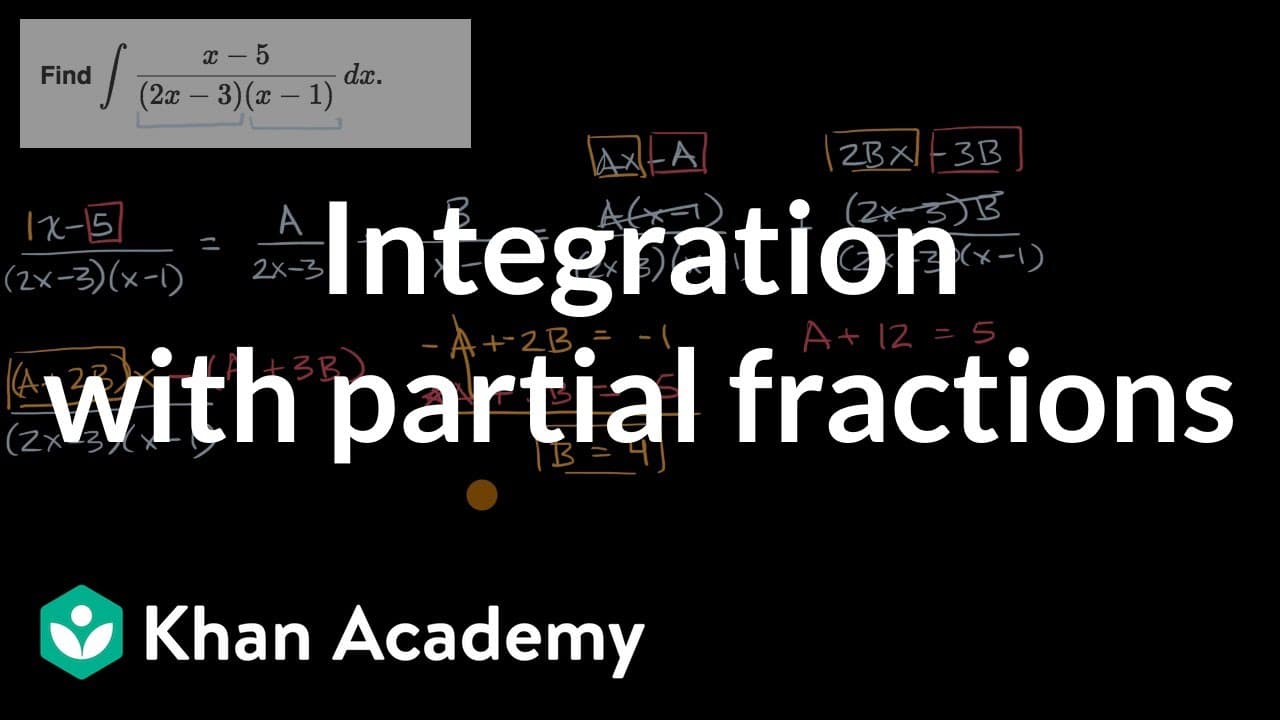
Learn how to solve an indefinite integral using partial fraction decomposition, step by step.
Transcript
- [Instructor] We are asked to find the value of this indefinite integral. And some of you, in attempting this, might try to say, all right, is the numerator here the derivative or a constant multiple of the derivative of the denominator? In which case, u-substitution might apply, but it's not the case here. So what do we do? And my hint to you wou... Read More
Key Insights
- 😑 Partial fraction decomposition is a technique used to break down a rational expression into the sum of two or more rational expressions.
- 🧑🏭 Factoring the denominator is essential before applying partial fraction decomposition.
- 😫 Setting up a system of equations allows us to solve for the unknown constants in the partial fraction decomposition.
Install to Summarize YouTube Videos and Get Transcripts
Explore YouTube Video Summarizer or Get YouTube Transcript Extractor
Questions & Answers
Q: How do we determine if u-substitution or partial fraction decomposition is the appropriate method for solving an indefinite integral?
In this case, u-substitution is not applicable because the numerator is not the derivative or constant multiple of the denominator. Therefore, partial fraction decomposition is the appropriate method.
Q: What is the degree of the numerator in a partial fraction decomposition?
The degree of the numerator is always one less than the degree of the denominator. In this case, since the denominator is first degree, the numerator will be zero degree or just constants.
Q: How do we solve for the unknown constants in the partial fraction decomposition?
We set up a system of equations by adding the two rational expressions with a common denominator. By pattern matching the numerators of the resulting expression, we can set up equations and solve for the constants A and B.
Q: How do we integrate the partial fraction decomposition?
The integral of each term in the partial fraction decomposition can be calculated separately. In this case, the integral of 1/(2x-3) is the natural log of the absolute value of 2x-3, and the integral of 1/(x-1) is the natural log of the absolute value of x-1.
Summary & Key Takeaways
-
The content explains how to find the value of an indefinite integral using partial fraction decomposition.
-
The video highlights the importance of factoring the denominator before applying the partial fraction decomposition.
-
The concept of setting up a system of equations to solve for the unknown constants is also discussed.
Read in Other Languages (beta)
Share This Summary 📚
Summarize YouTube Videos and Get Video Transcripts with 1-Click
Try YouTube Summary with ChatGPT & Claude or YouTube Transcript Generator
Explore More Summaries from Khan Academy 📚



Summarize YouTube Videos and Get Video Transcripts with 1-Click
Try YouTube Summary with ChatGPT & Claude or YouTube Transcript Generator