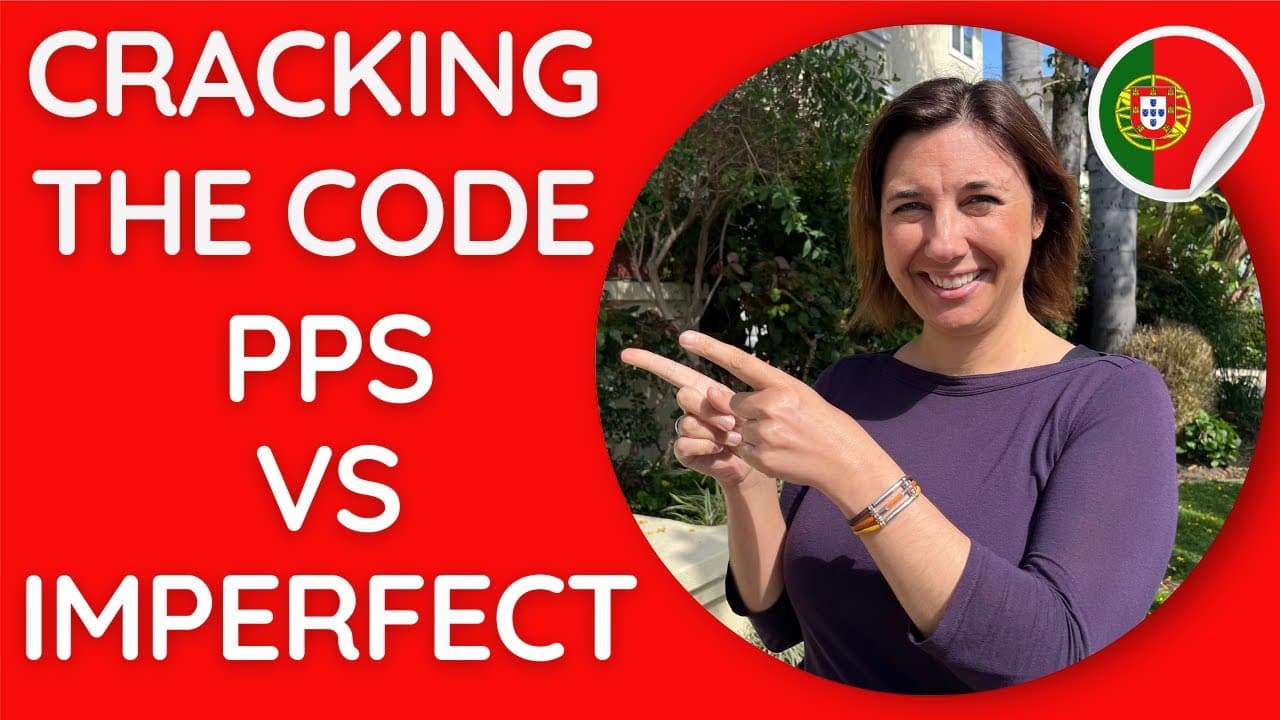
PPS and Imperfect Made Simple in Portuguese 🇵🇹
TL;DR
Learn the differences between PPS and Imperfect in Portuguese for better communication.
Transcript
One of the biggest struggles students have when learning Portuguese is knowing when to use the PPS (simple past perfect) and the Imperfeito (imperfect tense). This is a challenge, especially for native English speakers since a simple translation does not help. Today, I will walk you through each tense and give you practical examples to help you... Read More
Key Insights
- The PPS (simple past perfect) in Portuguese is used for actions that are perfectly finished and time-framed, unlike the Imperfect tense.
- Imperfect tense is used in Portuguese to describe actions that were continuous, habitual, or descriptive, often introduced by words like 'Antigamente' or 'Quando'.
- PPS is ideal for unhabitual past events, actions with a defined duration, and sequential past actions, providing a clear timeline of events.
- Imperfect tense expresses habitual actions or circumstances, often described with 'used to', and is essential for storytelling or describing past contexts.
- In Portuguese, the Imperfect tense is also used for expressing intentions, desires, or planned actions that are difficult or impossible to accomplish.
- The Imperfect of Courtesy in Portuguese is used for making polite requests, similar to the English conditional mood, but often in a more personal context.
- The Imperfect tense can replace the Conditional mood in colloquial Portuguese, making it a versatile tool for hypothetical or conditional situations.
- Understanding the nuances between PPS and Imperfect is crucial for mastering Portuguese, as they convey different aspects of past actions and intentions.
Install to Summarize YouTube Videos and Get Transcripts
Explore YouTube Video Summarizer or Get YouTube Transcript Extractor
Questions & Answers
Q: What is the main difference between PPS and Imperfect in Portuguese?
The main difference lies in their use to convey time and action permanence. PPS refers to localized, time-framed, perfectly finished actions, whereas the Imperfect tense suggests description, continuity, and repetition of actions, often used for habitual or ongoing past events.
Q: How is the PPS used in Portuguese?
PPS is used for unhabitual past events, actions with defined durations, and sequential past actions. It provides a clear timeline of events, indicating actions that are perfectly finished and time-framed, such as 'I woke up late for work today' or 'I studied French for two years.'
Q: When should the Imperfect tense be used in Portuguese?
The Imperfect tense is used for describing habitual actions or circumstances, often introduced by words like 'Antigamente' or 'Quando.' It is essential for storytelling or describing past contexts, such as 'I used to go to the cinema a lot' or 'When I was in college, I studied hard.'
Q: What are some unique uses of the Imperfect tense in Portuguese?
The Imperfect tense in Portuguese is uniquely used for expressing intentions, desires, or planned actions that are difficult or impossible to accomplish. It also serves as the Imperfect of Courtesy for making polite requests and can replace the Conditional mood in colloquial speech.
Q: How does the Imperfect of Courtesy work in Portuguese?
The Imperfect of Courtesy is used to make polite requests, similar to the English conditional mood. It is often used in personal contexts, such as 'Queria um café, por favor!' ('I would like a coffee, please'), expressing politeness and preference in a more personal manner.
Q: Can the Imperfect tense replace the Conditional mood in Portuguese?
Yes, the Imperfect tense can replace the Conditional mood in colloquial Portuguese. While the Conditional Mood exists, it is more common in written form. The Imperfect is used in conditional situations, such as 'What would you do if you were in my situation?'
Q: Why is it important to understand the differences between PPS and Imperfect?
Understanding the differences between PPS and Imperfect is crucial for mastering Portuguese as they convey different aspects of past actions and intentions. Correct usage allows for more precise communication, especially in expressing time, permanence, and the nature of past actions.
Q: What role do context and keywords play in using PPS and Imperfect?
Context and keywords like 'Antigamente' or 'Quando' play a significant role in choosing between PPS and Imperfect. They help indicate whether an action was habitual, ongoing, or perfectly finished, guiding the speaker in selecting the appropriate tense for accurate expression.
Summary & Key Takeaways
-
The video explains the key differences between the PPS and Imperfect tenses in Portuguese, highlighting their distinct uses in expressing past actions. PPS is used for completed actions, while Imperfect describes ongoing or habitual actions, providing essential insights for learners.
-
Practical examples illustrate when to use each tense, emphasizing the importance of context in choosing between PPS and Imperfect. Understanding these tenses helps in conveying precise meanings and intentions in Portuguese conversations.
-
The content also covers less obvious uses of the Imperfect tense, such as expressing intentions, making polite requests, and replacing the Conditional mood, showcasing its versatility in both formal and informal Portuguese communication.
Read in Other Languages (beta)
Share This Summary 📚
Summarize YouTube Videos and Get Video Transcripts with 1-Click
Try YouTube Summary with ChatGPT & Claude or YouTube Transcript Generator
Explore More Summaries from Learn European Portuguese Online 📚




Summarize YouTube Videos and Get Video Transcripts with 1-Click
Try YouTube Summary with ChatGPT & Claude or YouTube Transcript Generator