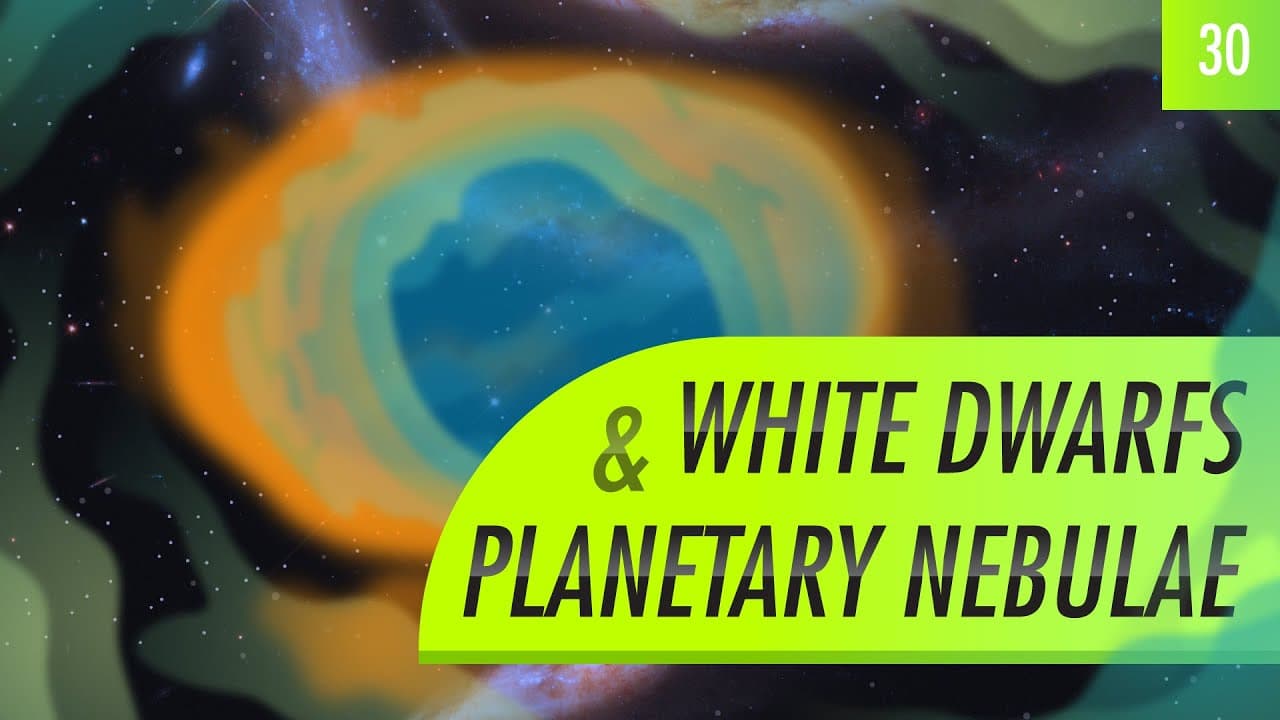
White Dwarfs & Planetary Nebulae: Crash Course Astronomy #30
TL;DR
White dwarfs form planetary nebulae, revealing star death processes.
Transcript
Hey folks, Phil Plait here. In the last episode of Crash Course Astronomy, I talked about the eventual fate of the Sun, and other low mass stars like it. After a series of expansions and contractions, they blow off their outer layers, become white dwarfs, and fade away over billions of years. The end. Except not so much. First, white dwarfs are pre... Read More
Key Insights
- White dwarfs are the remnants of low mass stars after they exhaust their fuel, characterized by extreme density and heat.
- The Sun will eventually become a white dwarf, but unlike more massive stars, it won't create a visible planetary nebula.
- Planetary nebulae are formed from the outer layers of dying stars, illuminated by the intense radiation of a white dwarf.
- The shapes of planetary nebulae are influenced by binary star systems or planets within the star, causing diverse and intricate structures.
- The glow in planetary nebulae is primarily due to hydrogen and oxygen, with oxygen giving them their characteristic green hue.
- The study of planetary nebulae provides insights into stellar evolution and the life cycles of stars.
- Planetary nebulae are transient, existing for only a few thousand years before dispersing into space.
- The discovery of exoplanets supports theories about planetary influences on the shapes of planetary nebulae.
Install to Summarize YouTube Videos and Get Transcripts
Explore YouTube Video Summarizer or Get YouTube Transcript Extractor
Questions & Answers
Q: What happens to a star like the Sun when it dies?
When a star like the Sun dies, it goes through a series of expansions and contractions, eventually blowing off its outer layers and leaving behind a core that becomes a white dwarf. This white dwarf is a dense, hot object that gradually cools and fades over billions of years.
Q: How do planetary nebulae form?
Planetary nebulae form when the outer layers of a dying star are expelled into space and illuminated by the radiation from the central white dwarf. This process creates a glowing shell of gas, which can take on various shapes depending on factors like binary star companions or planets within the star.
Q: Why do planetary nebulae have different shapes?
The shapes of planetary nebulae are influenced by several factors, including the presence of binary star systems or planets within the dying star. These factors can cause the ejected gas to form intricate structures, such as elongated shapes, spiral patterns, and jets, rather than simple spherical shells.
Q: What colors are seen in planetary nebulae and why?
Planetary nebulae exhibit various colors due to the emission of light from different elements. Hydrogen emits red light, while oxygen emits green and blue light, contributing to the nebulae's characteristic hues. The green glow was once misidentified as a new element, nebulium, but was later found to be oxygen.
Q: Will the Sun form a planetary nebula?
The Sun is unlikely to form a visible planetary nebula. While it will become a white dwarf, it probably won't be energetic enough to illuminate the surrounding gas. Planetary nebulae are typically formed by stars more massive and hotter than the Sun, which can produce the necessary radiation to excite the gas.
Q: How does the study of planetary nebulae contribute to our understanding of stellar evolution?
Studying planetary nebulae provides valuable insights into the processes involved in stellar death and the life cycles of stars. By analyzing the structure, color, and shape of these nebulae, astronomers can learn about the conditions and events that occur as stars exhaust their nuclear fuel and transition into white dwarfs.
Q: What role do planets play in the formation of planetary nebulae?
Planets can influence the formation of planetary nebulae by affecting the star's rotation. If a dying star engulfs a planet, the planet's orbit can cause the star to spin faster, impacting the shape of the ejected gas. This theory is supported by the discovery of exoplanets orbiting close to their stars.
Q: Why are planetary nebulae considered short-lived phenomena?
Planetary nebulae are short-lived because the gas they are composed of continues to expand and eventually disperses into space. This expansion causes the gas to thin out, and the nebula stops glowing after a few thousand years. As a result, planetary nebulae represent a brief phase in the life cycle of a star.
Summary & Key Takeaways
-
White dwarfs are incredibly dense and hot remnants of low mass stars, roughly Earth-sized, that form after a star exhausts its nuclear fuel. They often create planetary nebulae, which are illuminated by the intense radiation from the white dwarf, showcasing the beauty of stellar death.
-
Planetary nebulae display a variety of shapes due to factors like binary star systems or planets inside the dying star. The glow from these nebulae is primarily due to hydrogen and oxygen emissions, with oxygen providing a distinctive green color.
-
The study of planetary nebulae helps astronomers understand stellar evolution. These nebulae are short-lived, existing only for a few thousand years. The Sun will become a white dwarf but likely won't produce a visible planetary nebula.
Read in Other Languages (beta)
Share This Summary 📚
Summarize YouTube Videos and Get Video Transcripts with 1-Click
Try YouTube Summary with ChatGPT & Claude or YouTube Transcript Generator
Explore More Summaries from CrashCourse 📚




Summarize YouTube Videos and Get Video Transcripts with 1-Click
Try YouTube Summary with ChatGPT & Claude or YouTube Transcript Generator