Stanford CS229: Machine Learning | Summer 2019 | Lecture 3 - Probability and Statistics
TL;DR
This CS229 lecture provides an overview of probability theory, covering topics such as sample spaces, random variables, cumulative distribution functions, expectation, and maximum likelihood estimation.
Transcript
welcome back to the third lecture of cs229 so in the first two lectures we've been mostly going over the course prerequisites linear algebra probability so on wednesday's lecture just to recap we went over the concept of determinant it's geometrical interpretation and we went through two different kinds of decomposition of a matrix the eigen value ... Read More
Key Insights
- 🤩 The lecture provides a review of key concepts in linear algebra, probability, and matrix calculus.
- 💄 Probability theory is essential for understanding uncertainty and making probabilistic statements about random variables and events.
- 👮 Conditional expectation and the law of total expectation are powerful tools in probability and statistics for breaking down complex problems.
Install to Summarize YouTube Videos and Get Transcripts
Explore YouTube Video Summarizer or Get YouTube Transcript Extractor
Questions & Answers
Q: What is the difference between a sample space and an event?
A sample space is the collection of all possible outcomes of a random experiment, while an event is a subset of the sample space that we assign probabilities to.
Q: How is a random variable defined and what is its role in probability theory?
A random variable is a function that maps the outcomes of a random experiment to real numbers. It allows us to perform mathematical operations and calculations on random outcomes.
Q: What is the cumulative distribution function (CDF) and how is it related to probability?
The CDF is a function that gives the probability that a random variable takes a value less than or equal to a given threshold. It provides a measure of the probability assigned to different ranges of values.
Q: What is the difference between discrete and continuous random variables?
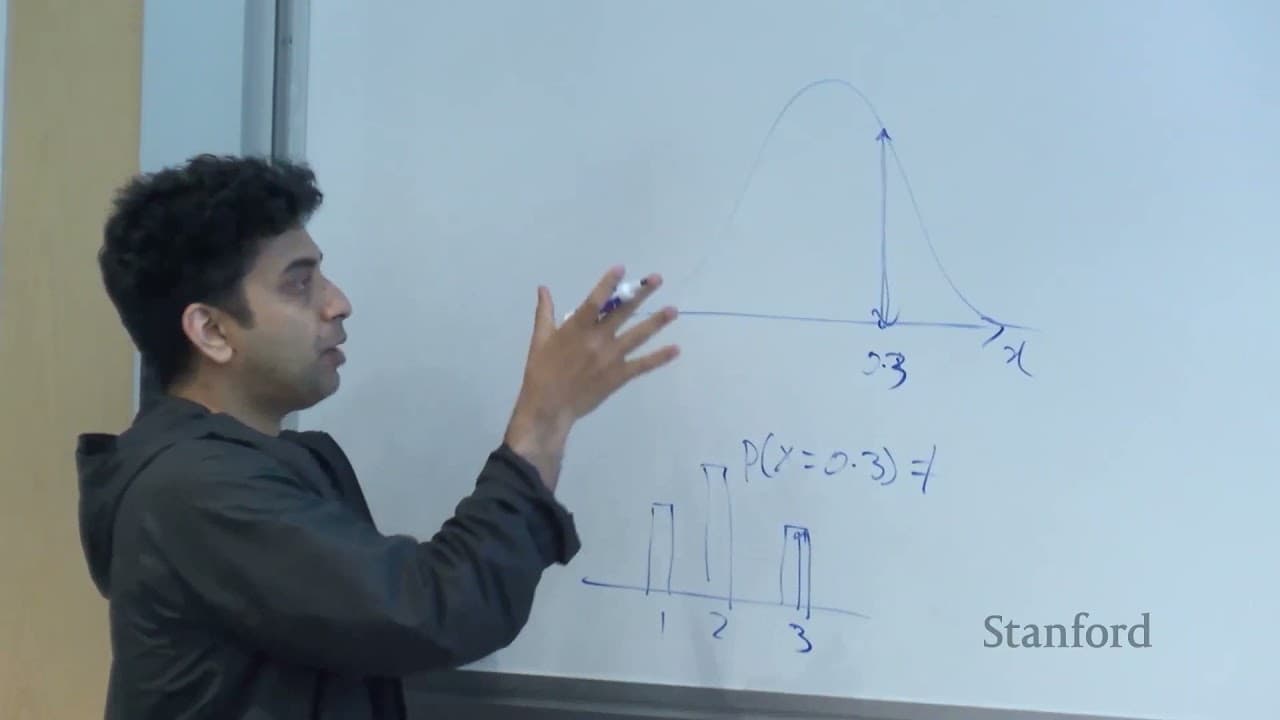
Discrete random variables take on a finite or countable number of values, while continuous random variables can take on any value within a given range. Discrete variables have probability mass functions, while continuous variables have probability density functions.
Q: Why is the density function of a continuous random variable not equal to the actual probability?
The density function of a continuous random variable is not equal to the actual probability because the probability of a continuous random variable taking a specific value is always zero. Instead, probabilities are defined for intervals or ranges of values.
Q: What is the concept of conditional expectation and how is it different from regular expectation?
Conditional expectation is a random variable that represents the average value of a function given a specific value of another random variable. It is different from regular expectation because it depends on the value of another variable.
Q: What is the law of total expectation and how is it related to conditional expectation?
The law of total expectation states that the expectation of a random variable can be calculated by averaging the conditional expectations given different values of another random variable. It is a way to decompose a complex problem into smaller sub-problems.
Q: How does maximum likelihood estimation (MLE) work in estimating parameters from data?
MLE is a method used to estimate the parameters of a statistical model by maximizing the likelihood of the observed data. It finds the values of the parameters that make the observed data most likely to occur. MLE is commonly used in machine learning for parameter estimation.
Summary & Key Takeaways
-
The lecture starts with a review of previous topics, including linear algebra, probability, and matrix calculus.
-
The concept of probability is discussed, including sample spaces, events, random variables, and cumulative distribution functions.
-
The lecture covers the importance of expectation and introduces the concept of maximum likelihood estimation.
-
The relationship between probability and statistics in machine learning is explained, with a focus on using data to estimate parameters and make predictions.
Read in Other Languages (beta)
Share This Summary 📚
Summarize YouTube Videos and Get Video Transcripts with 1-Click
Try YouTube Summary with ChatGPT & Claude or YouTube Transcript Generator
Explore More Summaries from Stanford Online 📚

Summarize YouTube Videos and Get Video Transcripts with 1-Click
Try YouTube Summary with ChatGPT & Claude or YouTube Transcript Generator