Graphing Radical Functions
TL;DR
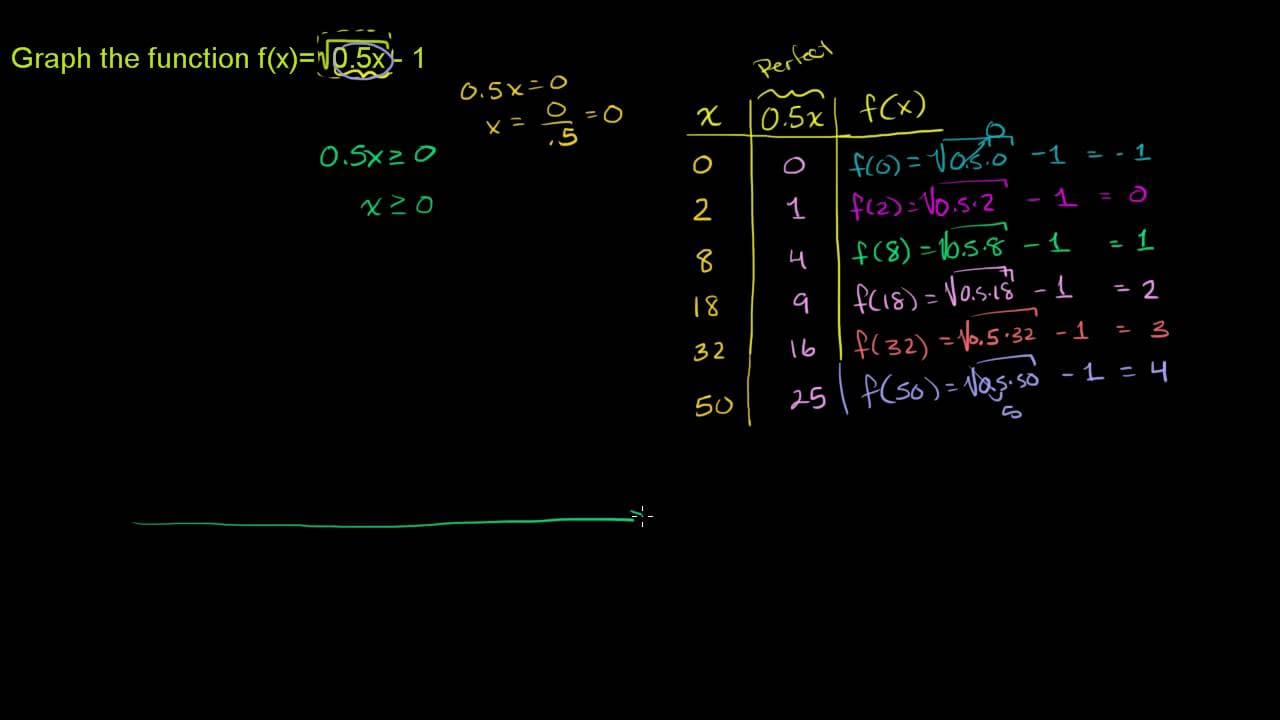
A detailed explanation of how to graph the function f(x) = √(0.5x - 1), step-by-step.
Transcript
We're asked to graph the function f of x is equal to the principal square root of 0.5x minus 1. And to graph it, we're just going to sample some points, some x values that are within the domain of this function definition. And see what the function is equal to for those x values. And then we could connect the dots and see what the curve might look ... Read More
Key Insights
- ☺️ Carefully choosing x-values that result in integer outputs simplifies the graphing process.
- ☺️ The domain of the function is restricted to x ≥ 0 because the principal square root requires positive values under the radical.
- 📈 The graph of the function f(x) = √(0.5x - 1) resembles half of a sideways parabola.
- 👈 The points obtained by evaluating f(x) for chosen x-values can be connected to form the graph of the function.
- 📈 The graph accurately represents the behavior of the function within its defined domain.
- 😥 Graphing functions often involves choosing strategic points for evaluation to simplify the graphing process.
Install to Summarize YouTube Videos and Get Transcripts
Explore YouTube Video Summarizer or Get YouTube Transcript Extractor
Questions & Answers
Q: Why is it important to choose x-values so that √(0.5x) is a perfect square?
Choosing x-values that result in √(0.5x) being a perfect square ensures that the function outputs clean integer values, which are easier to graph accurately without a calculator.
Q: How are the x-values determined from the values of √(0.5x)?
To obtain the x-values, we divide the values of √(0.5x) by 0.5 or multiply them by 2. For example, if √(0.5x) = 4, then x = 2.
Q: Why is the domain of the function restricted to x ≥ 0?
The domain is restricted to x ≥ 0 because to take the principal square root of a number, the value under the radical must be positive. Therefore, the function is only defined for positive x-values.
Q: Can any x-value greater than or equal to 0 be chosen to evaluate the function?
Yes, as long as x is greater than or equal to 0, it can be chosen to evaluate the function. The graph will include all points obtained by evaluating f(x) for any x in the domain.
Summary & Key Takeaways
-
The video explains how to graph the function f(x) = √(0.5x - 1) by sampling points within the domain of the function.
-
The x-values are carefully chosen to ensure the expression √(0.5x - 1) results in clean integer values.
-
By evaluating f(x) for these x-values, a set of points is obtained, which can be connected to form the graph of the function.
Read in Other Languages (beta)
Share This Summary 📚
Summarize YouTube Videos and Get Video Transcripts with 1-Click
Try YouTube Summary with ChatGPT & Claude or YouTube Transcript Generator
Explore More Summaries from Khan Academy 📚



Summarize YouTube Videos and Get Video Transcripts with 1-Click
Try YouTube Summary with ChatGPT & Claude or YouTube Transcript Generator