What Are Recurrent Neural Networks Used For?
TL;DR
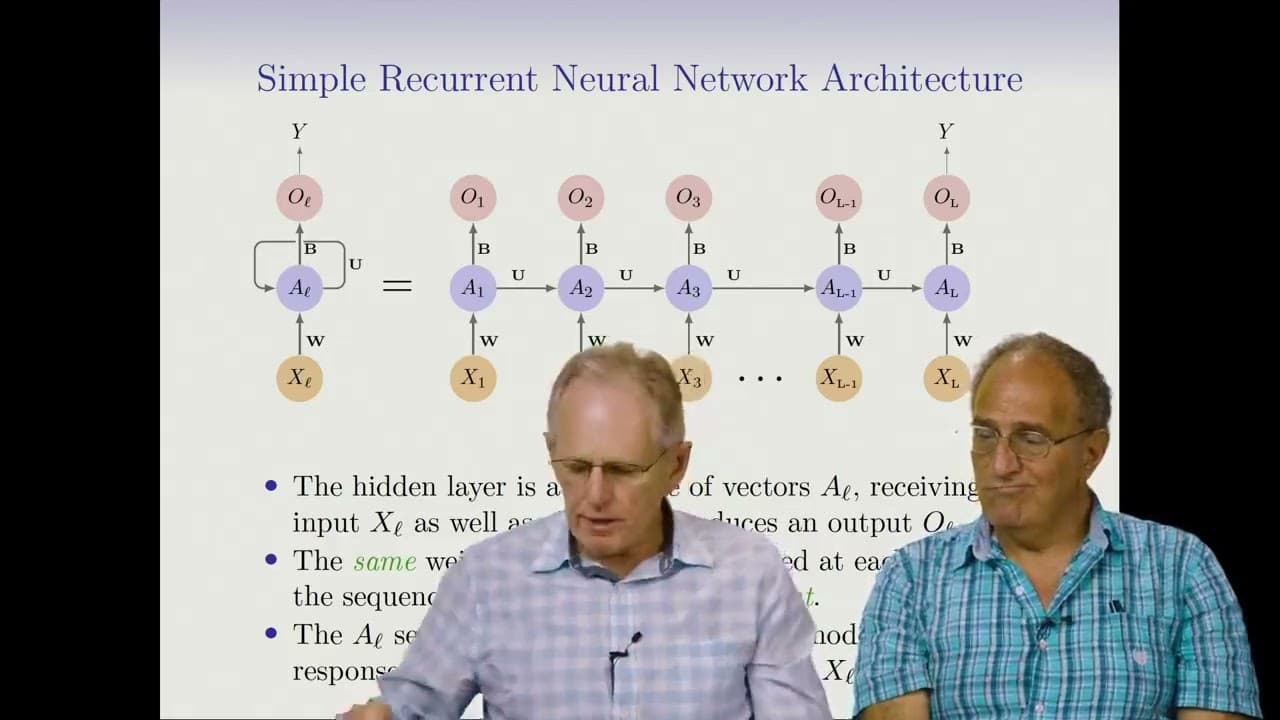
Recurrent Neural Networks (RNNs) are designed to model sequential data, effectively capturing the order and temporal dependencies within the data. They are commonly used in applications like sentiment analysis, where the input data comprises sequences such as text, speech, or time series. RNNs can remember past information, making them powerful for various tasks that involve sequential patterns.
Transcript
now we're going on to a new topic which is recurrent neural networks so like convolutional neural networks were used for for modeling images recurrent neural networks are used for modeling sequences data that arise as sequences so here's some examples so documents are sequences of words and their relative positions have meaning so the bag of words ... Read More
Key Insights
- 🎨 RNNs are specifically designed to model sequences of data that have a specific order or temporal dependency.
- 🏋️ RNN architecture consists of input sequences, hidden layer sequences, and output units, with weights that contribute to the memory of past sequences.
- 🧡 RNNs can handle both single-variable and sequence target outputs, making them suitable for a wide range of tasks.
- 🪘 More complex variations of RNNs, such as LSTM (long short-term memory), can improve performance but require longer training time.
Install to Summarize YouTube Videos and Get Transcripts
Explore YouTube Video Summarizer or Get YouTube Transcript Extractor
Questions & Answers
Q: How are recurrent neural networks (RNNs) different from convolutional neural networks (CNNs)?
RNNs are used for modeling sequences of data, whereas CNNs are used for modeling images. RNNs consider the sequential nature of data and build a memory of past sequences, while CNNs focus on extracting features from image data.
Q: Can RNNs handle target sequences that are also sequences?
Yes, RNNs can handle target sequences that are also sequences. For example, in language translation tasks, the target sequence would be a sequence of words in a different language. RNNs can learn to generate corresponding sequences using their memory of past data.
Q: How do the weights in RNNs contribute to the memory of past sequences?
The weights in RNNs, such as the weight matrices b, u, and w, allow the hidden units to receive input from both the current input vector and the previous hidden vector. This enables the memory of past sequences to be carried forward and updated with information from the next input vector.
Q: How are word embeddings used in RNNs?
Word embeddings are used to represent each word in a sequence as a lower-dimensional real-valued feature vector. These embeddings capture semantic relationships and synonyms between words. Instead of using a high-dimensional one-hot encoded vector for each word, a pre-trained word embedding matrix is used to reduce the dimensionality and improve the efficiency of the RNN model.
Summary & Key Takeaways
-
RNNs are used to model sequences of data such as words in documents, weather data, and music notes, by considering the order of the data.
-
RNN architecture consists of input sequences, hidden layer sequences, and output units, with weights that carry memory of past sequences.
-
RNNs can be used for sentiment analysis on document sequences, but more complex variations of RNNs exist with additional layers and capabilities.
Read in Other Languages (beta)
Share This Summary 📚
Summarize YouTube Videos and Get Video Transcripts with 1-Click
Try YouTube Summary with ChatGPT & Claude or YouTube Transcript Generator
Explore More Summaries from Stanford Online 📚


Summarize YouTube Videos and Get Video Transcripts with 1-Click
Try YouTube Summary with ChatGPT & Claude or YouTube Transcript Generator