Finding area by rearranging parts | Geometry | 6th grade | Khan Academy
TL;DR
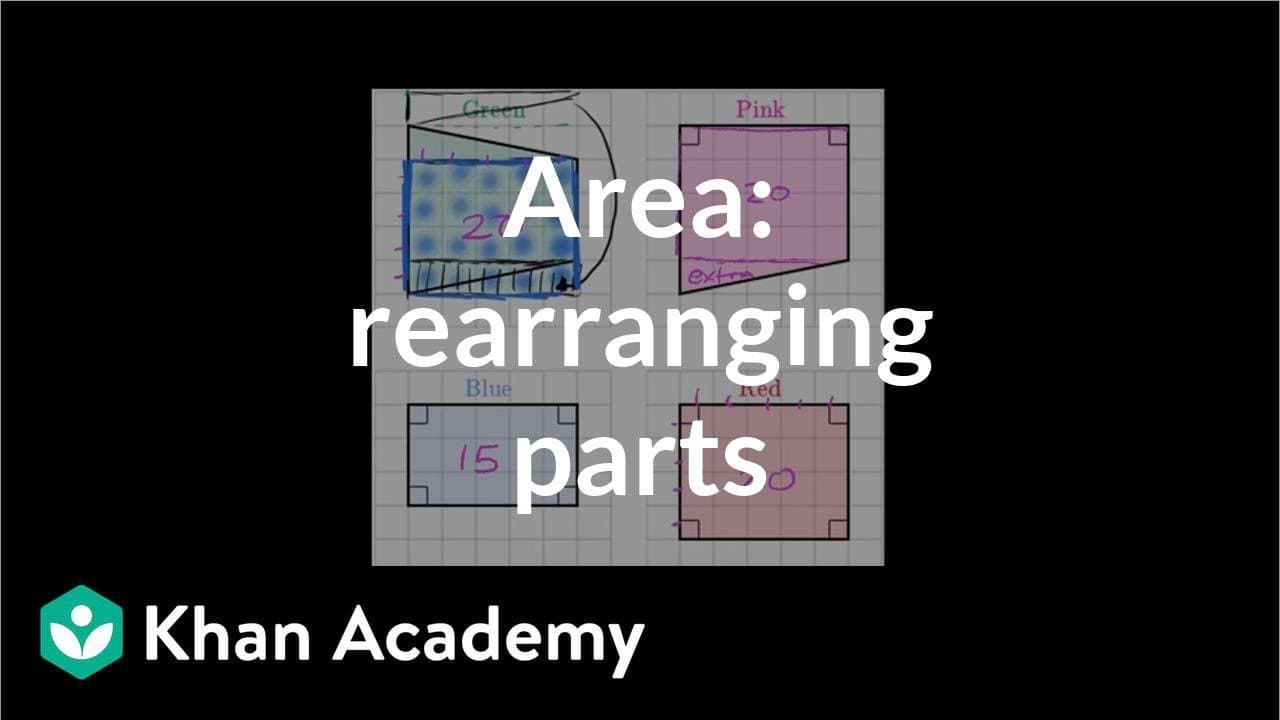
This video explains how to determine the area of a green quadrilateral by rearranging its parts and comparing them to other quadrilaterals.
Transcript
We have four quadrilaterals drawn right over here. And what I want us to think about is looking at this green quadrilateral here. I want you to pause the video and think about which of these figures have the same area as the green quadrilateral? And so pause the video now and think about that. So I'm assuming you gave a shot at it. Now let's think ... Read More
Key Insights
- 🥳 The area of a quadrilateral can be determined by comparing it to rectangles and rearranging its parts.
- 💚 Part of the green quadrilateral is made up of two triangles, which represent half of a rectangle's area.
- 💚 By flipping and relocating one of the triangles, it can fill in the missing section of the rectangle, demonstrating the green quadrilateral's same area.
Install to Summarize YouTube Videos and Get Transcripts
Explore YouTube Video Summarizer or Get YouTube Transcript Extractor
Questions & Answers
Q: How is the area of the green quadrilateral related to the area of a rectangle?
The video demonstrates that the green quadrilateral has the same area as a rectangle with a height of 4 and a length of 5. By rearranging the parts of the green quadrilateral, its area corresponds to that of the rectangle.
Q: Can you explain the process of rearranging the parts of the green quadrilateral?
The video suggests putting dotted lines to divide the green quadrilateral into two triangles and one rectangle. The two triangles represent half of the rectangle's area. By flipping and relocating one of the triangles, it can fill in the missing section of the rectangle, showing that the green quadrilateral has the same area.
Q: How can we determine the area of the green quadrilateral without counting squares?
Instead of counting squares, we can multiply the height (4) by the length (5) of the corresponding rectangle. The product, 20, represents the area of the green quadrilateral in terms of square units or unit squares.
Q: Which of the other quadrilaterals have the same area as the green quadrilateral?
The pink quadrilateral has a larger area than the green quadrilateral. The blue rectangle has an area of 15 square units, which is smaller than the green quadrilateral. Only the red rectangle has the same area as the green quadrilateral, with an area of 20 square units.
Summary & Key Takeaways
-
The video introduces four quadrilaterals and asks the viewer to identify which ones have the same area as the green quadrilateral.
-
The green quadrilateral is broken down into two triangles, each representing half of a rectangle's area.
-
By rearranging the triangles, the green quadrilateral's area is shown to be equal to a rectangle with a height of 4 and a length of 5.
Read in Other Languages (beta)
Share This Summary 📚
Summarize YouTube Videos and Get Video Transcripts with 1-Click
Try YouTube Summary with ChatGPT & Claude or YouTube Transcript Generator
Explore More Summaries from Khan Academy 📚



Summarize YouTube Videos and Get Video Transcripts with 1-Click
Try YouTube Summary with ChatGPT & Claude or YouTube Transcript Generator