Types of forces and free body diagrams | AP Physics 1 | Khan Academy
TL;DR
This video explains the different types of forces in free body diagrams, including weight, normal force, tension, and friction.
Transcript
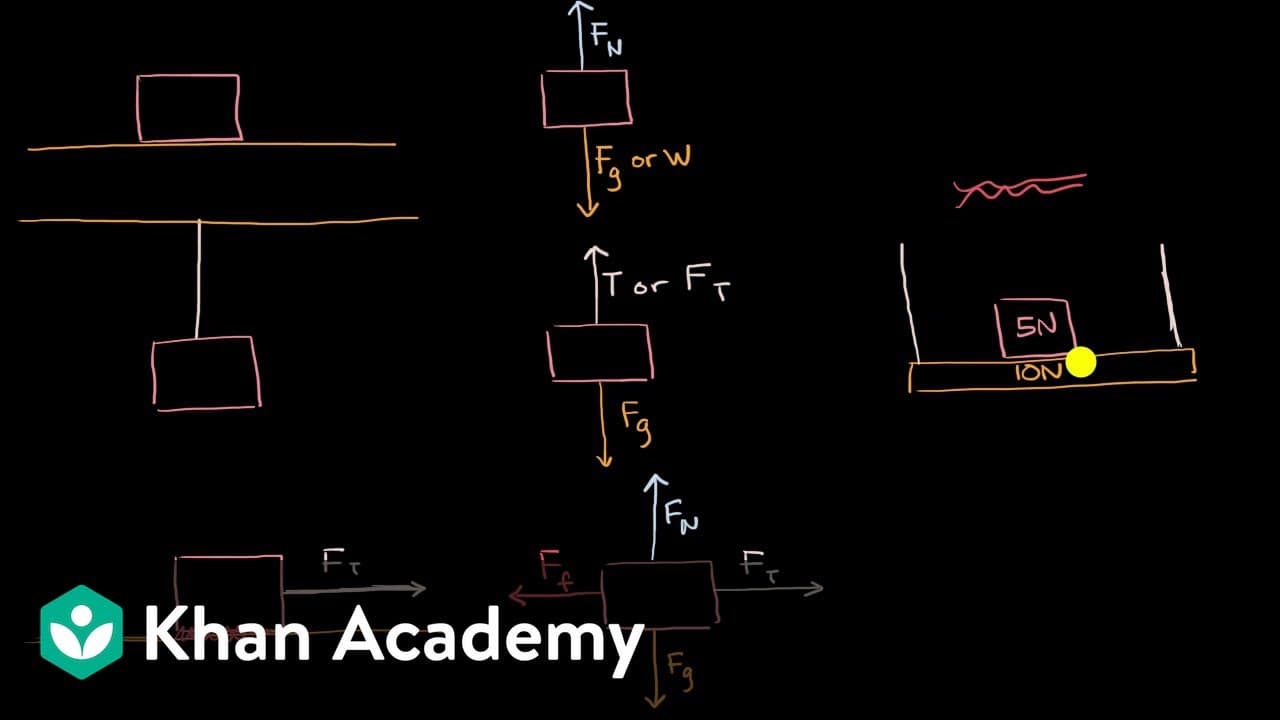
- [Instructor] In this video, we're gonna discuss different types of forces, but we're gonna do it in the context of free body diagrams. So let's say I have a table here, and I have a block that is sitting stationary on that table. What are all of the forces that are going to act on this blocK? Well, to do that, to think about that, I can draw a fr... Read More
Key Insights
- 🥶 Weight and normal force are common forces present in free body diagrams.
- 🏋️ Tension can counteract weight and prevent objects from accelerating downwards.
- 🛝 Friction opposes the direction of motion and can prevent objects from sliding.
- 🥶 Free body diagrams isolate forces acting on an object to better understand their effects.
Install to Summarize YouTube Videos and Get Transcripts
Explore YouTube Video Summarizer or Get YouTube Transcript Extractor
Questions & Answers
Q: What are the forces acting on a block on a table?
The forces acting on a block on a table are weight (pulling downwards) and normal force (table pushing upwards). The weight is a result of gravity, while the normal force counteracts it.
Q: What are the forces acting on a block hanging from a string?
The forces acting on a block hanging from a string are weight (pulling downwards) and tension (string pulling upwards). The tension in the string keeps the block from accelerating downwards.
Q: What forces are present when pulling a block on the ground with a rope?
When pulling a block on the ground with a rope, the forces present are weight (pulling downwards), normal force (ground pushing upwards), tension (pulling force), and friction (counteracting the pulling force). The normal force and friction prevent the block from moving.
Q: How are free body diagrams useful in understanding forces?
Free body diagrams help us visualize and analyze the forces acting on an object. By isolating the object and considering each force, we can determine its effect on the object's motion.
Summary & Key Takeaways
-
In free body diagrams, forces acting on an object are represented. For a block on a table, the forces present are weight (gravity pulling downwards) and normal force (table pushing upwards).
-
For a block hanging from a string, the forces are weight (pulling downwards) and tension (string pulling upwards).
-
When a block is pulled on the ground with a rope, the forces are weight (pulling downwards), normal force (ground pushing upwards), tension (pulling force), and friction (counteracting the pulling force).
Read in Other Languages (beta)
Share This Summary 📚
Summarize YouTube Videos and Get Video Transcripts with 1-Click
Try YouTube Summary with ChatGPT & Claude or YouTube Transcript Generator
Explore More Summaries from Khan Academy 📚



Summarize YouTube Videos and Get Video Transcripts with 1-Click
Try YouTube Summary with ChatGPT & Claude or YouTube Transcript Generator