Stanford Seminar - Recent progress in verifying neural networks, Zico Kolter
TL;DR
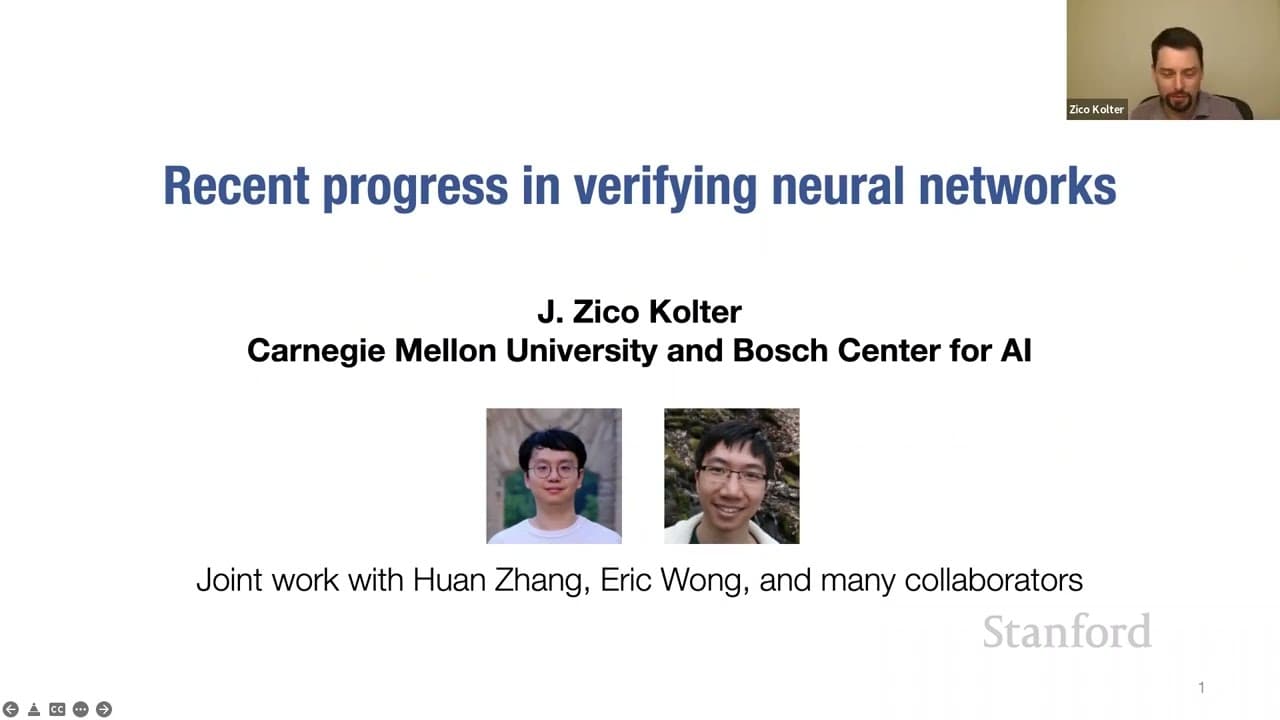
This talk discusses recent progress in verifying deep neural networks and highlights the challenges and advancements in this field.
Transcript
all right so this this talk is about uh recent progress in verifying neural networks um and i should really emphasize that the work i'm presenting here is really the work of two uh with your former current members of my group uh eric wong a former student of mine um and huangjiang a current postdoc of mine as well as many many collaborators actuall... Read More
Key Insights
- 🌥️ Recent progress has been made in verifying deep neural networks, but challenges remain in scaling these techniques to larger networks.
- 👊 Robustness to attacks is a crucial aspect of deep learning, as deep networks are vulnerable to adversarial perturbations.
- 💨 Verification techniques offer a way to ensure the reliability of deep networks and address their security vulnerabilities.
Install to Summarize YouTube Videos and Get Transcripts
Explore YouTube Video Summarizer or Get YouTube Transcript Extractor
Questions & Answers
Q: How can we verify the robustness of deep learning models?
Verification of robustness involves certifying that small perturbations to every pixel in an image will not change the output of a deep learning model. This can be done by formulating the problem as a mixed integer linear program and using techniques such as relaxation and branch and bound to solve it efficiently.
Q: Are deep learning models vulnerable to attacks?
Yes, deep learning models are vulnerable to adversarial attacks where small perturbations to an input can cause misclassification. These attacks can be harmful in various applications, such as self-driving cars or security systems. Ensuring the robustness of deep learning models is crucial to address this vulnerability.
Q: Can verification techniques improve the performance of deep networks?
Verification techniques focus on certifying properties of deep networks, such as robustness and accuracy, rather than directly improving performance. However, by ensuring the reliability of deep networks under various conditions, verification techniques can indirectly contribute to improving their overall performance and reliability.
Q: How does the process of verification work for deep networks?
Verification involves formulating the problem as a mixed integer linear program and solving it using techniques like relaxation and branch and bound. By creating fast approximations and leveraging the parallelism of GPU computation, verification techniques can efficiently solve these problems and provide guarantees about the properties of deep networks.
Summary & Key Takeaways
-
The speaker presents recent progress in verifying deep neural networks and acknowledges the contributions of collaborators.
-
They discuss the promise and perils of deep learning, highlighting the impressive capabilities of deep networks but also their vulnerability to attacks and security threats.
-
The speaker explains the concept of verifying deep learning and how it involves certifying properties such as robustness and accuracy of deep networks.
-
They introduce advances in verification techniques and discuss the future of verification in deep learning.
Read in Other Languages (beta)
Share This Summary 📚
Summarize YouTube Videos and Get Video Transcripts with 1-Click
Try YouTube Summary with ChatGPT & Claude or YouTube Transcript Generator
Explore More Summaries from Stanford Online 📚

Summarize YouTube Videos and Get Video Transcripts with 1-Click
Try YouTube Summary with ChatGPT & Claude or YouTube Transcript Generator