2011 Calculus AB free response #4c | AP Calculus AB | Khan Academy
TL;DR
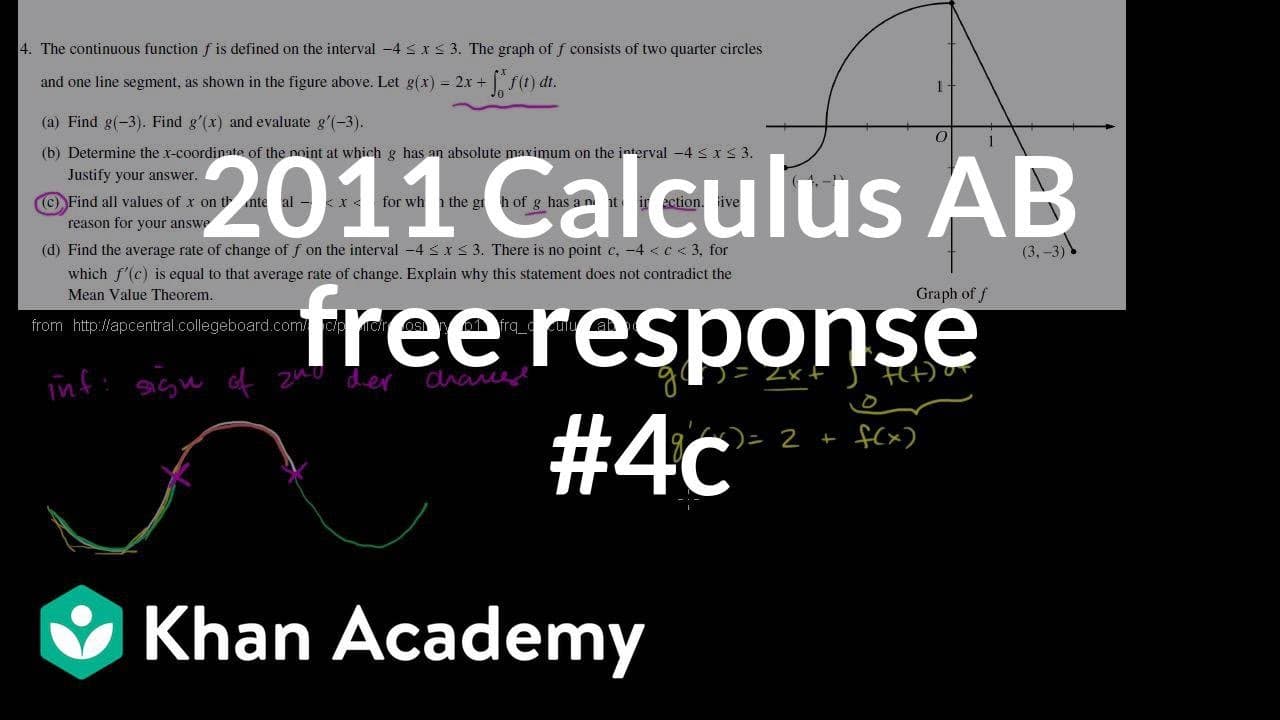
The video explains how to identify points of inflection on the graph of g(x) by analyzing its second derivative and the sign changes in the slope of f(x).
Transcript
Part C. Find all values of x on the interval negative 4 is less than x is less than 3 for which the graph of g has a point of inflection. Give a reason for your answer. So an inflection point is a point where the sign of the second derivative changes. So if you take the second derivative at that point, or as we go close to that point, or as we cros... Read More
Key Insights
- 😥 An inflection point is a point on the graph where the concavity changes, identified by the sign change in the second derivative.
- 😥 The slope of f(x) represents the instantaneous slope, indicating the direction and rate of change at each point.
- 😥 Analyzing the second derivative allows us to find when the slope of f(x) changes sign, which corresponds to points of inflection.
- 😥 Points of inflection can occur even if the function is not differentiable at those specific points.
- 😥 Understanding inflection points helps in visualizing the shape and behavior of a graph.
- 😥 Trigonometric curves can also have points of inflection where the slope changes from decreasing to increasing or vice versa.
- 😥 The process of identifying points of inflection involves finding the sign changes in the second derivative or the slope of f(x).
Install to Summarize YouTube Videos and Get Transcripts
Explore YouTube Video Summarizer or Get YouTube Transcript Extractor
Questions & Answers
Q: What is an inflection point on a graph?
An inflection point is a point where the sign of the second derivative changes, indicating a change in the concavity of the graph.
Q: How can we identify points of inflection on the graph of g(x)?
We can find points of inflection by determining the sign changes in the second derivative of g(x) or the slope of f(x).
Q: Does a sign change in the second derivative always indicate a point of inflection?
Yes, a sign change in the second derivative always indicates a point of inflection. It shows a change in the concavity of the graph.
Q: Can a point of inflection have a non-differentiable point on its graph?
Yes, a point of inflection can have a non-differentiable point on its graph, as shown in the example where f(x) is not differentiable at x=0.
Summary & Key Takeaways
-
An inflection point is a point on the graph of g(x) where the sign of the second derivative changes.
-
To find points of inflection, we need to analyze the second derivative of g(x) and determine where it changes sign.
-
The sign changes in the second derivative of g(x) correspond to sign changes in the slope of f(x).
Read in Other Languages (beta)
Share This Summary 📚
Summarize YouTube Videos and Get Video Transcripts with 1-Click
Try YouTube Summary with ChatGPT & Claude or YouTube Transcript Generator
Explore More Summaries from Khan Academy 📚



Summarize YouTube Videos and Get Video Transcripts with 1-Click
Try YouTube Summary with ChatGPT & Claude or YouTube Transcript Generator