What Are Populations, Samples, and Parameters in Statistics?
TL;DR
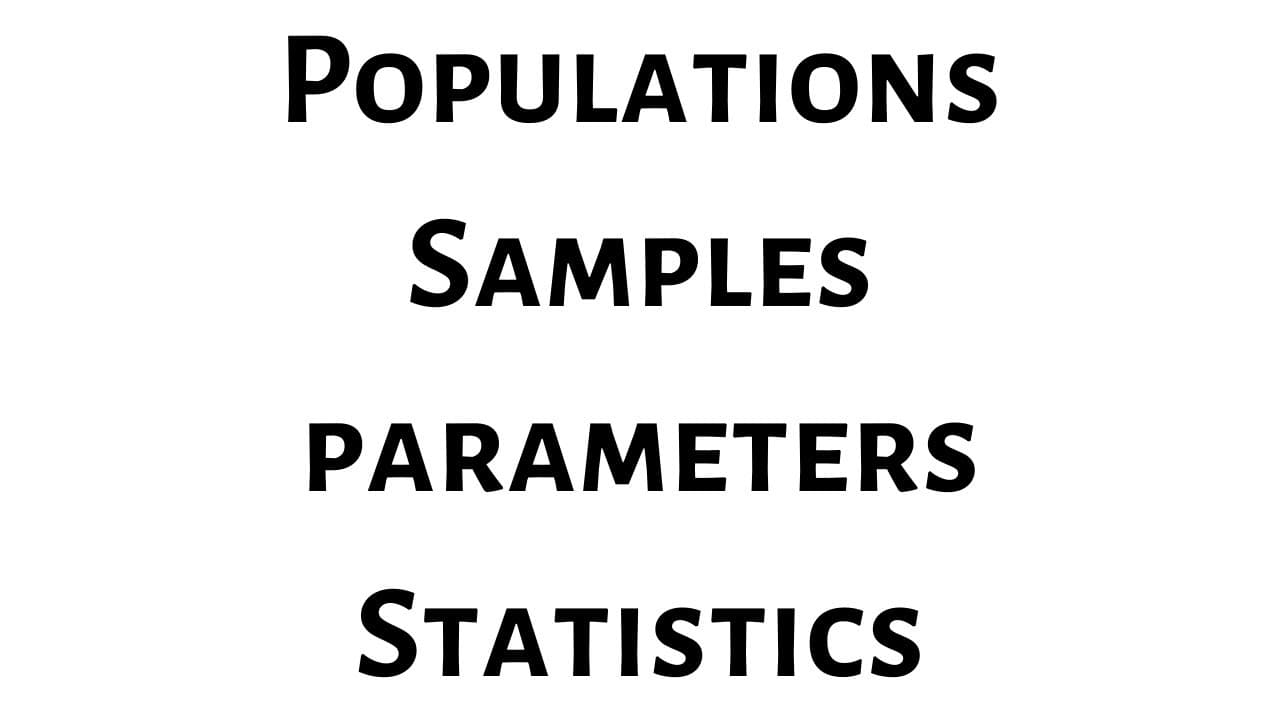
In statistics, a population includes all individuals of interest, while a parameter is a numerical value describing a characteristic of that population, such as an average. A sample is a subset of the population used for analysis, and a statistic is a number that describes a characteristic of that sample. Understanding these concepts is fundamental for effective statistical analysis.
Transcript
hi everyone in this video we're going to talk about a couple very important definitions the first definition is that of a population so population so a population is everything you care about so let me just say it's every individual of interest so it's everything you care about so if you care about the GPAs of all the students at your local college... Read More
Key Insights
- ❓ A population encompasses everything of interest in a study.
- ❓ Parameters describe aspects of the population, while statistics do the same for samples.
- 🤝 Sampling is crucial for practical data collection when dealing with large populations.
- 🆘 Statistics help generalize findings from samples to entire populations accurately.
- 😒 Mean weight examples illustrate the practical use of samples and statistics in estimating population characteristics.
- ❓ The main objective of statistics is to analyze samples to draw insights about entire populations.
- ❓ Understanding the relationships between populations, parameters, samples, and statistics is fundamental in statistical analysis.
Install to Summarize YouTube Videos and Get Transcripts
Explore YouTube Video Summarizer or Get YouTube Transcript Extractor
Questions & Answers
Q: What is the relationship between population, parameter, sample, and statistic?
The population is everything of interest, with parameters describing it. Sampling is done to create a sample, and statistics are derived from the sample.
Q: Why do we use samples instead of surveying entire populations?
Sampling is more practical for large populations. It provides insights without needing to analyze every individual, making statistics more manageable and informative.
Q: What is the main purpose of statistics in relation to populations and samples?
Statistics help infer information about populations by analyzing samples. It allows for generalizing findings from samples to the larger population accurately.
Q: How does the concept of mean weight in a population illustrate the use of samples and statistics?
By taking a sample of people from a population and calculating their mean weight, we can use statistics to estimate the population's mean weight more practically.
Summary & Key Takeaways
-
A population refers to everything of interest, like all GPAs in a college.
-
A parameter is a number describing an aspect of the population, such as the average GPA.
-
A sample is a subgroup of the population, and a statistic is a number describing an aspect of the sample.
Read in Other Languages (beta)
Share This Summary 📚
Summarize YouTube Videos and Get Video Transcripts with 1-Click
Try YouTube Summary with ChatGPT & Claude or YouTube Transcript Generator
Explore More Summaries from The Math Sorcerer 📚




Summarize YouTube Videos and Get Video Transcripts with 1-Click
Try YouTube Summary with ChatGPT & Claude or YouTube Transcript Generator