Z-Transform Of Sinusoidal Signal | Z-Transform | Signals and Systems
TL;DR
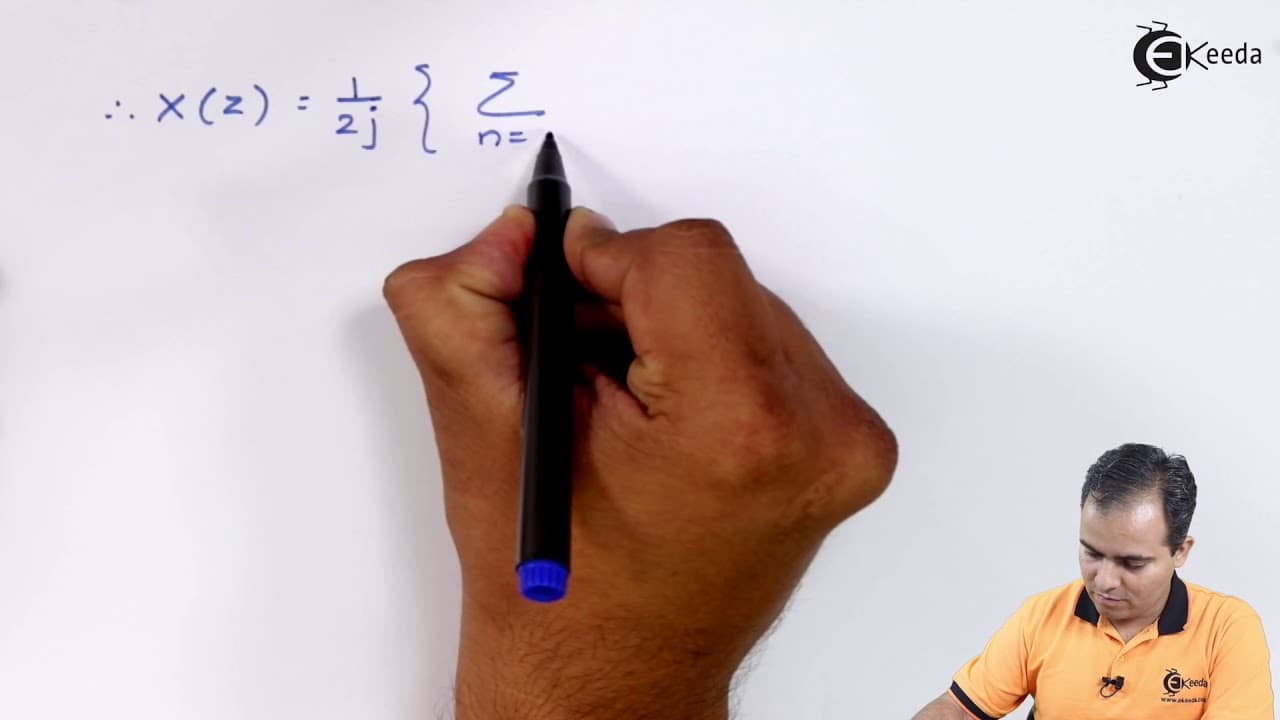
This video explains how to calculate the Z-transform of a sinusoidal wave by considering it as a right-handed or left-handed sequence.
Transcript
click the bell icon to get latest videos from akira hello friends i'm tori be having the study as a transform of sinusoidal wave or sign a signal or sinusoidal sequence whatever sinusoidal it is nothing but a simply sine wave so now basically sine wave is valid from minus infinity to infinity but if we're going to find out of that such type of a si... Read More
Key Insights
- 🤪 The Z-transform of a sinusoidal wave without modifications is infinity.
- 🔍 By considering the sinusoidal wave as a right-handed or left-handed sequence, the Z-transform can be calculated effectively.
- 🤪 The Z-transform formula for a right-handed sequence of a sinusoidal wave is 1/(2j) * (e^(jOmegan) - e^(-jOmegan)) / (1 - e^(-j*Omega)).
- 😘 The linearity property and the Z-transform of cos and sin functions are used in the calculations.
- 🔍 The Z-transform of a left-handed sequence of a sinusoidal wave can also be calculated using similar steps.
- 🤪 The final result of the Z-transform of a sinusoidal wave is expressed in terms of sine and cosine functions.
Install to Summarize YouTube Videos and Get Transcripts
Explore YouTube Video Summarizer or Get YouTube Transcript Extractor
Questions & Answers
Q: What is the problem with finding the Z-transform of a sinusoidal wave without any modifications?
The Z-transform of a sinusoidal wave without any modifications is infinity, which is not a useful result.
Q: How can we obtain a right-handed sequence of a sinusoidal wave for Z-transform calculation?
Multiply the sinusoidal wave by U(n) to obtain a right-handed sequence.
Q: How can we obtain a left-handed sequence of a sinusoidal wave for Z-transform calculation?
Multiply the sinusoidal wave by -U(-n-1) to obtain a left-handed sequence.
Q: What is the difference between the results of left-handed and right-handed sequences of a sinusoidal wave?
Both sequences represent sinusoidal waves, but the left-handed sequence has a negative sign compared to the right-handed sequence.
Q: What is the formula for finding the Z-transform of a sinusoidal wave?
The formula is Z-transform = 1/(2j) * (e^(jOmegan) - e^(-jOmegan)).
Q: How can we calculate the Z-transform of a sinusoidal wave with the given formula?
Substitute the values of e^(jOmega) and e^(-jOmega) in the formula and simplify the expression step by step to find the Z-transform.
Q: What are the properties of the Z-transform used in the calculations?
The linearity property and the Z-transform of cos and sin (e^j*Omega) functions are used in the calculations.
Q: What is the final result and interpretation of the Z-transform of a sinusoidal wave?
The Z-transform of a sinusoidal wave multiplied by U(n) is 1/(2j) * (e^(jOmega) - e^(-jOmega)) / (1 - e^(-j*Omega)).
Summary & Key Takeaways
-
The video discusses the Z-transform of a sinusoidal wave and explains that if the wave is left as it is, the result will be infinity. To avoid this, the wave can be considered as a right-handed or left-handed sequence.
-
To obtain a right-handed sequence, the sine wave is multiplied by U(n). To obtain a left-handed sequence, the sine wave is multiplied by -U(-n-1).
-
The video demonstrates the calculations and transformations involved in finding the Z-transform of a right-handed sequence of a sinusoidal wave.
Read in Other Languages (beta)
Share This Summary 📚
Summarize YouTube Videos and Get Video Transcripts with 1-Click
Try YouTube Summary with ChatGPT & Claude or YouTube Transcript Generator
Explore More Summaries from Ekeeda 📚



Summarize YouTube Videos and Get Video Transcripts with 1-Click
Try YouTube Summary with ChatGPT & Claude or YouTube Transcript Generator