How Did the Rosetta Mission Land on a Comet 67P?
TL;DR
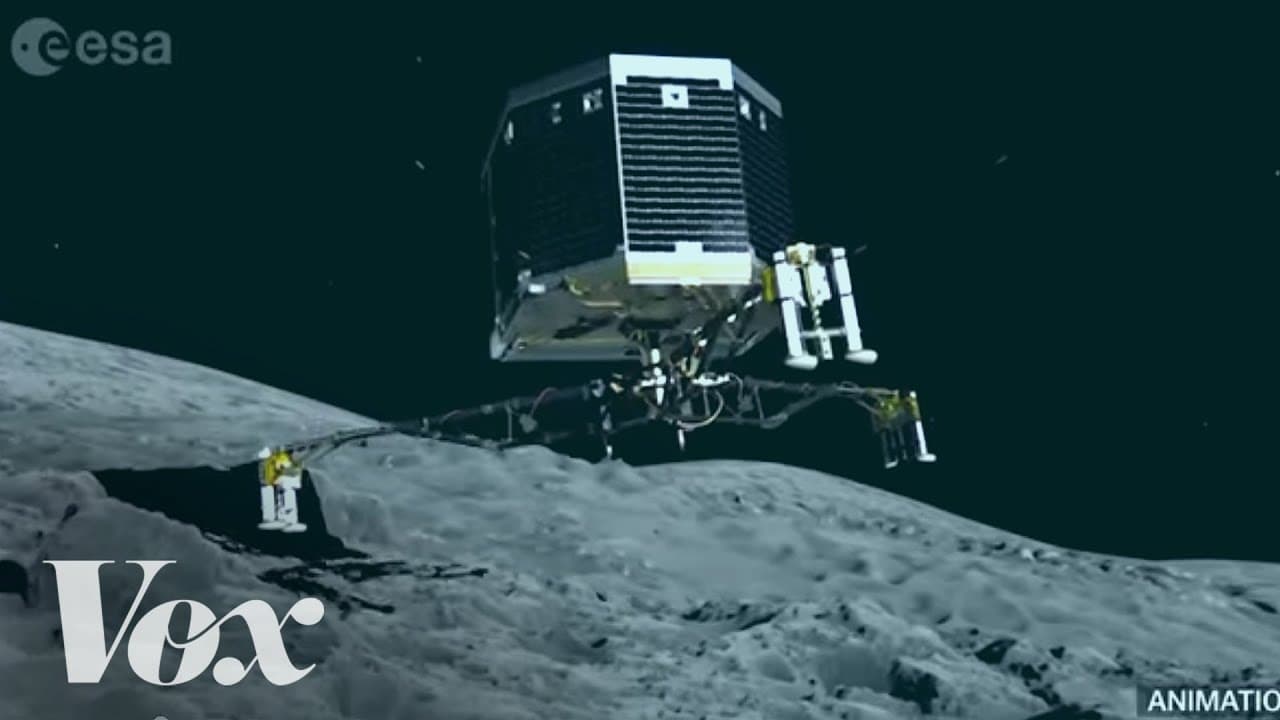
The Rosetta mission successfully landed the Philae probe on comet 67P/Churyumov-Gerasimenko, marking the first controlled landing on a comet. This groundbreaking achievement involved a decade-long journey covering over 3.5 billion miles, utilizing gravity assists from Earth and Mars, and allowed the probe 64 hours to conduct soil sample analyses, providing crucial insights into the early solar system.
Transcript
We've just reached an entire new milestone in space exploration. "A mission to go to a comet, drill out a sample, and bring it back to Earth." The European Space Agency's Rosetta spacecraft just landed a small, 220-pound robot onto a comet, making it the 7th celestial body we've ever landed a spacecraft on. Previous missions have flown by comets, a... Read More
Key Insights
- The Rosetta mission marked a significant milestone in space exploration by successfully landing a probe on a comet, a first in space history.
- Comet 67P/Churyumov-Gerasimenko, the target of the mission, is approximately 2.5 miles wide and travels at 84,000 miles per hour.
- The mission involved complex maneuvers, including using Earth's and Mars' gravity as slingshots, to reach the comet after a decade-long journey.
- The spacecraft traveled over 3.5 billion miles, equivalent to nearly 40 times the distance from the Earth to the sun.
- Rosetta's lander, Philae, had only 64 hours of battery life to conduct scientific experiments and collect data on the comet's surface.
- The mission aims to provide insights into the composition of comets, which can help understand the origins of the solar system.
- Comets are considered ancient celestial bodies, potentially carrying water and organic molecules crucial for life on Earth.
- The Rosetta mission continues to orbit the comet, sending back valuable data until the end of 2015.
Install to Summarize YouTube Videos and Get Transcripts
Explore YouTube Video Summarizer or Get YouTube Transcript Extractor
Questions & Answers
Q: What was the primary objective of the Rosetta mission?
The primary objective of the Rosetta mission was to land a probe on comet 67P/Churyumov-Gerasimenko to study its composition and gather data that could provide insights into the early solar system. The mission aimed to conduct scientific experiments, including drilling and analyzing soil samples, to understand more about the origins of comets and potentially the building blocks of life on Earth.
Q: How did Rosetta reach comet 67P?
Rosetta reached comet 67P through a complex series of maneuvers, utilizing the gravitational pull of Earth and Mars as slingshots to gain the necessary speed and trajectory. The spacecraft traveled over 3.5 billion miles, a journey that took more than a decade. It involved a 2.5-year hibernation period due to the distance from the sun, before finally waking up and catching up with the comet in August 2014.
Q: What challenges did the Rosetta mission face during the landing?
The Rosetta mission faced several challenges during the landing on comet 67P, including the comet's low gravity, which made it difficult for the Philae lander to stay anchored on the surface. The lander, weighing about 220 pounds, had the effective weight of a sheet of paper on the comet. Additionally, the mission had to contend with the unexpected duck shape of the comet, which complicated the landing site selection and landing process.
Q: What scientific opportunities does the Rosetta mission provide?
The Rosetta mission provides significant scientific opportunities by allowing researchers to study the composition of comet 67P in detail. By analyzing the comet's surface material, scientists hope to gain insights into the presence of water and organic molecules, shedding light on the origins of the solar system and the potential role comets played in bringing essential elements for life to Earth. The mission's findings could enhance our understanding of the early solar system's development.
Q: What is the significance of studying comets like 67P?
Studying comets like 67P is significant because they are considered ancient remnants from the early solar system, potentially holding clues about its formation and evolution. Comets may contain water and organic molecules, which are crucial for understanding the origins of life on Earth. By analyzing their composition, scientists can gain insights into the conditions and processes that existed in the early solar system, helping to unravel the mysteries of planetary formation and the potential for life elsewhere in the universe.
Q: How long did the Rosetta mission take to reach its target?
The Rosetta mission took over a decade to reach its target, comet 67P/Churyumov-Gerasimenko. Launched in March 2004, the spacecraft traveled more than 3.5 billion miles, utilizing gravity assists from Earth and Mars to reach the comet. After a 2.5-year hibernation period due to its distance from the sun, Rosetta finally caught up with the comet in August 2014, marking a significant milestone in space exploration.
Q: What was unique about the landing site chosen for Philae?
The landing site chosen for Philae on comet 67P was unique due to its relatively smooth and flat characteristics, which were essential for a successful landing. However, the selection process was complicated by the comet's unexpected duck shape, which required careful consideration to ensure the lander could safely touch down and remain stable. The low gravity environment added to the challenge, as it made it difficult for Philae to stay anchored on the comet's surface.
Q: What happens after the lander's battery depletes?
After the Philae lander's battery depletes, it deactivates unless it can harness enough solar power to recharge. The lander had a limited operational window of 64 hours to conduct scientific experiments and gather data. Meanwhile, the Rosetta spacecraft continues to orbit the comet, sending back valuable data and images until December 2015, when the comet moves away from the inner solar system. This extended mission duration allows for continuous observation and data collection, contributing to our understanding of comets.
Summary & Key Takeaways
-
The European Space Agency's Rosetta mission achieved a groundbreaking feat by landing the Philae probe on comet 67P/Churyumov-Gerasimenko. This mission, launched in 2004, involved intricate space maneuvers and a decade-long journey, providing unprecedented opportunities to study the comet's composition and the early solar system.
-
Comet 67P, a duck-shaped celestial body, is about 2.5 miles wide and orbits the sun every 6.5 years. Rosetta's journey to the comet required gravity assists from Earth and Mars, covering over 3.5 billion miles, and involved a 2.5-year hibernation period due to its distance from the sun.
-
The Philae lander had a limited 64-hour window to conduct experiments on the comet's surface, focusing on drilling and analyzing soil samples. Despite the short time frame, the mission's findings are expected to enhance our understanding of comets and their role in the solar system's formation.
Read in Other Languages (beta)
Share This Summary 📚
Summarize YouTube Videos and Get Video Transcripts with 1-Click
Try YouTube Summary with ChatGPT & Claude or YouTube Transcript Generator
Explore More Summaries from Vox 📚




Summarize YouTube Videos and Get Video Transcripts with 1-Click
Try YouTube Summary with ChatGPT & Claude or YouTube Transcript Generator