Products
Features
YouTube Video Summarizer
Summarize YouTube videos
Web & PDF Highlighter
Highlight web pages & PDFs
Chat with PDF
Ask any PDF questions with AI
Ask AI Clone
Chat with your highlights & memories
Audio Transcriber
Transcribe audio files to text
Glasp Reader
Read and highlight articles
Kindle Highlight Export
Export your Kindle highlights
Idea Hatch
Hatch ideas from your highlights
Integrations
Obsidian Plugin
Notion Integration
Pocket Integration
Instapaper Integration
Medium Integration
Readwise Integration
Snipd Integration
Hypothesis Integration
Apps & Extensions
Chrome Extension
Safari Extension
Edge Add-ons
Firefox Add-ons
iOS App
Android App
Discover
Discover
Ideas
Discover new ideas and insights
Articles
Curated articles and insights
Books
Book recommendations by great minds
Posts
Essays and notes from readers
Quotes
Inspiring quotes collection
Videos
Curated videos and summaries
Explore Glasp
Glasp Newsletter
Weekly insights and updates
Glasp Talk
Interview series with great minds
Glasp Blog
Latest news and articles
Glasp Use Cases
Learn how others use Glasp
Build & Support
Glasp API
Access Glasp's API for developers
MCP Connector
Connect Glasp to Claude & ChatGPT
Community
Glasp Reddit Community
Students
Student discount and benefits
FAQs
Frequently Asked Questions
AboutPricing
DashboardLog inSign up

What Is the RSA Algorithm and How Does It Work?
9 views
•
July 21, 2023
by
Ekeeda
YouTube video player
What Is the RSA Algorithm and How Does It Work?

TL;DR

The RSA algorithm is a widely-used public-key encryption method that was developed in 1977. It operates on integers, utilizing exponentials for encryption and decryption. This method requires both a public and a private key, with the encryption and decryption processes revolving around mathematical operations involving modular arithmetic.

Transcript

hello and welcome back to the course today in this session we are going to have the introduction to the rsa algorithm um as far as this particular algorithm is concerned uh uh this uh has been challenged many times that uh every algorithm one comes into uh in the in place and uh in in terms of any application so uh it has been challenged by many pe... Read More

Key Insights

  • 🤩 The RSA algorithm was developed to address the need for a strong public-key encryption approach.
  • 😒 RSA operates on integers and makes use of exponentials for encryption and decryption.
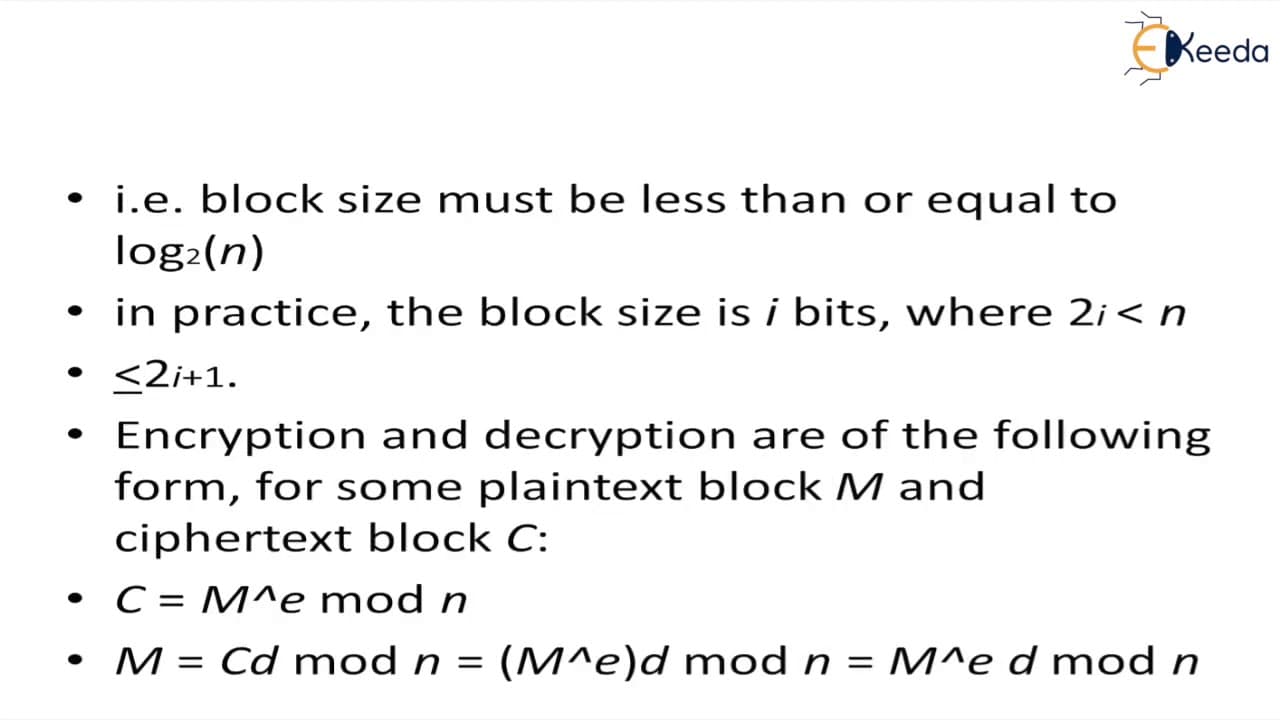
  • 🚫 The block size in RSA is typically i bits, with the value of n being between 2^i and 2^(i+1).
  • 📞 The RSA algorithm requires both the sender and receiver to know the value of n, while only the receiver knows the values of e and d.

Install to Summarize YouTube Videos and Get Transcripts

Explore YouTube Video Summarizer or Get YouTube Transcript Extractor

Questions & Answers

Q: What was the challenge that led to the development of the RSA algorithm?

The challenge was to create a cryptographic algorithm for public key systems that could meet the requirements of complex encryption and decryption processes.

Q: Who developed the RSA algorithm and when was it first published?

The RSA algorithm was developed by Ron Rivest, Adi Shamir, and Leonard Adleman in 1977 and first published in 1978.

Q: What is the block size in RSA and how is it related to the value of n?

The block size in RSA is typically i bits, where n varies between 2^i and 2^(i+1). The value of n must be less than 2^(i+1) and greater than or equal to 2^i.

Q: What are the requirements for the RSA algorithm to be considered satisfactory for public-key encryption?

The requirements are: 1) It should be possible to find values for e, d, and n such that m^(e*d) mod n = m. 2) It should be relatively easy to calculate mod operations with e and n for all values of m less than n. 3) It should be computationally hard to determine d from e and n.

Summary & Key Takeaways

  • The RSA algorithm was developed in 1977 to meet the challenge of creating a cryptographic algorithm for public key systems.

  • RSA is a block cipher that operates on integers between 0 to n-1, with n typically being 1024 bits or 309 decimal digits.

  • The encryption and decryption process in RSA involves exponentials and the knowledge of public and private keys.


Read in Other Languages (beta)

English

Share This Summary 📚

Summarize YouTube Videos and Get Video Transcripts with 1-Click

Download browser extensions on:

Try YouTube Summary with ChatGPT & Claude or YouTube Transcript Generator

Explore More Summaries from Ekeeda 📚
Problem 1 Parametric Amplifiers - Avalanche Transit Time Devices - Microwave Engineering thumbnail
Problem 1 Parametric Amplifiers - Avalanche Transit Time Devices - Microwave Engineering
Ekeeda
Sensors in a Drone and Requirements thumbnail
Sensors in a Drone and Requirements
Ekeeda
What Are the Key Properties of Fluids in Fluid Mechanics? thumbnail
What Are the Key Properties of Fluids in Fluid Mechanics?
Ekeeda
Bellows thumbnail
Bellows
Ekeeda
View Of Data - Introduction to DBMS - Database Management System thumbnail
View Of Data - Introduction to DBMS - Database Management System
Ekeeda
Engineering Mathematics (GATE) - Green’s, Stokes’s, and Gauss’s Theorems - 1 Nov, 11 AM thumbnail
Engineering Mathematics (GATE) - Green’s, Stokes’s, and Gauss’s Theorems - 1 Nov, 11 AM
Ekeeda

Summarize YouTube Videos and Get Video Transcripts with 1-Click

Download browser extensions on:

Try YouTube Summary with ChatGPT & Claude or YouTube Transcript Generator

Apps & Extensions

  • Chrome Extension
  • Safari Extension
  • Edge Add-ons
  • Firefox Add-ons
  • iOS App
  • Android App

Key Features

  • YouTube Video Summarizer
  • Web & PDF Summarizer
  • Web & PDF Highlighter
  • Chat with PDF
  • Ask AI Clone
  • Audio Transcriber
  • Glasp Reader
  • Kindle Highlight Export
  • Idea Hatch

Integrations

  • Obsidian Plugin
  • Notion Integration
  • Pocket Integration
  • Instapaper Integration
  • Medium Integration
  • Readwise Integration
  • Snipd Integration
  • Hypothesis Integration

More Features

  • APIs
  • MCP Connector
  • Blog & Post
  • Embed Links
  • Image Highlight
  • Personality Test
  • Quote Shots

Company

  • About us
  • Blog
  • Community
  • FAQs
  • Job Board
  • Newsletter
  • Pricing
Terms

•

Privacy

•

Guidelines

© 2026 Glasp Inc. All rights reserved.