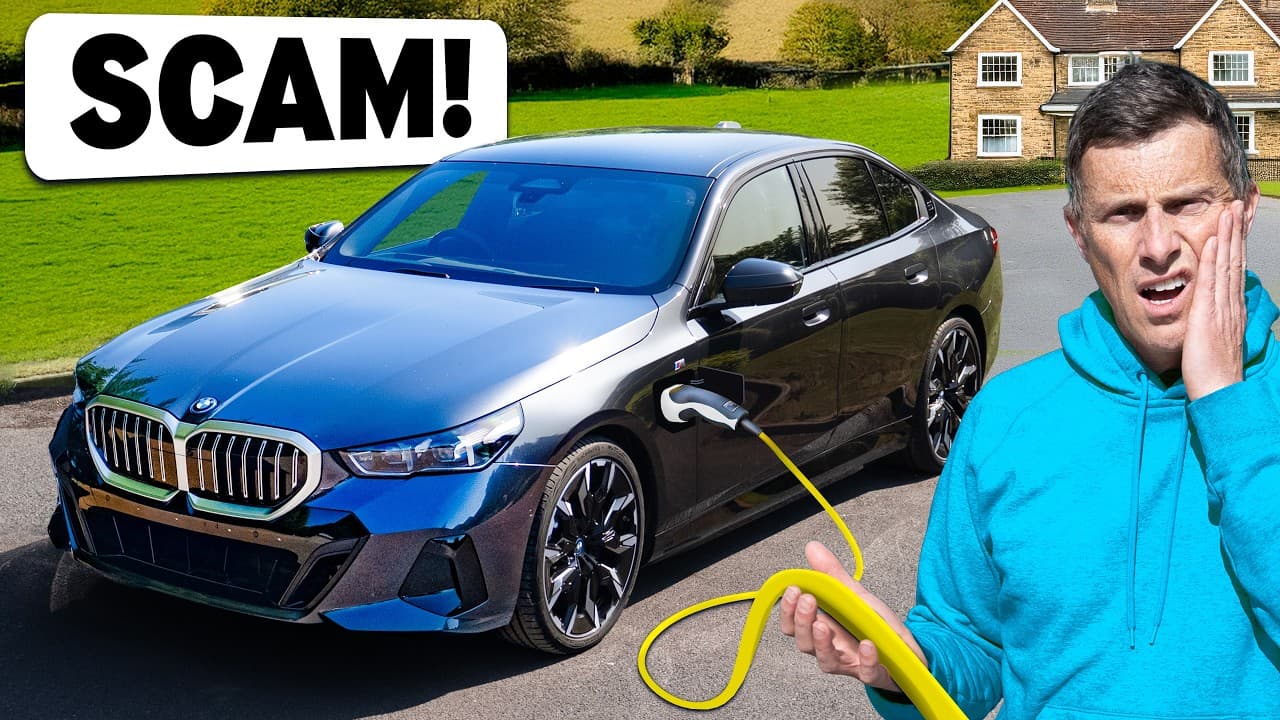
I EXPOSE WHY HYBRIDS ARE POINTLESS!
TL;DR
Plug-in hybrids may not be cost-effective for private buyers.
Transcript
Are plug-in hybrids the best of both worlds or a poor compromise? To find out, I've got each version of the new BMW 5 Series, the electric, the petrol, and the plug-in hybrid. I'm going to drive each of these cars on a variety of motorway, country road, and in town. And we'll find out exactly how much they really cost to run and own. And it might n... Read More
Key Insights
- Plug-in hybrids offer tax benefits but may not be cost-effective for private buyers due to higher initial costs and running expenses.
- The BMW 530e hybrid has a claimed electric range of 59-64 miles, but real-world tests showed it achieved 56.3 miles.
- The 530e hybrid requires 70,000 miles of electric-only driving to offset its premium over the 520i petrol model.
- Electric vehicles (EVs) like the i5 have higher production emissions due to battery materials, impacting their overall environmental benefit.
- Insurance costs for hybrids and EVs are higher due to specialized parts and repair requirements, affecting overall ownership costs.
- The BMW 520i petrol model proved to be the most cost-effective option for private buyers in terms of fuel and maintenance.
- Despite being heavier, the i5 EV offered better handling and ride comfort compared to the hybrid and petrol models.
- Charging infrastructure challenges and costs can make hybrids and EVs less appealing compared to traditional petrol vehicles.
Install to Summarize YouTube Videos and Get Transcripts
Explore YouTube Video Summarizer or Get YouTube Transcript Extractor
Questions & Answers
Q: What are the tax benefits of plug-in hybrids?
Plug-in hybrids like the BMW 530e offer significant tax benefits, especially for company car drivers. The government provides large tax breaks due to their lower emissions compared to petrol cars. For example, a high-rate taxpayer would pay significantly less tax on a hybrid compared to a petrol model, making them attractive for business use.
Q: How does the real-world performance of the 530e's electric range compare to its claims?
In real-world testing, the BMW 530e achieved an electric-only range of 56.3 miles, which is slightly less than the claimed range of 59-64 miles. This indicates that while the manufacturer's claims are somewhat accurate, actual performance can vary based on driving conditions and habits.
Q: What are the environmental impacts of producing hybrid and electric vehicles?
Hybrid and electric vehicles have higher production emissions due to the materials required for their batteries, such as lithium and cobalt. For instance, the production of the BMW i5 results in 17 tons of CO2, compared to 11.1 tons for the petrol 520i. This highlights the environmental trade-offs associated with these vehicles.
Q: Why are insurance costs higher for hybrids and EVs?
Insurance costs for hybrids and EVs are higher because they often require specialized components and repairs that are not as readily available as those for petrol cars. Additionally, repair shops may need specially trained technicians to handle these vehicles, leading to increased premiums.
Q: How do the driving experiences of the BMW 5 Series models compare?
The BMW i5 offers a more comfortable and smoother ride due to its electric powertrain and weight distribution. In contrast, the 520i petrol model feels sportier and more responsive. The 530e hybrid sits in between, providing a balance of both but lacking the distinct advantages of either.
Q: What are the cost implications of using public charging for hybrids and EVs?
Using public charging stations can significantly increase the running costs of hybrids and EVs. In the video, it was shown that charging costs for the 530e hybrid were higher than expected, making it less cost-effective compared to the petrol 520i when relying on public charging infrastructure.
Q: What are the long-term cost considerations for the BMW 530e hybrid?
The BMW 530e hybrid requires extensive electric-only driving to offset its initial cost premium over the 520i petrol model. It would take approximately 70,000 miles of electric driving to break even, making it less appealing for those who do not drive long distances regularly.
Q: What conclusion does the video reach regarding the best BMW 5 Series model for private buyers?
The video concludes that for private buyers, the BMW 520i petrol model is the most cost-effective option. It offers lower running costs, simpler maintenance, and better insurance rates compared to the 530e hybrid and i5 electric models, making it a more practical choice for everyday use.
Summary & Key Takeaways
-
The video explores whether plug-in hybrids offer a practical balance between cost, efficiency, and environmental benefits compared to electric and petrol cars. It uses the BMW 5 Series as a case study to evaluate claims versus real-world performance.
-
The BMW 530e plug-in hybrid, while offering significant tax benefits, requires extensive electric-only driving to justify its higher purchase price. This makes it less appealing for private buyers compared to the petrol-powered 520i.
-
The analysis highlights the challenges of charging infrastructure and the higher insurance and production costs associated with hybrids and EVs, ultimately suggesting that the petrol model remains a more viable option for most private consumers.
Read in Other Languages (beta)
Share This Summary 📚
Summarize YouTube Videos and Get Video Transcripts with 1-Click
Try YouTube Summary with ChatGPT & Claude or YouTube Transcript Generator
Explore More Summaries from carwow 📚



Summarize YouTube Videos and Get Video Transcripts with 1-Click
Try YouTube Summary with ChatGPT & Claude or YouTube Transcript Generator