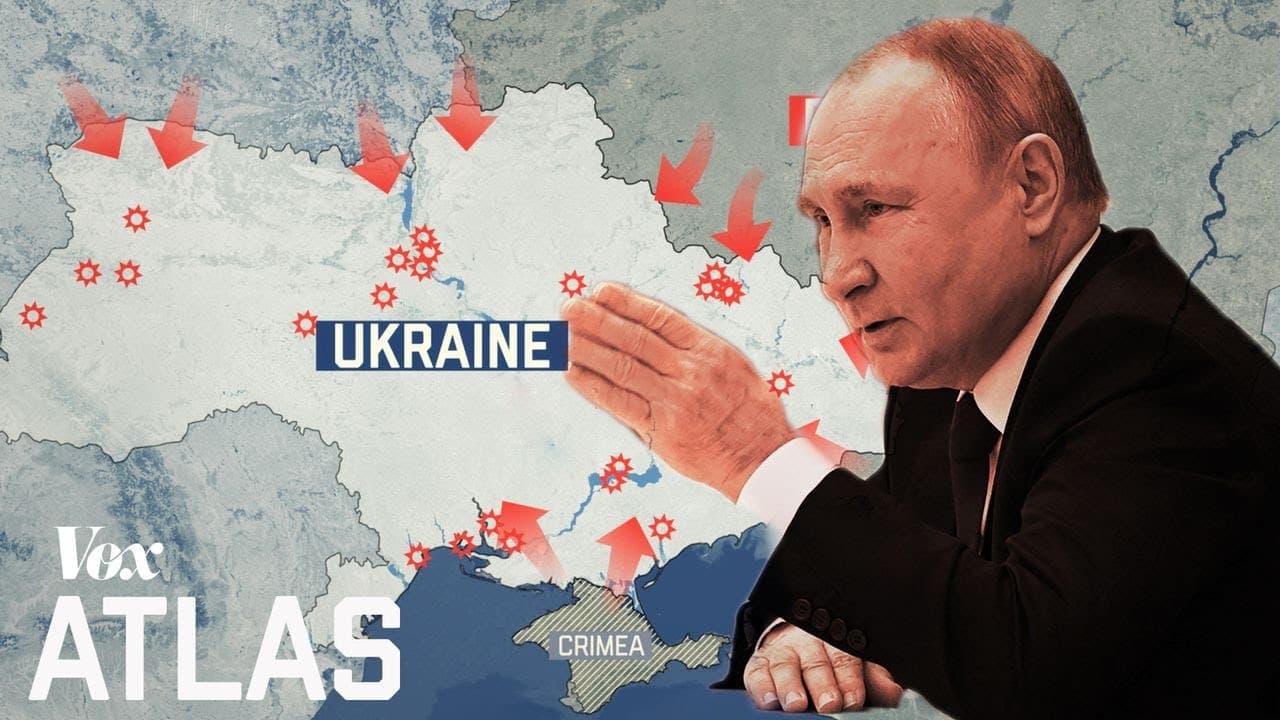
Putin's war on Ukraine, explained
TL;DR
Russia's invasion of Ukraine marks a significant European conflict.
Transcript
[in Russian] "I have made the decision to carry out a special military operation." Putin called this a "special military operation". But it's clear, this is a full scale invasion. "There was total panic. Hysteria. Tears.' "The flame was higher than the house." "We're like, in a cellar." "I'm not sure if it's like deep enough to help us to survive."... Read More
Key Insights
- Russia's invasion of Ukraine is a full-scale military operation, despite being termed a 'special military operation' by Putin.
- The conflict has resulted in hundreds of casualties and displaced over half a million Ukrainians, making it one of Europe's largest wars since WWII.
- Ukraine's historical ties with Russia date back to the Russian Empire, but it has fought for its own identity and independence.
- The Cold War era shaped Europe's political landscape, with NATO and the Warsaw Pact forming opposing military alliances.
- Ukraine's desire to join NATO and the EU has been a point of contention with Russia, leading to increased tensions.
- Russia's annexation of Crimea in 2014 and support for separatists in Donbas region have been precursors to the current conflict.
- Putin's demands for NATO to cease expansion and revert to 1997 borders were rejected by Western leaders, escalating tensions.
- Economic sanctions and military aid are the primary responses from the international community, while avoiding direct military confrontation with Russia.
Install to Summarize YouTube Videos and Get Transcripts
Explore YouTube Video Summarizer or Get YouTube Transcript Extractor
Questions & Answers
Q: What prompted Russia's full-scale invasion of Ukraine in 2022?
Russia's full-scale invasion of Ukraine in 2022 was prompted by a combination of historical, political, and strategic factors. Putin's long-standing view that Ukraine belongs to Russia, coupled with Ukraine's desire to join NATO and the EU, created tensions. The rejection of Putin's demands for NATO to cease expansion further escalated the situation, leading to the invasion.
Q: How has the international community responded to Russia's invasion of Ukraine?
The international community has responded to Russia's invasion of Ukraine primarily through economic sanctions and military aid. Countries around the world have imposed some of the harshest economic sanctions on Russia to slow down its aggression. Additionally, NATO has activated its response force for the first time, and the US has sent additional troops to Eastern Europe.
Q: What historical events have shaped the current Russia-Ukraine conflict?
The current Russia-Ukraine conflict is shaped by historical events dating back to the Russian Empire, the Soviet Union, and the Cold War. Ukraine's brief independence after the Russian Revolution, its incorporation into the Soviet Union, and the ideological divide during the Cold War all contributed to the tensions. The dissolution of the Soviet Union and Ukraine's aspirations to join Western alliances further fueled the conflict.
Q: What role does NATO play in the Russia-Ukraine conflict?
NATO plays a significant role in the Russia-Ukraine conflict as Ukraine's desire to join the alliance is a major point of contention with Russia. NATO's expansion into Eastern Europe after the Cold War, moving closer to Russia's borders, has been perceived as a threat by Putin. The rejection of Putin's demand for NATO to revert to 1997 borders escalated tensions, contributing to the invasion.
Q: How has Ukraine's relationship with Russia evolved over time?
Ukraine's relationship with Russia has evolved from being part of the Russian Empire and the Soviet Union to seeking independence and aligning with Western alliances. While they share historical ties, Ukraine has fought for its own identity and sovereignty. The annexation of Crimea and the conflict in Donbas further strained relations, leading to the current conflict.
Q: What are the implications of Russia's invasion of Ukraine for Europe?
Russia's invasion of Ukraine has significant implications for Europe, marking one of the largest conflicts since WWII. It challenges the post-Cold War security architecture, threatens regional stability, and raises concerns about further Russian aggression. The conflict has also prompted discussions on energy security, military readiness, and the need for a unified European response.
Q: What are the humanitarian impacts of the Russia-Ukraine conflict?
The humanitarian impacts of the Russia-Ukraine conflict are severe, with hundreds of casualties and over half a million Ukrainians displaced. The conflict has led to a refugee crisis, with neighboring countries opening their borders to fleeing Ukrainians. The war has also disrupted access to essential services, creating a dire situation for civilians caught in the conflict zones.
Q: How has the conflict affected global geopolitical dynamics?
The Russia-Ukraine conflict has affected global geopolitical dynamics by highlighting the tensions between Russia and Western alliances. It has strained Russia's relations with the West, prompted discussions on NATO's role and expansion, and raised concerns about global security. The conflict has also impacted international trade and energy markets, influencing global economic stability.
Summary & Key Takeaways
-
On February 24th, Russia launched a full-scale invasion of Ukraine, marking a significant escalation in the conflict that began with the annexation of Crimea in 2014. The invasion has resulted in hundreds of casualties and forced over half a million Ukrainians to flee their homes, making it one of Europe's largest wars since WWII.
-
The historical context of the conflict traces back to the Cold War era, where Europe was divided into two spheres of influence: NATO and the Soviet-led Warsaw Pact. Ukraine's aspirations to join NATO and the EU have been a point of contention with Russia, leading to increased tensions and ultimately, the current invasion.
-
The international response has been to impose harsh economic sanctions on Russia and provide military aid to Ukraine, while avoiding direct military confrontation. Putin's demands for NATO to cease expansion were rejected, and the conflict continues to escalate with Russian forces pushing deeper into Ukraine.
Read in Other Languages (beta)
Share This Summary 📚
Summarize YouTube Videos and Get Video Transcripts with 1-Click
Try YouTube Summary with ChatGPT & Claude or YouTube Transcript Generator
Explore More Summaries from Vox 📚
Summarize YouTube Videos and Get Video Transcripts with 1-Click
Try YouTube Summary with ChatGPT & Claude or YouTube Transcript Generator