Products
Features
YouTube Video Summarizer
Summarize YouTube videos
Web & PDF Highlighter
Highlight web pages & PDFs
Chat with PDF
Ask any PDF questions with AI
Ask AI Clone
Chat with your highlights & memories
Audio Transcriber
Transcribe audio files to text
Glasp Reader
Read and highlight articles
Kindle Highlight Export
Export your Kindle highlights
Idea Hatch
Hatch ideas from your highlights
Integrations
Obsidian Plugin
Notion Integration
Pocket Integration
Instapaper Integration
Medium Integration
Readwise Integration
Snipd Integration
Hypothesis Integration
Apps & Extensions
Chrome Extension
Safari Extension
Edge Add-ons
Firefox Add-ons
iOS App
Android App
Discover
Discover
Ideas
Discover new ideas and insights
Articles
Curated articles and insights
Books
Book recommendations by great minds
Posts
Essays and notes from readers
Quotes
Inspiring quotes collection
Videos
Curated videos and summaries
Explore Glasp
Glasp Newsletter
Weekly insights and updates
Glasp Talk
Interview series with great minds
Glasp Blog
Latest news and articles
Glasp Use Cases
Learn how others use Glasp
Build & Support
Glasp API
Access Glasp's API for developers
MCP Connector
Connect Glasp to Claude & ChatGPT
Community
Glasp Reddit Community
Students
Student discount and benefits
FAQs
Frequently Asked Questions
AboutPricing
DashboardLog inSign up

Stem and Leaf Plots

January 11, 2019
by
The Organic Chemistry Tutor
YouTube video player
Stem and Leaf Plots

TL;DR

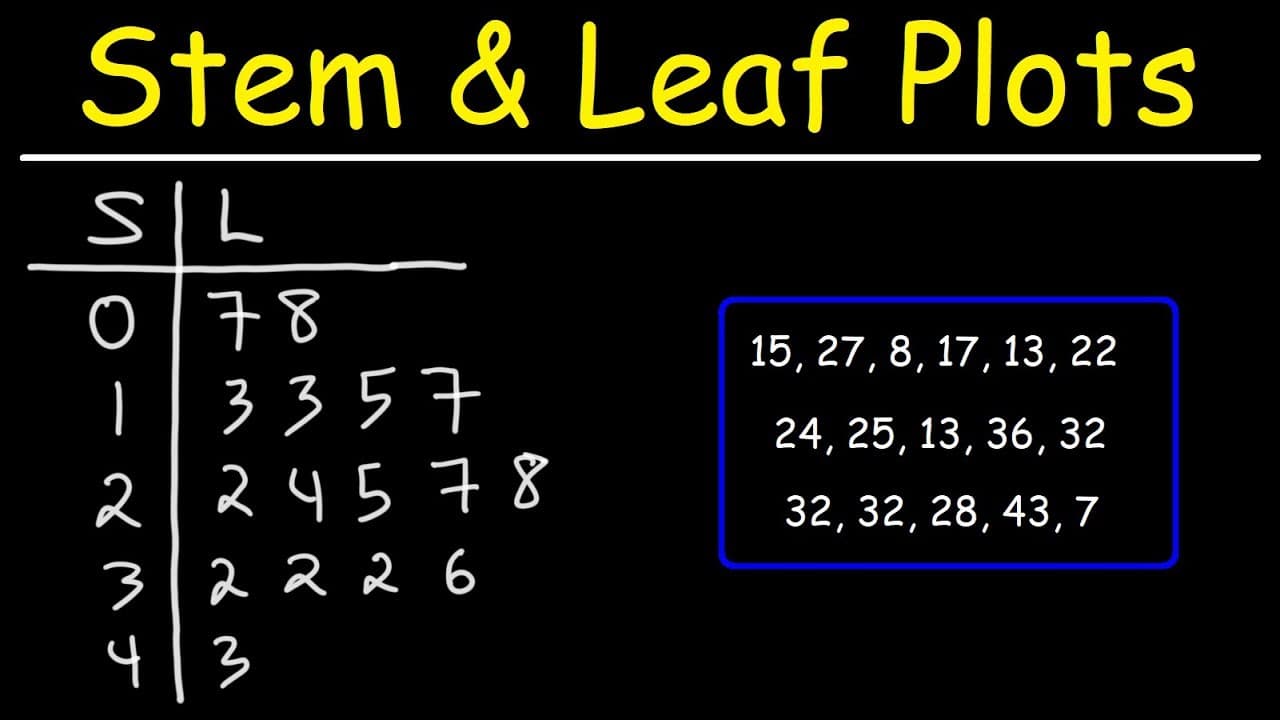
This video explains the process of creating a stem and leaf plot with examples using whole numbers and decimal numbers.

Transcript

in this video we're going to talk about how to make a stem and leaf plot so let's say we have the numbers 15 27 8 17 13 22 24 25 bear with me i only have a few more to write down and then 32 28 43 and 7. so how can we make a stem and leaf plot using those numbers now we need to make basically a two column table i'm going to write s for stem and l f... Read More

Key Insights

  • 🍀 Stem and leaf plots are useful for organizing and visualizing data.
  • 🥺 The stem and leaf plot is created by grouping numbers based on their leading digits.
  • 🍀 Stem and leaf plots can handle numbers beyond a hundred by using stems for the ten's place.
  • #️⃣ Stem and leaf plots can be used for decimal numbers by separating the whole number and decimal parts.
  • 🤩 Creating a key helps in identifying the actual values represented by the stems and leaves in the plot.
  • 🍀 Stem and leaf plots provide a clear representation of the distribution of data.
  • 🍀 Stem and leaf plots can be helpful in identifying patterns or outliers in a dataset.

Install to Summarize YouTube Videos and Get Transcripts

Explore YouTube Video Summarizer or Get YouTube Transcript Extractor

Questions & Answers

Q: What is a stem and leaf plot?

A stem and leaf plot is a graphical representation of data, where the stems represent the leading digits of the numbers, and the leaves represent the trailing digits.

Q: How do you group numbers in a stem and leaf plot?

In a stem and leaf plot, you group the numbers by their leading digits (stems) and place the trailing digits (leaves) in the corresponding row.

Q: How do you handle numbers beyond a hundred in a stem and leaf plot?

When dealing with numbers beyond a hundred, each stem represents a ten's place, and the leaves represent the remaining digits.

Q: Can stem and leaf plots be used for decimal numbers?

Yes, stem and leaf plots can be used to represent decimal numbers. The stems represent the whole number part, and the leaves represent the decimal part of the numbers.

Summary & Key Takeaways

  • The video demonstrates the steps to create a stem and leaf plot using a list of whole numbers.

  • It also provides an example of making a stem and leaf plot with numbers beyond a hundred.

  • The video further explains how to make a stem and leaf plot with decimal numbers.


Read in Other Languages (beta)

English

Share This Summary 📚

Summarize YouTube Videos and Get Video Transcripts with 1-Click

Download browser extensions on:

Try YouTube Summary with ChatGPT & Claude or YouTube Transcript Generator

Explore More Summaries from The Organic Chemistry Tutor 📚
Distance, Displacement, Average Speed, Average Velocity - Physics thumbnail
Distance, Displacement, Average Speed, Average Velocity - Physics
The Organic Chemistry Tutor
Integral of tan^5(x) thumbnail
Integral of tan^5(x)
The Organic Chemistry Tutor
Molarity Dilution Problems Solution Stoichiometry Grams, Moles, Liters Volume Calculations Chemistry thumbnail
Molarity Dilution Problems Solution Stoichiometry Grams, Moles, Liters Volume Calculations Chemistry
The Organic Chemistry Tutor
Perpendicular Lines, Slope, Rays, and Segments | Geometry thumbnail
Perpendicular Lines, Slope, Rays, and Segments | Geometry
The Organic Chemistry Tutor
Integration By Parts Formula Derivation thumbnail
Integration By Parts Formula Derivation
The Organic Chemistry Tutor
How to Solve Simple Quadratic Equations Step by Step thumbnail
How to Solve Simple Quadratic Equations Step by Step
The Organic Chemistry Tutor

Summarize YouTube Videos and Get Video Transcripts with 1-Click

Download browser extensions on:

Try YouTube Summary with ChatGPT & Claude or YouTube Transcript Generator

Apps & Extensions

  • Chrome Extension
  • Safari Extension
  • Edge Add-ons
  • Firefox Add-ons
  • iOS App
  • Android App

Key Features

  • YouTube Video Summarizer
  • Web & PDF Summarizer
  • Web & PDF Highlighter
  • Chat with PDF
  • Ask AI Clone
  • Audio Transcriber
  • Glasp Reader
  • Kindle Highlight Export
  • Idea Hatch

Integrations

  • Obsidian Plugin
  • Notion Integration
  • Pocket Integration
  • Instapaper Integration
  • Medium Integration
  • Readwise Integration
  • Snipd Integration
  • Hypothesis Integration

More Features

  • APIs
  • MCP Connector
  • Blog & Post
  • Embed Links
  • Image Highlight
  • Personality Test
  • Quote Shots

Company

  • About us
  • Blog
  • Community
  • FAQs
  • Job Board
  • Newsletter
  • Pricing
Terms

•

Privacy

•

Guidelines

© 2026 Glasp Inc. All rights reserved.