Stanford EE104: Introduction to Machine Learning | 2020 | Lecture 14 - Boolean classification
TL;DR
This content explores boolean classification, loss functions, and their application in predicting rainfall in Australia using a logistic regression model.
Transcript
hello and welcome to the section on boolean classification so we've already seen the core idea we have a target variable which is categorical which we embed as representatives in euclidean space and in the boolean classification case we will embed them in a one-dimensional euclidean space the reals as plus or minus one so true might embed plus one ... Read More
Key Insights
- 🌸 Loss functions in boolean classification are designed to quantify how much a prediction deviates from the true value based on different preferences for false negatives and false positives.
- 🌸 Convex loss functions, such as logistic loss and hinge loss, are preferred as they are both differentiable and easier to minimize.
- 🌸 The support vector machine is a popular classifier for boolean classification, combining hinge loss with square regularization.
- 😫 The choice of loss function can impact the performance of the classifier, but it is recommended to validate the performance using a separate test set.
- ❓ Feature engineering and more sophisticated predictors can potentially improve the performance of boolean classification models.
- ❓ The relevance of different features in boolean classification models can be assessed by examining the parameters of the model and their magnitudes.
- 🐿️ In the case of predicting rainfall in Australia, the difference between pressure at 9 am and 3 pm, min and max temperature, wind gust speed, humidity at 3 pm, and pressure at 9 am and 3 pm were found to be significant predictors.
Install to Summarize YouTube Videos and Get Transcripts
Explore YouTube Video Summarizer or Get YouTube Transcript Extractor
Questions & Answers
Q: What is boolean classification?
Boolean classification involves representing a target variable as plus or minus one in a one-dimensional euclidean space and using regularized empirical risk minimization to fit models.
Q: How are loss functions defined in boolean classification?
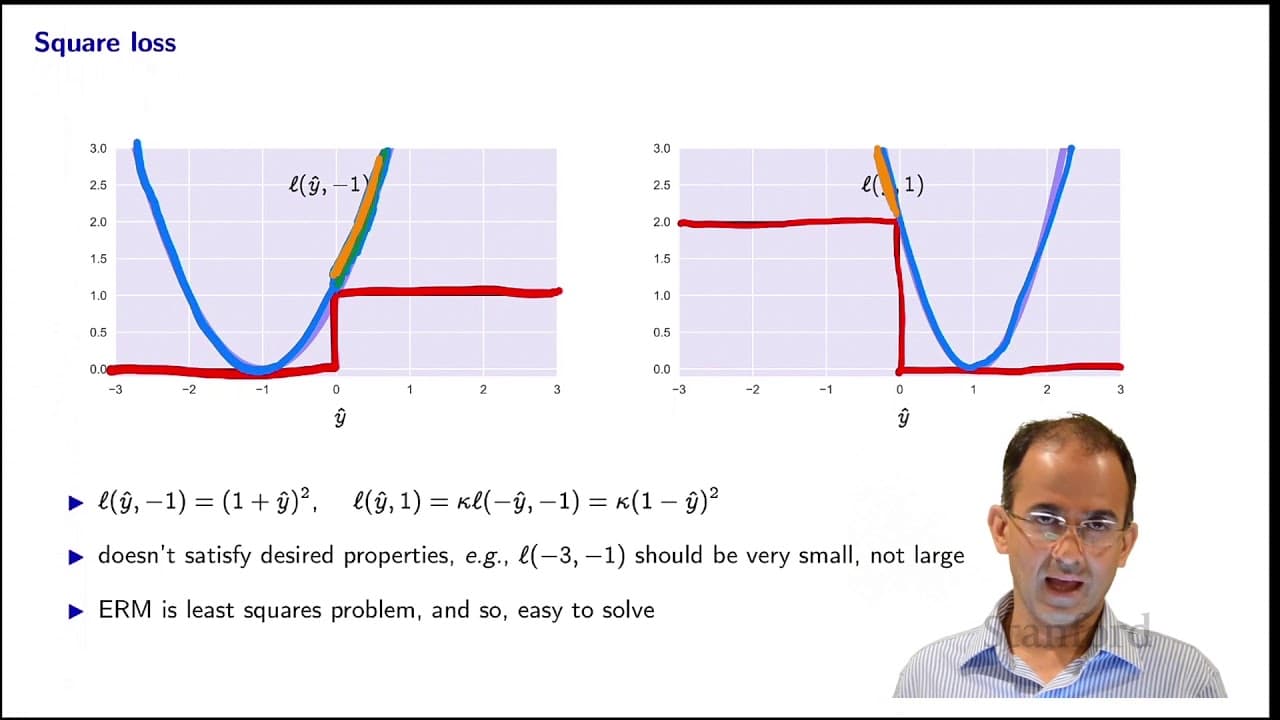
In boolean classification, there are two scalar loss functions: l(y_hat, 1) and l(y_hat, -1), which quantify the loss for a predicted value y_hat when the true value is 1 and -1, respectively.
Q: What are the properties of the square loss function?
The square loss function assigns a higher loss when the predictions deviate from the true value in both positive and negative directions, making it suitable for least squares problems.
Q: What is the name and pearson loss function?
The name and pearson loss function is an ideal loss function for boolean classification, but it is difficult to minimize due to its discontinuities and zero derivatives, making it less commonly used.
Q: What are some commonly used loss functions in boolean classification?
The logistic loss and hinge loss are widely used for boolean classification, as they provide smooth and convex approximations of the name and pearson loss, making them easier to minimize.
Summary & Key Takeaways
-
Boolean classification involves embedding a target variable in a one-dimensional euclidean space and using regularized empirical risk minimization to fit with various loss functions and regularizers.
-
Different loss functions, such as square loss, logistic loss, hinge loss, and hubristic loss, exist for boolean classification, each with its own properties and trade-offs.
-
The logistic loss and hinge loss are commonly used for boolean classification, while the support vector machine is a specific case of hinge loss with square regularization.
Read in Other Languages (beta)
Share This Summary 📚
Summarize YouTube Videos and Get Video Transcripts with 1-Click
Try YouTube Summary with ChatGPT & Claude or YouTube Transcript Generator
Explore More Summaries from Stanford Online 📚

Summarize YouTube Videos and Get Video Transcripts with 1-Click
Try YouTube Summary with ChatGPT & Claude or YouTube Transcript Generator