Biodiversity flourishes in Phanerozoic eon | Cosmology & Astronomy | Khan Academy
TL;DR
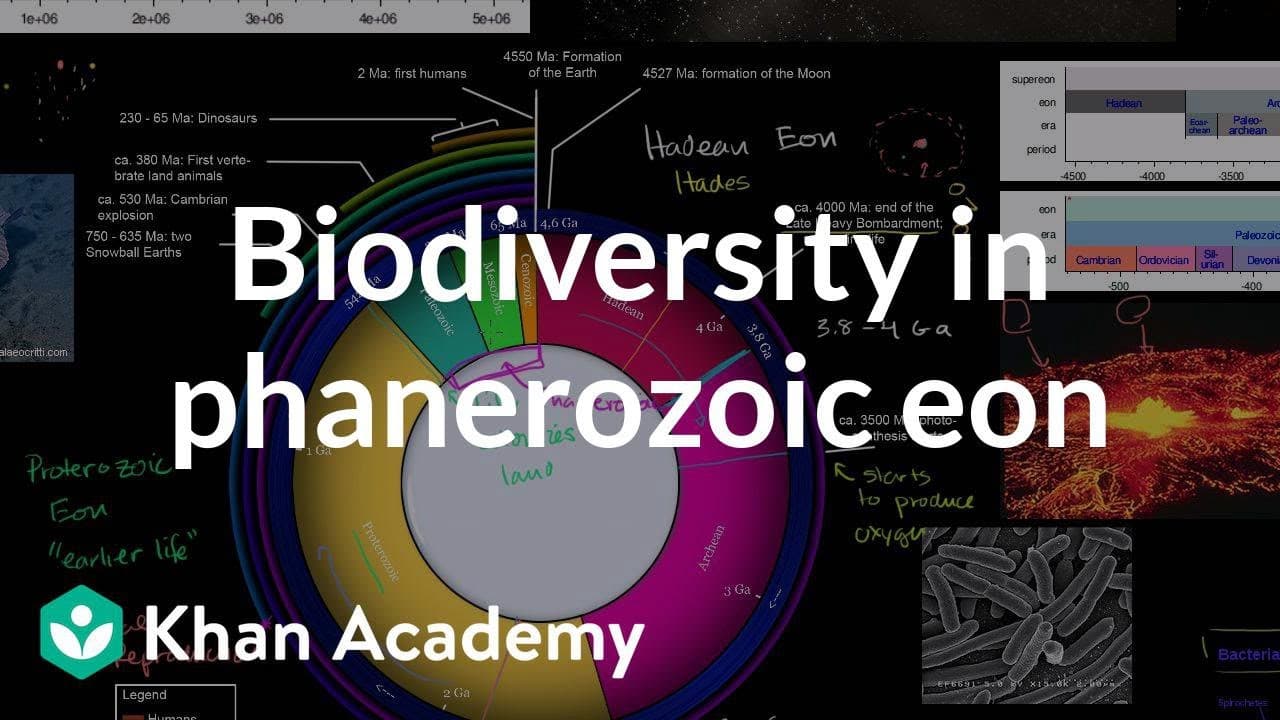
Oxygen accumulation in the atmosphere led to the first snowball Earth, allowing for the development of eukaryotic cells and multicellular organisms. Sexual reproduction accelerated the pace of evolution. The ozone layer enabled life to colonize land. The Cambrian period saw a burst in biodiversity. Humans have only existed for a relatively short time compared to other organisms.
Transcript
The Earth is now starting to get closer to being hospitable to people like us or animals like us. In the last video, we saw during the Proterozoic Eon, oxygen began to accumulate in the atmosphere. This actually caused this first snowball Earth and this mass extinction of all the anaerobic species. But it made conditions suitable for eukaryotic cel... Read More
Key Insights
- 👻 The accumulation of oxygen in the Proterozoic Eon allowed for the development of eukaryotic cells and multicellular organisms.
- 🥺 Sexual reproduction introduced a systematic mixing of DNA, leading to increased variation and faster evolution.
- 🇧🇻 The ozone layer, formed due to oxygen accumulation, enabled life to colonize land and protected it from harmful UV rays.
- ❓ The Cambrian period witnessed a burst in biodiversity, known as the Cambrian Explosion.
- 🫤 Plants colonized land approximately 450 million years ago, while insects appeared around 400 million years ago.
- 🫤 Reptiles emerged about 300 million years ago, followed by the first mammals around 200 million years ago.
- ❤️🩹 The Mesozoic Era, known as the Age of Dinosaurs, ended with a mass extinction caused by a large meteor impact.
Install to Summarize YouTube Videos and Get Transcripts
Explore YouTube Video Summarizer or Get YouTube Transcript Extractor
Questions & Answers
Q: How did oxygen accumulation in the atmosphere affect the Earth during the Proterozoic Eon?
Oxygen accumulation caused the first snowball Earth and mass extinction of anaerobic species, but it also allowed for the development of eukaryotic cells and multicellular organisms.
Q: How did sexual reproduction impact evolution?
Sexual reproduction introduced systematic mixing of DNA, resulting in more variation in the gene pool and accelerating the pace of evolution.
Q: When did life begin to colonize land?
Life started to colonize land around 550 million years ago, coinciding with the development of the ozone layer that protected the land from UV rays.
Q: When did the Cambrian Explosion occur?
The Cambrian Explosion occurred during the Cambrian period, around 540 million years ago, leading to a significant increase in biodiversity on Earth.
Summary & Key Takeaways
-
Oxygen accumulation during the Proterozoic Eon caused the first snowball Earth and mass extinction of anaerobic species, but also enabled the development of eukaryotic cells and multicellular organisms.
-
Sexual reproduction introduced variation in DNA, leading to an acceleration in the pace of evolution.
-
The ozone layer protected the land from UV rays, allowing life to colonize land and marking the appearance of significant life forms.
Read in Other Languages (beta)
Share This Summary 📚
Summarize YouTube Videos and Get Video Transcripts with 1-Click
Try YouTube Summary with ChatGPT & Claude or YouTube Transcript Generator
Explore More Summaries from Khan Academy 📚



Summarize YouTube Videos and Get Video Transcripts with 1-Click
Try YouTube Summary with ChatGPT & Claude or YouTube Transcript Generator