Overview of protein structure | Macromolecules | Biology | Khan Academy
TL;DR
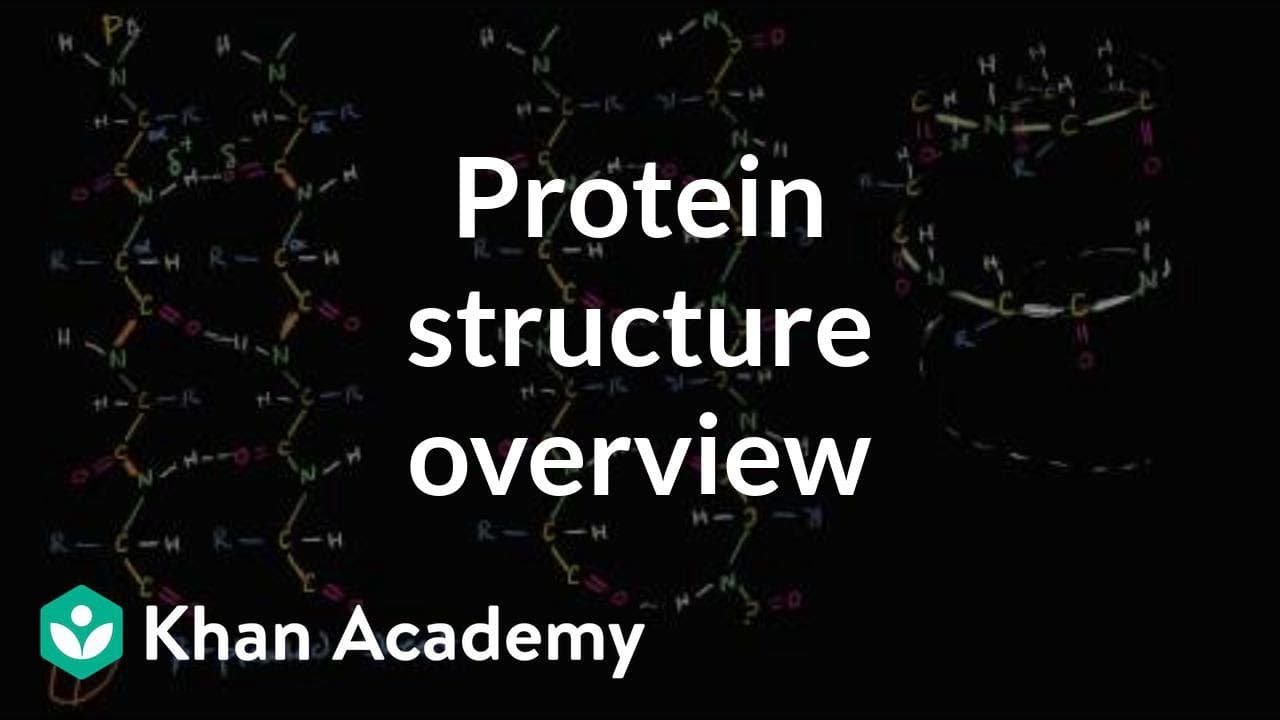
Proteins have different levels of structure, including primary, secondary, tertiary, and quaternary. Each level plays a role in determining protein function.
Transcript
- [Voiceover] We've already spent a lot of time talking about proteins, and how they do a huge variety of things in biological systems, anything from acting as hormones to antibodies to providing structures in cells, signaling mechanism, a whole series of things and their ability to do all of those things in living systems comes out, it's a by-prod... Read More
Key Insights
- 🧡 Proteins have diverse functions, ranging from transportation to signaling, due to their varied structures.
- ❓ The primary structure of a protein is determined by the sequence of nucleotides in the DNA.
- 💁 Secondary structures, such as beta-pleated sheets and alpha helices, form due to interactions between the peptide backbone.
- ⛓️ Tertiary structure is influenced by interactions between the side chains of amino acids.
- ⛓️ The quaternary structure describes the arrangement of multiple polypeptide chains in a protein complex.
- ❓ Understanding protein structure is crucial for understanding protein function and developing treatments and interventions.
- 🏑 Protein structure is a complex and fascinating field of study with numerous applications in biology and medicine.
Install to Summarize YouTube Videos and Get Transcripts
Explore YouTube Video Summarizer or Get YouTube Transcript Extractor
Questions & Answers
Q: What is the primary structure of a protein?
The primary structure refers to the sequence of amino acids in a protein. It is determined by the sequence of nucleotides in DNA and is essential for protein synthesis.
Q: How does the secondary structure of a protein form?
The secondary structure is formed by interactions between the peptide backbone. For example, hydrogen bonds between the electronegative oxygen and hydrogen of neighboring peptide bonds can create structures like beta-pleated sheets and alpha helices.
Q: What determines the tertiary structure of a protein?
The tertiary structure is determined by interactions between the side chains of amino acids. These interactions can include hydrogen bonding, hydrophobic interactions, ionic bonding, and disulfide bond formation.
Q: What is the quaternary structure of a protein?
The quaternary structure refers to how multiple polypeptide chains come together to form a larger protein complex. An example is hemoglobin, which is made up of four polypeptide chains.
Summary & Key Takeaways
-
Proteins have a wide variety of functions in biological systems, including acting as hormones, antibodies, and structural components of cells.
-
Protein structure is essential for protein function, such as the transportation of oxygen by hemoglobin.
-
There are four levels of protein structure: primary (the sequence of amino acids), secondary (interactions of the peptide backbone), tertiary (interactions of side chains), and quaternary (arrangement of multiple polypeptide chains).
Read in Other Languages (beta)
Share This Summary 📚
Summarize YouTube Videos and Get Video Transcripts with 1-Click
Try YouTube Summary with ChatGPT & Claude or YouTube Transcript Generator
Explore More Summaries from Khan Academy 📚



Summarize YouTube Videos and Get Video Transcripts with 1-Click
Try YouTube Summary with ChatGPT & Claude or YouTube Transcript Generator