Therapist explains how to choose a career
TL;DR
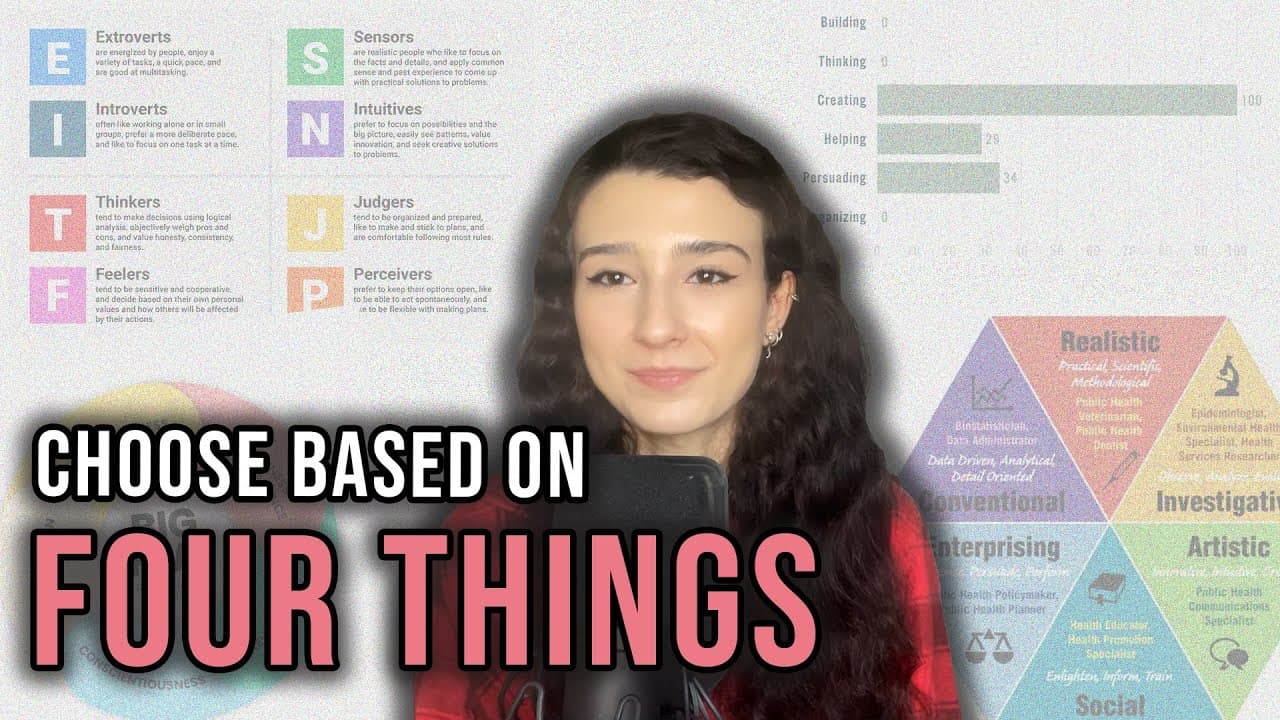
Tips and theories for selecting a suitable career path.
Transcript
hi guys today we're finally talking about a much requested topic which is some tips for helping you pick the right career choice in this video we're going to discuss how career assessment Works to help determine a person's most fitting vocation discuss a few different theories of career development and I'm also going... Read More
Key Insights
- Career assessment involves personality tests, interest inventories, skills assessments, and values assessments to find the best vocational fit.
- Personality tests like MBTI and MMPI can provide insights but should not be sole determinants in career choices.
- Interest inventories, such as those using Holland codes, help identify vocational interests aligning with personal preferences.
- Skills assessments focus on existing competencies, highlighting areas for growth and development in career planning.
- Values assessments ensure alignment between personal values and career requirements, preventing potential conflicts.
- Developmental theories, like Ginsberg's and Sup's, outline career growth stages from childhood fantasies to retirement.
- Trait Factor theories, such as Holland's typology, match personality types with suitable careers for better job satisfaction.
- Social cognitive theory emphasizes the influence of societal modeling and self-efficacy on career decision-making.
Install to Summarize YouTube Videos and Get Transcripts
Explore YouTube Video Summarizer or Get YouTube Transcript Extractor
Questions & Answers
Q: What are the four components of career assessment?
The four components of career assessment are personality tests, interest inventories, skills assessments, and values assessments. These tools help career counselors and individuals identify suitable career paths by evaluating personality traits, interests, abilities, and personal values, ensuring alignment with potential vocational opportunities.
Q: How does the MBTI test relate to career assessment?
The MBTI test is often used in career assessment to provide insights into personality traits that may align with certain vocations. However, it should not be the sole determinant in career decisions due to debates on its validity. It can serve as a starting point for exploring career options rather than a definitive guide.
Q: What is the role of interest inventories in career development?
Interest inventories play a crucial role in career development by assessing an individual's preferences and interests. Tools like the Holland code categorize interests, helping individuals identify careers that align with their passions. This alignment can lead to greater job satisfaction and fulfillment in chosen career paths.
Q: Why are values assessments important in career choice?
Values assessments are vital in career choice as they ensure alignment between an individual's personal values and the values prioritized by a career. Misalignment can lead to dissatisfaction and ethical conflicts, making it crucial to choose careers that resonate with one's core values for long-term success and fulfillment.
Q: What are developmental theories in career development?
Developmental theories in career development, such as Ginsberg's and Sup's, describe the stages individuals go through in their career journey. These stages range from childhood fantasies to career exploration and establishment, highlighting how personal and vocational identities evolve over time, influencing career decisions.
Q: How does Holland's career typology theory work?
Holland's career typology theory categorizes individuals into six personality types: realistic, investigative, artistic, social, enterprising, and conventional. Each type aligns with specific career paths, suggesting that compatibility between one's personality type and career requirements can enhance job satisfaction and performance.
Q: What is social cognitive theory's impact on career decisions?
Social cognitive theory impacts career decisions by emphasizing the role of societal modeling and self-efficacy. Individuals make career choices based on observed behaviors and perceived abilities, influenced by societal messages and personal experiences. This theory highlights the importance of positive role models and self-belief in career success.
Q: What personal advice does the speaker offer about career choices?
The speaker advises against making fear-based career choices and emphasizes the importance of passion-driven decisions. They advocate for lifelong learning and adaptability, suggesting that career paths should evolve with changing interests and circumstances. The speaker encourages pursuing careers that inspire excitement and motivation, rather than avoidance of perceived challenges.
Summary & Key Takeaways
-
The video discusses various methods and theories used in career assessment, including personality tests, interest inventories, and skills assessments, to guide individuals in choosing the right career path.
-
It highlights developmental and trait factor theories, explaining how personal growth stages and personality types influence career selection and satisfaction.
-
The speaker shares personal career advice, emphasizing lifelong learning, passion-driven choices, and avoiding fear-based decisions in career planning.
Read in Other Languages (beta)
Share This Summary 📚
Summarize YouTube Videos and Get Video Transcripts with 1-Click
Try YouTube Summary with ChatGPT & Claude or YouTube Transcript Generator
Explore More Summaries from Psychology with Dr. Ana 📚





Summarize YouTube Videos and Get Video Transcripts with 1-Click
Try YouTube Summary with ChatGPT & Claude or YouTube Transcript Generator