Complementary Angles and Supplementary Angles - Geometry
TL;DR
Learn how to solve geometry problems involving complementary and supplementary angles using algebra.
Transcript
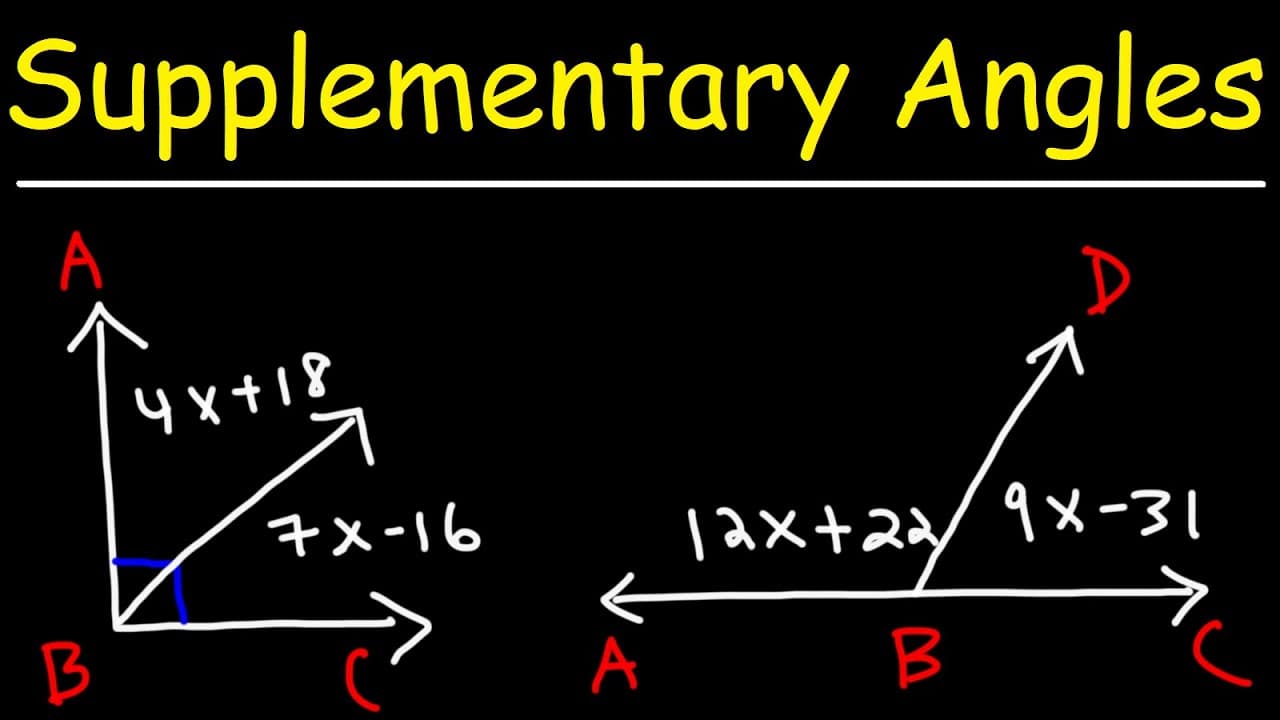
in this video we're going to focus on solving problems associated with complementary and supplementary angles but now let's review complementary angles are angles that add up to 90. supplementary angles are angles that form a linear pair and add up to 180. so in this example the angle ABD which is this angle here it's complementary with this angle ... Read More
Key Insights
- 🔺 Complementary angles are determined when a ray splits a right angle (90 degrees).
- 🔺 Supplementary angles are formed when two angles add up to 180 degrees.
- 🍉 Algebraic operations, such as combining like terms and solving equations, are used to find the value of x.
- 😑 Substituting the value of x into angle expressions allows for the calculation of angle measures.
- 🔺 Linear pairs of angles are always supplementary.
- 🫥 The sum of all angles on a straight line is 180 degrees.
- 🔺 Geometry problems often involve a combination of algebra and angle relationships.
Install to Summarize YouTube Videos and Get Transcripts
Explore YouTube Video Summarizer or Get YouTube Transcript Extractor
Questions & Answers
Q: What do complementary angles and supplementary angles mean?
Complementary angles add up to 90 degrees, while supplementary angles add up to 180 degrees.
Q: How do we determine if two angles are complementary?
Two angles are complementary if the ray between them splits a right angle, meaning they add up to 90 degrees.
Q: How do we find the value of x in these problems?
To find the value of x, we combine like terms, isolate x through algebraic operations, and solve the resulting equation.
Q: How do we calculate the angle measures once we know the value of x?
We substitute the value of x into the expressions given for the angles and simplify to find their respective measures.
Q: Can you explain how to calculate the angle measure for angle ABD in the first example?
Angle ABD is equal to 4x + 18. As x is determined to be 8, substituting it into the equation gives us 4(8) + 18 = 50 degrees.
Q: Why is the second example different from the first?
In the second example, the two angles form a linear pair, making them supplementary and adding up to 180 degrees.
Q: How do we find the missing angle in the third example?
By subtracting the measures of the two known angles (80 and 40 degrees) from 180 degrees, we find that the missing angle, EBC, measures 60 degrees.
Q: Is algebra always necessary to solve problems involving complementary and supplementary angles?
In most cases, algebra is needed to find the value of x or to solve for the angle measures. Algebra allows us to use equations and manipulations to find the unknown values.
Summary & Key Takeaways
-
Complementary angles add up to 90 degrees, and supplementary angles add up to 180 degrees.
-
In the first example, by determining the value of x as 8, the angle measures for ABD and DBC are found to be 50 degrees and 40 degrees, respectively.
-
In the second example, the value of x is calculated as 9, and the angle measures for ABD and DBC are found to be 130 degrees and 50 degrees, respectively.
-
In the third example, by solving for x (7), the angle measures for ABD, EBC, and DBE are found to be 40 degrees, 60 degrees, and 80 degrees, respectively.
Read in Other Languages (beta)
Share This Summary 📚
Summarize YouTube Videos and Get Video Transcripts with 1-Click
Try YouTube Summary with ChatGPT & Claude or YouTube Transcript Generator
Explore More Summaries from The Organic Chemistry Tutor 📚




Summarize YouTube Videos and Get Video Transcripts with 1-Click
Try YouTube Summary with ChatGPT & Claude or YouTube Transcript Generator