Energy Method of Numerical - Free Undamped Single Degree of Freedom Vibration System
TL;DR
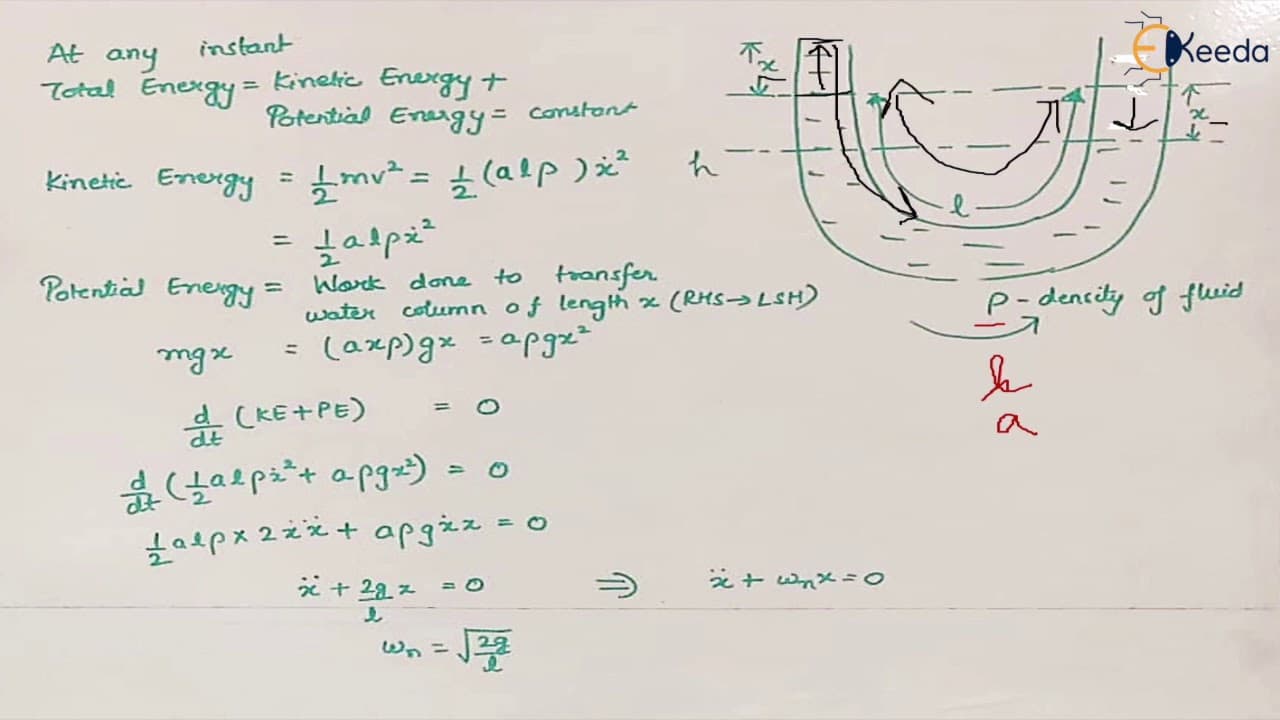
The video explains how to derive the equation of vibration for a water column using the conservation of energy and the concept of potential and kinetic energy.
Transcript
hello everyone in this video we'll discuss a numerical or energy method now the energy equation we have already discussed which says that the total mechanical energy in a system that is the sum of potential and kinetic energy it remains constant and while considering this case we do not take into account any dissipative element so we take we do not... Read More
Key Insights
- 🦾 The total mechanical energy of a system, the sum of potential and kinetic energy, remains constant.
- 💦 The equation of vibration for a water column can be derived by considering factors such as density, length, and area.
- 📳 The conservation of energy can be applied to find the equation of vibration.
- 💦 The water column vibrates due to its potential energy and overshoots the equilibrium position due to its velocity.
- 🫡 The maximum value of the equation can be found by differentiating the kinetic and potential energy with respect to time.
- ‼️ The equation of vibration can be represented as x double dot plus 2g upon l into x equals 0.
- ❓ Comparing the equation with the general equation of Simple Harmonic Motion (SHM) gives the natural frequency.
Install to Summarize YouTube Videos and Get Transcripts
Explore YouTube Video Summarizer or Get YouTube Transcript Extractor
Questions & Answers
Q: What is the main concept discussed in the video?
The main concept discussed in the video is the conservation of energy and how it is used to derive the equation of vibration for a water column.
Q: What factors are considered when deriving the equation of vibration?
The factors considered when deriving the equation of vibration for a water column are the density of the fluid, length of the column, and the area.
Q: What causes the water column to vibrate?
The potential energy of the water column causes it to vibrate. When a force is applied to the column, water displaces above and below the equilibrium position, resulting in oscillations.
Q: How is the equation of vibration derived?
The equation of vibration is derived by applying the conservation of energy, with the kinetic energy and potential energy of the system being equal. Differentiation is used to find the maximum value and derive the equation.
Summary & Key Takeaways
-
The video discusses the energy equation, which states that the total mechanical energy in a system, the sum of potential and kinetic energy, remains constant.
-
By considering certain factors such as density, length, and area, the video explains how a water column vibrates due to its potential energy.
-
The equation of vibration for the water column is derived by applying the conservation of energy and finding the maximum value using differentiation.
Read in Other Languages (beta)
Share This Summary 📚
Summarize YouTube Videos and Get Video Transcripts with 1-Click
Try YouTube Summary with ChatGPT & Claude or YouTube Transcript Generator
Explore More Summaries from Ekeeda 📚

Summarize YouTube Videos and Get Video Transcripts with 1-Click
Try YouTube Summary with ChatGPT & Claude or YouTube Transcript Generator