Polynomial remainder theorem example | Polynomial and rational functions | Algebra II | Khan Academy
TL;DR
The Polynomial Remainder Theorem allows for a simpler way to find the remainder when dividing a polynomial by a given expression.
Transcript
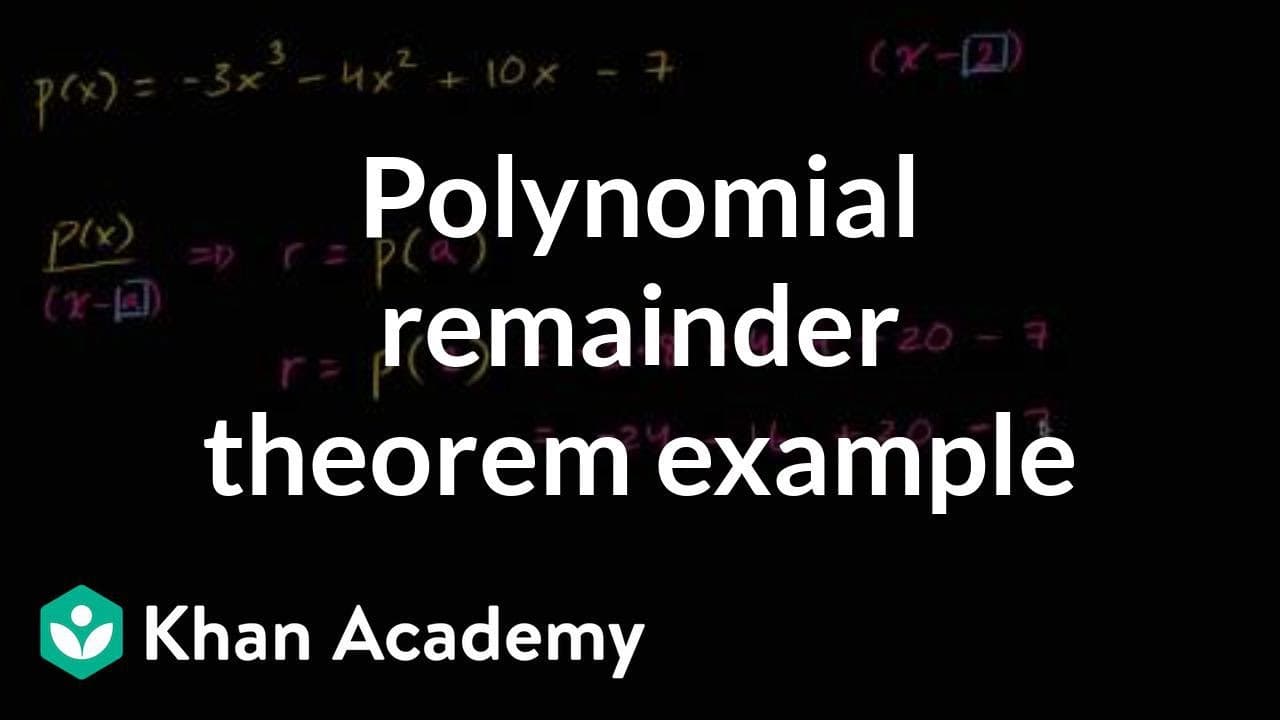
- So we have a polynomial here. What I'm curious about is what is the remainder if I were to divide this polynomial by, let's just say, x minus, I want the remainder when I divide this polynomial by x minus two? You could do this. You could figure this out with algebraic long division, but I'll give you a hint. It is much simpler and much less comp... Read More
Key Insights
- ❓ The Polynomial Remainder Theorem simplifies finding polynomial remainders by evaluating the polynomial at a given value.
- 👾 Algebraic long division is a more computationally intensive and space-consuming method compared to using the Polynomial Remainder Theorem.
- 🈸 The degree of the polynomial doesn't affect the application of the Polynomial Remainder Theorem.
- 💨 The Polynomial Remainder Theorem provides a faster and more efficient way to find remainders, especially when dealing with larger polynomials.
Install to Summarize YouTube Videos and Get Transcripts
Explore YouTube Video Summarizer or Get YouTube Transcript Extractor
Questions & Answers
Q: What is the Polynomial Remainder Theorem?
The Polynomial Remainder Theorem states that when dividing a polynomial by (x-a), the remainder is equal to the value of the polynomial when evaluated at a. It provides a simpler method to find remainders compared to algebraic long division.
Q: How can the remainder be found using the Polynomial Remainder Theorem?
To find the remainder when dividing a polynomial by (x-a), evaluate the polynomial at the value of "a". The result will be the remainder.
Q: What is the benefit of using the Polynomial Remainder Theorem?
The Polynomial Remainder Theorem offers a simpler and less computation-intensive method to find remainders, eliminating the need for lengthy algebraic long division calculations. It saves time and space on paper.
Q: Can the Polynomial Remainder Theorem be used for polynomials of any degree?
Yes, the Polynomial Remainder Theorem can be applied to polynomials of any degree. It provides a general method to find remainders when dividing polynomials by expressions of the form (x-a).
Summary & Key Takeaways
-
The Polynomial Remainder Theorem states that when dividing a polynomial by (x-a), the remainder is equal to the value of the polynomial when evaluated at a.
-
In this case, the polynomial is (-3x^2 + 4x -7), and when dividing it by (x-2), the remainder can be found by evaluating the polynomial at x=2.
-
By using the Polynomial Remainder Theorem, the remainder (-27) can be determined without the need for algebraic long division.
Read in Other Languages (beta)
Share This Summary 📚
Summarize YouTube Videos and Get Video Transcripts with 1-Click
Try YouTube Summary with ChatGPT & Claude or YouTube Transcript Generator
Explore More Summaries from Khan Academy 📚



Summarize YouTube Videos and Get Video Transcripts with 1-Click
Try YouTube Summary with ChatGPT & Claude or YouTube Transcript Generator