Put-call parity arbitrage II | Finance & Capital Markets | Khan Academy
TL;DR
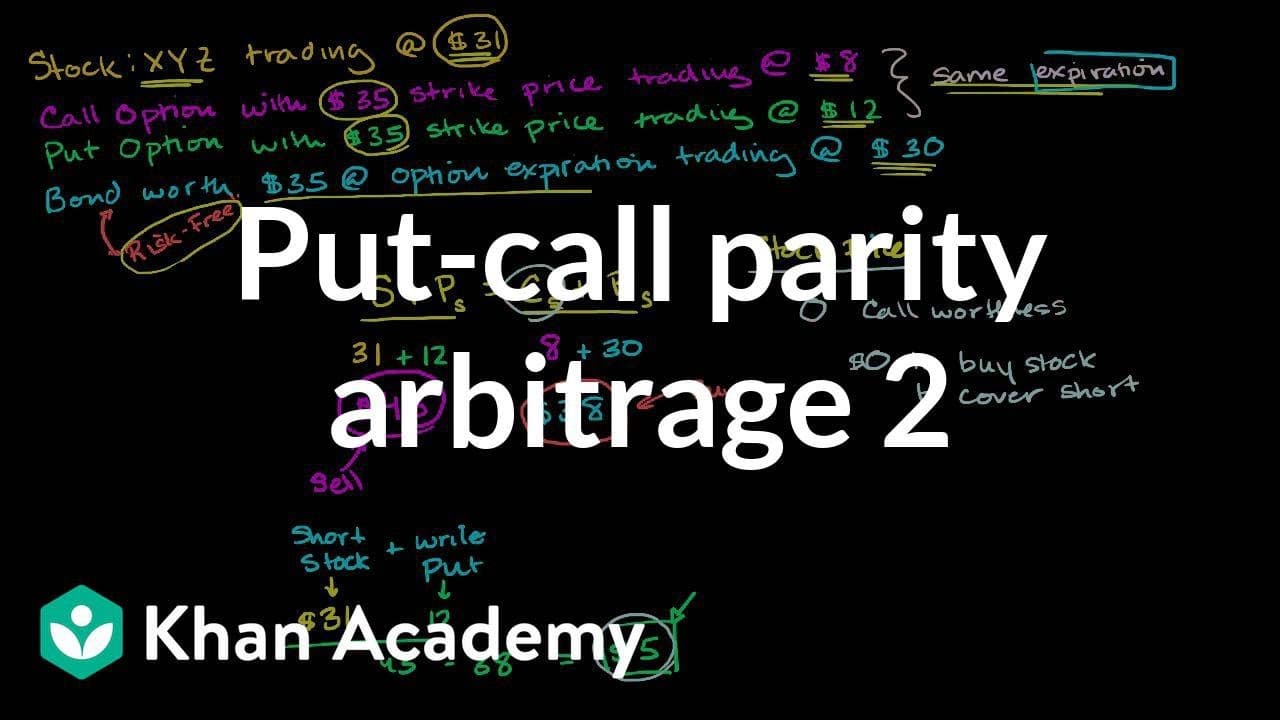
This video explains how a risk-free profit of $5 can be achieved through options trading by covering all possible scenarios for the underlying stock price at option expiration.
Transcript
Voiceover: So, I claimed in the last video that we made a $5 risk-free profit by spending $38 to buy a call and a bond and we got $43 by shorting a stock and essentially writing a put option. What I want to do in this video is verify that we really do have all of our basis covered. So let's just think about all of the different scenarios for the un... Read More
Key Insights
- 🥶 By incorporating different options and positions, it is possible to create a strategy that covers all possible scenarios and ensures a risk-free profit at option expiration.
- 🧘 If the stock price reaches $0, the call option becomes worthless, but the bond can be used to cover the short position, requiring an additional $35 to buy back stock from the put holder.
- 😮 If the stock price rises significantly, the call option and bond can be used to cover the short position, but the cost of buying back stock increases accordingly.
- 🥶 Opportunities for risk-free profits in options trading are uncommon due to the ability of computer programs to quickly exploit these situations.
- 👻 The strategy presented allows for the preservation of the original $5 profit regardless of the stock price at expiration.
- 📔 Careful consideration of options and their values is crucial in ensuring all obligations are covered.
- 🍧 Selling put options entails the risk of having to buy back the stock from the put holder at the strike price.
Install to Summarize YouTube Videos and Get Transcripts
Explore YouTube Video Summarizer or Get YouTube Transcript Extractor
Questions & Answers
Q: How can a risk-free profit be achieved through options trading?
By carefully structuring trades involving a call option, bond, shorting a stock, and writing a put option, it is possible to cover all scenarios and ensure a risk-free profit at option expiration.
Q: What happens if the stock price reaches $0?
In this scenario, the call option becomes worthless, but the short position can be covered without any cost using the bond. However, $35 must be spent to buy back the stock from the put holder.
Q: What happens if the stock price rises to $70?
If the stock price reaches $70, the call option is worth $35, and the bond also becomes worth $35. The put option is worthless, but $70 must be spent to cover the short position.
Q: Are opportunities for risk-free profits common in options trading?
No, such opportunities are rare as computer programs can quickly identify and exploit these arbitrage opportunities, making them less viable in practice.
Summary & Key Takeaways
-
By purchasing a call option and a bond, and simultaneously shorting a stock and writing a put option, a risk-free profit of $5 can be obtained.
-
If the stock price reaches $0, the call becomes worthless, but the short position can be covered without any cost using the bond. Spending $35 is required to buy back the stock from the put holder.
-
If the stock price rises to $70, the call is worth $35, and the bond also becomes worth $35. The put option is worthless, but the short position must be covered by spending $70.
Read in Other Languages (beta)
Share This Summary 📚
Summarize YouTube Videos and Get Video Transcripts with 1-Click
Try YouTube Summary with ChatGPT & Claude or YouTube Transcript Generator
Explore More Summaries from Khan Academy 📚



Summarize YouTube Videos and Get Video Transcripts with 1-Click
Try YouTube Summary with ChatGPT & Claude or YouTube Transcript Generator