How to Analyze One-Dimensional Motion with Calculus
TL;DR
One-dimensional motion can be effectively understood by expressing position as a function of time. Key concepts like position, velocity, and acceleration are introduced, with velocity representing the derivative of position and acceleration the derivative of velocity. The video provides practical examples and graphs to illustrate these relationships over time.
Transcript
- [Instructor] What we're going to do in this video is start to think about how we describe position in one dimension as a function of time. So we could say our position, and we're gonna think about position on the x-axis as a function of time. And we could define it by some expression, let's say, in this situation, it is going to be our time to th... Read More
Key Insights
- 😑 Position on the x-axis can be described using a given expression as a function of time.
- 🧘 The graph of position, velocity, and acceleration provides insights into the motion of an object.
- 🫡 Velocity is the derivative of position, and acceleration is the derivative of velocity, both with respect to time.
Install to Summarize YouTube Videos and Get Transcripts
Explore YouTube Video Summarizer or Get YouTube Transcript Extractor
Questions & Answers
Q: How can we describe position on the x-axis as a function of time?
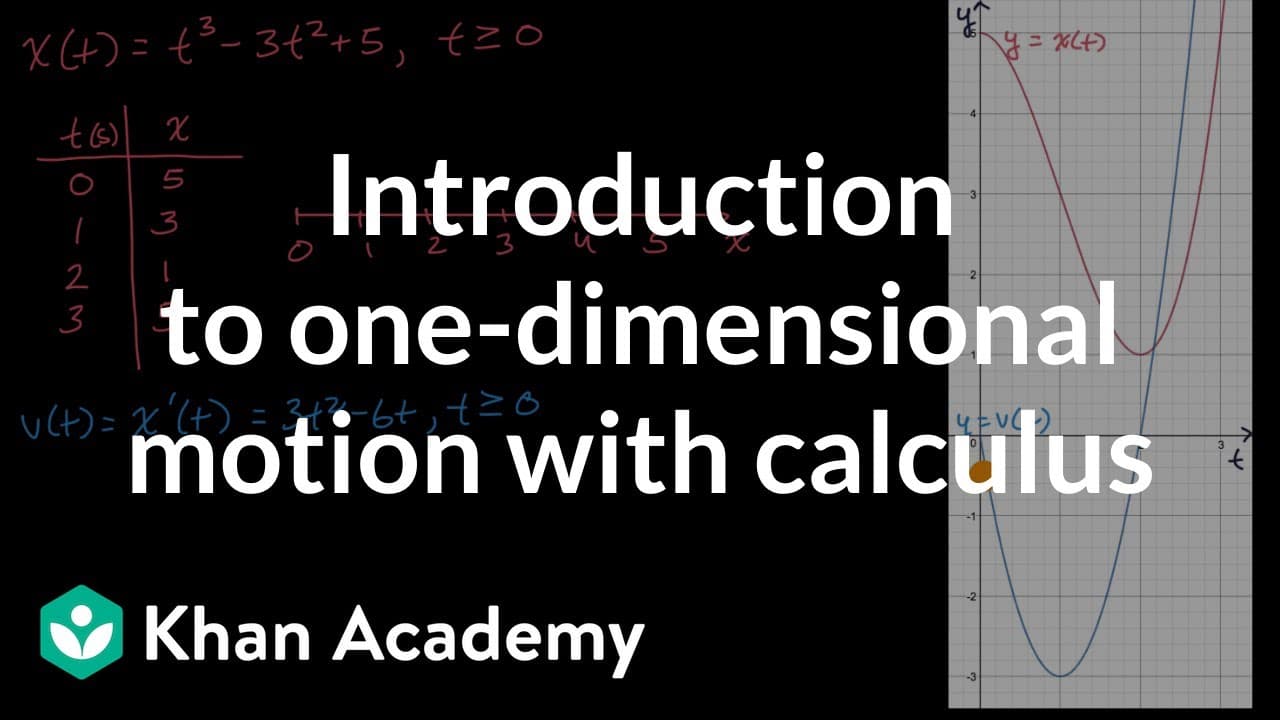
Position on the x-axis can be described as a function of time using a given expression, such as x(t) = t^3 - 3t^2 + 5, where t is time.
Q: What does the graph of position as a function of time look like?
The graph of position as a function of time is a curve that shows the change in position over time. It can be represented on a graph where time is on the x-axis and position is on the y-axis.
Q: How do we calculate velocity as a function of time?
Velocity is calculated as the derivative of position with respect to time. In the given example, the velocity function is v(t) = 3t^2 - 6t.
Q: What does the graph of velocity as a function of time represent?
The graph of velocity as a function of time shows how the velocity of the object changes over time. It indicates whether the object is moving to the left (negative velocity) or to the right (positive velocity).
Q: How is speed different from velocity?
Speed refers to the magnitude of velocity, disregarding its direction. It can be calculated as the absolute value of velocity.
Q: How can we calculate acceleration as a function of time?
Acceleration is calculated as the derivative of velocity with respect to time. In the given example, the acceleration function is a(t) = 6t - 6.
Q: How does the graph of acceleration change over time?
The graph of acceleration as a function of time shows how the acceleration of the object changes. In the given example, it starts with a negative acceleration, then becomes positive.
Q: What does a positive acceleration represent?
A positive acceleration indicates that the object is speeding up or changing direction in a positive direction along the x-axis.
Summary & Key Takeaways
-
The video explains how to describe position on the x-axis as a function of time using a given expression.
-
It demonstrates how to create a table to understand the position at different times.
-
It showcases the graph of position, velocity, and acceleration as functions of time.
Read in Other Languages (beta)
Share This Summary 📚
Summarize YouTube Videos and Get Video Transcripts with 1-Click
Try YouTube Summary with ChatGPT & Claude or YouTube Transcript Generator
Explore More Summaries from Khan Academy 📚



Summarize YouTube Videos and Get Video Transcripts with 1-Click
Try YouTube Summary with ChatGPT & Claude or YouTube Transcript Generator