“Do” Questions & Negatives – DO, DOES, DON’T, DOESN’T
TL;DR
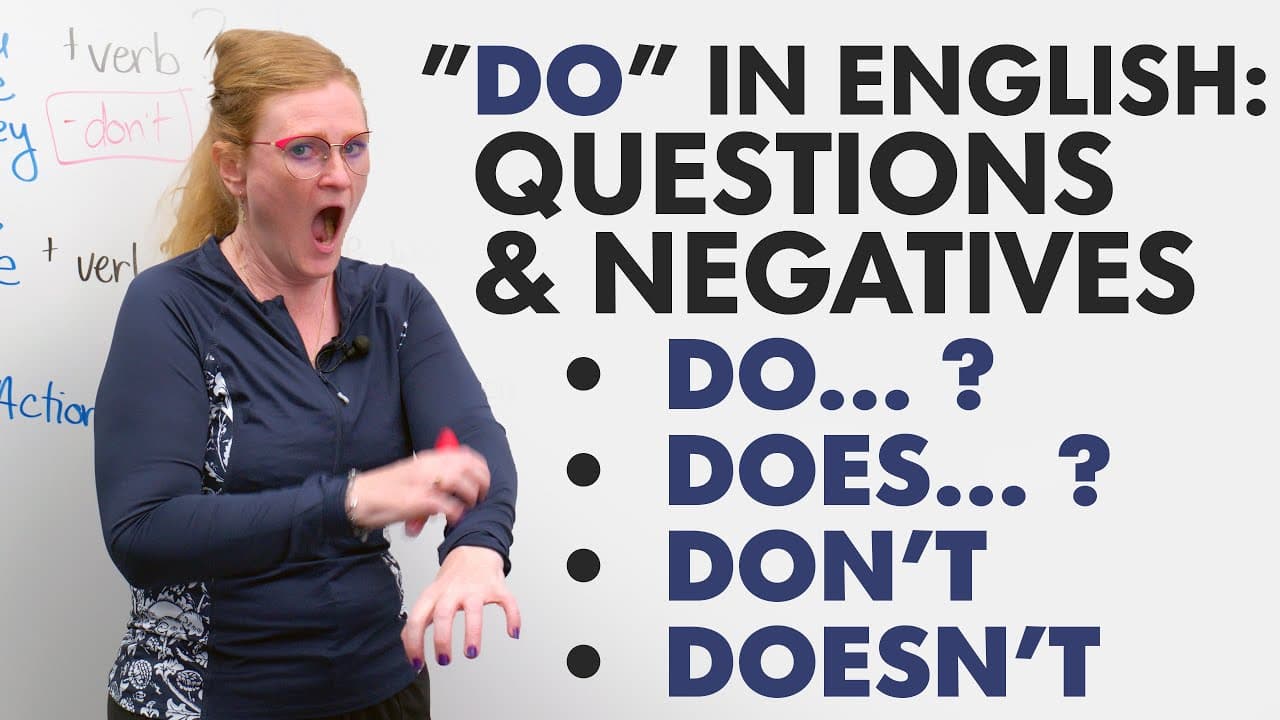
Ronnie explains the correct usage of the verb "do" in everyday actions and opinions, emphasizing the importance of subject agreement.
Transcript
Hi there. My name's Ronnie, and I have a question for you. Do you like traveling? I do. And let's play a fun little game. I'm going to spin the globe - this thing's called a globe - and wherever my finger lands, I shall go there next. I can close my eyes, too, to make it also more dramatic. Oh, it looks like I'm going to South America. Wow. Looks l... Read More
Key Insights
- ❓ The verb "do" is used to talk about everyday actions and opinions.
- ⁉️ Subject agreement is crucial when using "do" in questions.
- ❓ Subjects "I", "you", "we", and "they" require the use of "do" in the question form, while subjects "he", "she", and "it" require "does".
- 💁 The negative forms of "do" are "don't" for subjects "I", "you", "we", and "they" and "doesn't" for subjects "he", "she", and "it".
Install to Summarize YouTube Videos and Get Transcripts
Explore YouTube Video Summarizer or Get YouTube Transcript Extractor
Questions & Answers
Q: What is the proper way to form questions using the verb "do"?
When the subject is "I", "you", "we", or "they", use "do" in the question form. For example, "Do you like traveling?" is correct.
Q: How should questions be formed when the subject is "he", "she", or "it"?
When the subject is "he", "she", or "it", use "does" in the question form. For instance, "Does he want a beer?" is the correct way to ask the question.
Q: What is the negative form of "do" for subjects like "I", "you", "we", and "they"?
The negative form for these subjects is "don't". For example, "I don't want a beer."
Q: How is the negative form of "do" formed for subjects such as "he", "she", and "it"?
The negative form for these subjects is "doesn't". For instance, "He doesn't want a beer."
Summary & Key Takeaways
-
Ronnie introduces the verb "do" and its use in everyday actions and opinions, highlighting subject agreement.
-
He explains that for subjects "I", "you", "we", and "they", the question form uses "do". For subjects "he", "she", and "it", the question form uses "does".
-
Ronnie emphasizes the negative form of "do" and "does" using "don't" and "doesn't", respectively.
-
He encourages practicing conversations in English by asking questions about opinions and everyday actions.
Read in Other Languages (beta)
Share This Summary 📚
Summarize YouTube Videos and Get Video Transcripts with 1-Click
Try YouTube Summary with ChatGPT & Claude or YouTube Transcript Generator
Explore More Summaries from English with Ronnie · EnglishLessons4U with engVid 📚






Summarize YouTube Videos and Get Video Transcripts with 1-Click
Try YouTube Summary with ChatGPT & Claude or YouTube Transcript Generator