Case III Analysis of Short Fin - Extended Surfaces - Heat Transfer
TL;DR
This video discusses the analysis of short fins in heat transfer, including the differential equation, boundary conditions, and temperature distribution.
Transcript
click the bell icon to get latest videos from ekeeda hello friends previously we had seen the analysis of fins and the three cases now let us consider the third case that is the analysis of short fins in this case now in the third case we have considered the fin is having some infinite length and so it is a short fin and in this case what we are go... Read More
Key Insights
- ☺️ Short fins in heat transfer analysis have an infinite length, and the heat conducted at x=l is entirely convected.
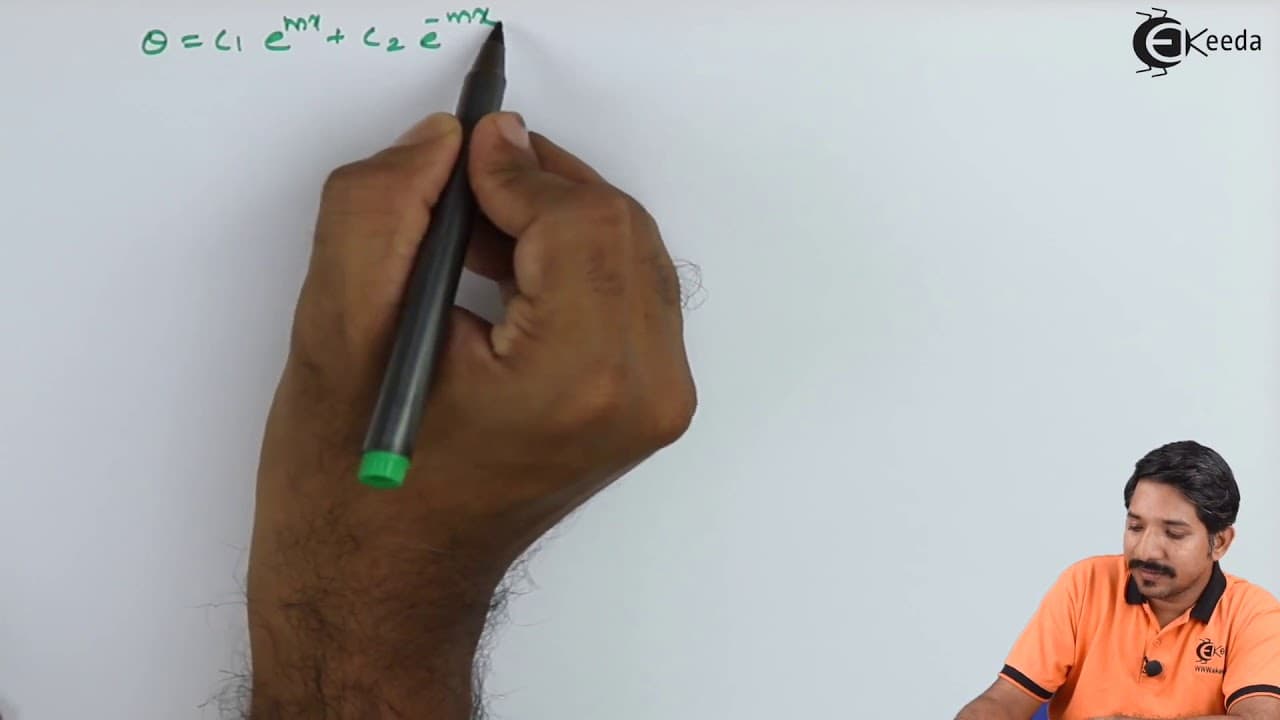
- 🖐️ The differential equation for short fin analysis is d^2θ/dx^2 - m^2θ = 0, and the solution is θ = c1e^(mx) + c2e^(-mx).
- ☺️ Boundary conditions at x=0 and x=l determine the temperature distribution and heat transfer rate.
Install to Summarize YouTube Videos and Get Transcripts
Explore YouTube Video Summarizer or Get YouTube Transcript Extractor
Questions & Answers
Q: What are the boundary conditions for the analysis of short fins?
The first boundary condition is that at x=0, the temperature (θ) is equal to θ0, which can be written as θ0 = t0 - t∞. The second boundary condition is that at x=l, the heat conducted is completely convected, expressed as -kA(dθ/dx) = hAθ.
Q: How is the temperature distribution expressed in the third case of the analysis?
In the third case, the temperature distribution is given by cosh(h/mk), where h is the convective heat transfer coefficient, m is a constant, and k is the thermal conductivity of the fin material.
Q: What is the significance of the heat transfer rate in the analysis of short fins?
The heat transfer rate, expressed as q' = √(hpkaθ0) tanh(ml) + (h/(1 + h/mk)), determines the efficiency of heat transfer in short fins and accounts for both conduction and convection effects.
Q: How does the temperature distribution change in the presence of convection?
The temperature distribution shows a small drop due to convection, indicating that the heat transfer by conduction is slightly affected by the convective heat transfer at the surface of the fin.
Summary & Key Takeaways
-
The video covers the analysis of short fins, considering that the fin has an infinite length and the heat conducted at x=l is completely convected.
-
The differential equation for this analysis is d^2θ/dx^2 - m^2θ = 0, and the solution is θ = c1e^(mx) + c2e^(-mx).
-
The boundary conditions are defined at x=0 and x=l, and the temperature distribution and heat transfer rate are derived based on these conditions.
Read in Other Languages (beta)
Share This Summary 📚
Summarize YouTube Videos and Get Video Transcripts with 1-Click
Try YouTube Summary with ChatGPT & Claude or YouTube Transcript Generator
Explore More Summaries from Ekeeda 📚






Summarize YouTube Videos and Get Video Transcripts with 1-Click
Try YouTube Summary with ChatGPT & Claude or YouTube Transcript Generator