Stanford Seminar - Towards Generalizable Autonomy: Duality of Discovery & Bias
TL;DR
The speaker discusses the importance of structure and learning in robotics, emphasizing the need for object-oriented representations, task-aware objectives, and causal generative models to achieve generalized robotic systems.
Transcript
I think this is wonderful it's always wonderful to be back at Stanford so many familiar faces and I'm honored to be a speaker here today uh as a history of the seminar I was involved when the seminar was started initially uh with with Michael uh when we we started this in double A for those of you who joined us and for those of you who might be joi... Read More
Key Insights
- 🧡 Structure and learning are crucial for building generalized robotic systems capable of performing a wide range of tasks.
- ❓ Object-oriented representations and affordances enhance perception and manipulation tasks in robotics.
- ❓ Task-aware objectives in model learning improve decision-making and enable adaptive behavior.
- ❓ Causal generative models enhance learning from imitation and facilitate effective imitation of human behavior.
Install to Summarize YouTube Videos and Get Transcripts
Explore YouTube Video Summarizer or Get YouTube Transcript Extractor
Questions & Answers
Q: How do structured models improve object-oriented perception in robotics?
Structured models, such as slot attention and geometric mating, enable the understanding of object-level representations and affordances. These models provide prior knowledge about relationships between objects and help in predicting and completing object shapes accurately.
Q: What is the advantage of using slot attention for dynamics modeling in robotic systems?
Slot attention allows for the creation of semantically consistent representations of scenes and objects. This enables the prediction of future dynamics and facilitates online planning and decision-making with abstract actions.
Q: How does task-aware model learning improve decision-making in robotics?
Task-aware model learning focuses on objectives that are relevant to the task at hand, rather than general prediction objectives. By incorporating task-specific knowledge, decision-making algorithms can optimize performance and adapt to different environments more effectively.
Q: Can the concept of causal generative models be used to improve learning from imitation in robotics?
Yes, causal generative models can enable robots to understand the significance and purpose of tasks being performed by humans. By learning abstract actions and modeling task dynamics, robots can imitate human behavior more accurately and generalize to new situations.
Summary & Key Takeaways
-
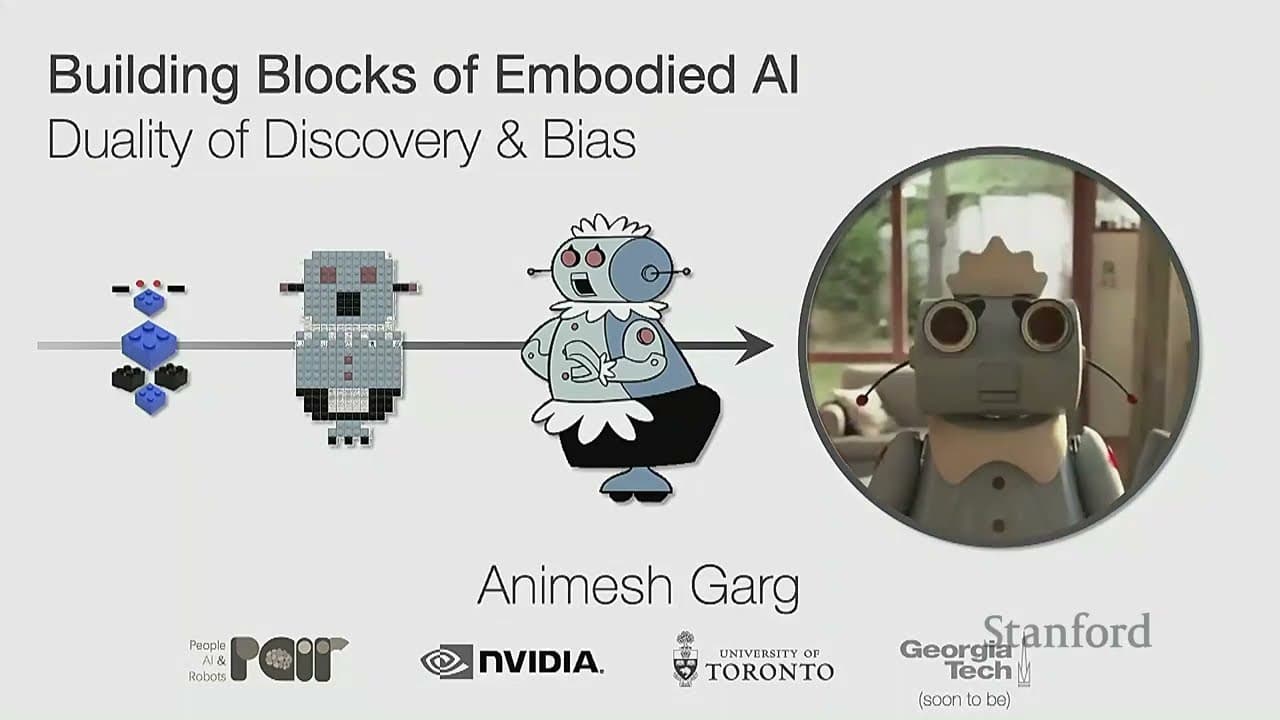
The speaker introduces the concept of building robots capable of performing general tasks like Rosie from The Jetsons, emphasizing the challenges and slow progress in this area.
-
They highlight the study of reasoning and control for embodied systems as a two-stage process: understanding task specifications and generalizing from those specifications to different settings.
-
The speaker presents various research projects focused on object-oriented perception, learning from imitation, and decision-making in robotics.
Read in Other Languages (beta)
Share This Summary 📚
Summarize YouTube Videos and Get Video Transcripts with 1-Click
Try YouTube Summary with ChatGPT & Claude or YouTube Transcript Generator
Explore More Summaries from Stanford Online 📚

Summarize YouTube Videos and Get Video Transcripts with 1-Click
Try YouTube Summary with ChatGPT & Claude or YouTube Transcript Generator