What Is the Differentiation Property of the Z-Transform?
TL;DR
The differentiation property of the Z-transform allows you to analyze a signal multiplied by 'n' by relating it to the first derivative of its Z-transform. This property is essential for understanding signal behavior and is crucial for performing inverse Z-transform calculations, particularly with repeated poles.
Transcript
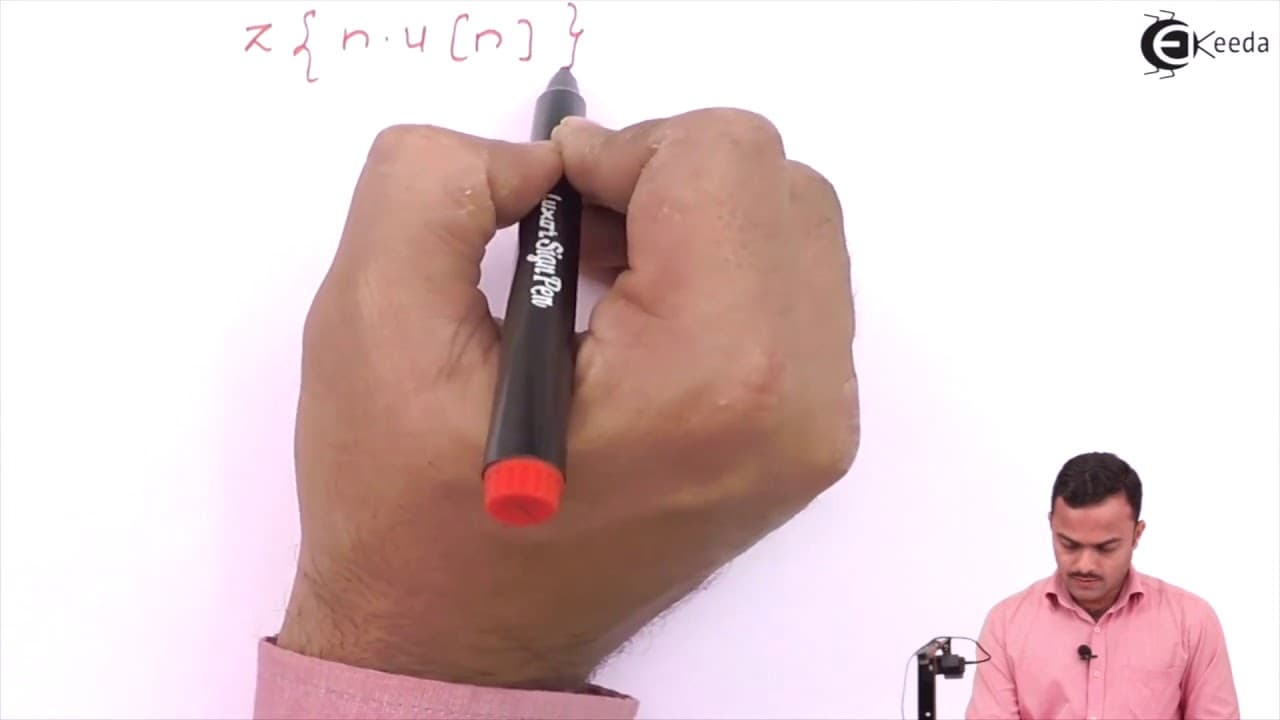
hi friends in this video we are going to see a differentiation in the z domain property of z transfer it says signal x of n with z transform is x of z with r ocr getting multiplied with n then z transformability minus z d by d z of x of c with roc r let's take an example just have x of an once again a simple function u of n so z transform will be 1... Read More
Key Insights
- 🤪 The video explains the differentiation property of Z-transform, which allows us to analyze signals with derivatives.
- 🤪 Applying the differentiation property can help in understanding the behavior of signals and performing inverse Z-transform calculations.
Install to Summarize YouTube Videos and Get Transcripts
Explore YouTube Video Summarizer or Get YouTube Transcript Extractor
Questions & Answers
Q: What is the differentiation property of Z-transform?
The differentiation property states that if a signal 'x(n)' has a Z-transform 'X(z)', then the Z-transform of 'n * x(n)' is equal to '-z * dX(z)/dz'.
Q: What is the significance of the differentiation property in signal analysis?
The differentiation property allows us to compute the Z-transform of signals with derivatives, which is important in various signal processing applications such as system analysis and filter design.
Q: Can you give an example of applying the differentiation property?
Sure, if we have a signal 'u(n)' with a Z-transform '1/(1-z^(-1))', then the Z-transform of 'n * u(n)' is '-z/(z-1)^2'. This can be useful in understanding the behavior of the signal and performing inverse Z-transform calculations.
Q: Why is it important to recognize the multiplication of signals by 'n' in Z-transform calculations?
Recognizing the multiplication of signals by 'n' is important because it affects the Z-transform representation, especially when dealing with repeated poles. Failure to account for this multiplication can lead to incorrect results in inverse Z-transform calculations.
Summary & Key Takeaways
-
The video discusses the differentiation property of Z-transform and its application in signal analysis.
-
It explains how to obtain the Z-transform of a signal multiplied by 'n' and discusses its significance.
-
An example is given to show how to relate the Z-transform of a signal with its first derivative.
Read in Other Languages (beta)
Share This Summary 📚
Summarize YouTube Videos and Get Video Transcripts with 1-Click
Try YouTube Summary with ChatGPT & Claude or YouTube Transcript Generator
Explore More Summaries from Ekeeda 📚


Summarize YouTube Videos and Get Video Transcripts with 1-Click
Try YouTube Summary with ChatGPT & Claude or YouTube Transcript Generator