Representing vectors in rn using subspace members | Linear Algebra | Khan Academy
TL;DR
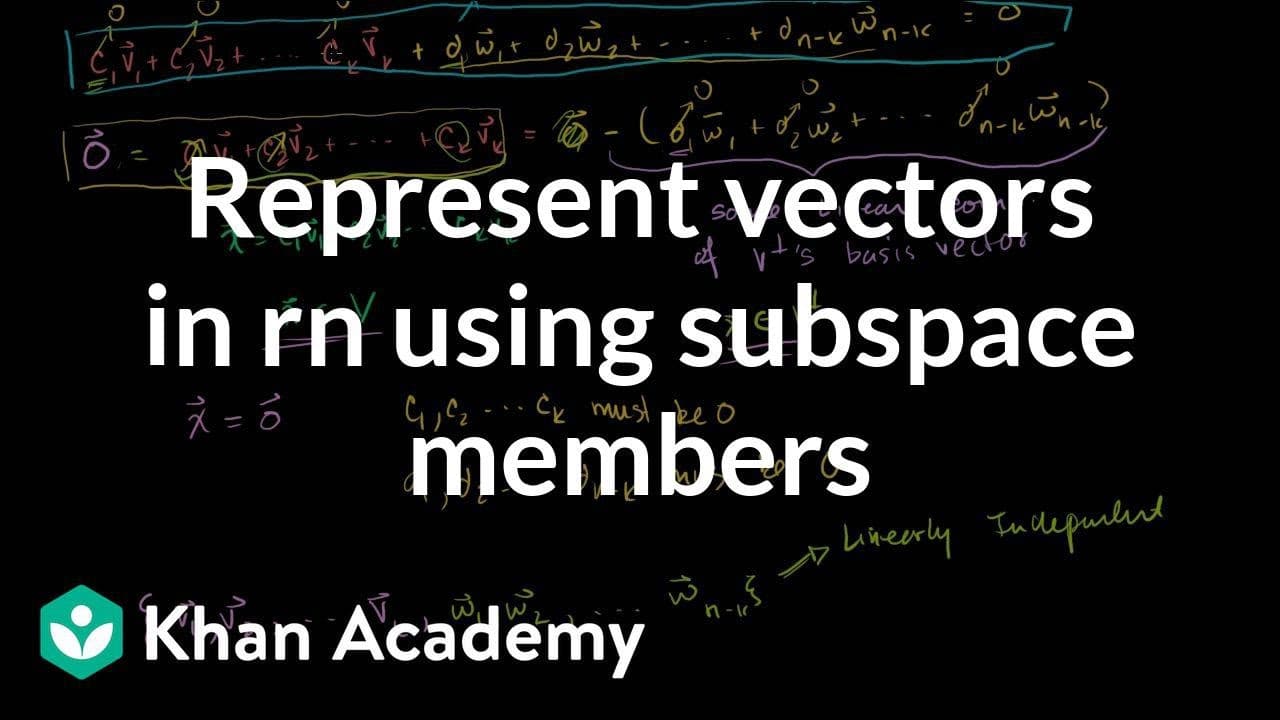
The intersection between a subspace and its orthogonal complement is only the zero vector, and any vector in Rn can be represented as the sum of a vector in the subspace and a vector in its orthogonal complement.
Transcript
Let's say I have some subspace V, that is a subset of Rn. And let's say that we also have its orthogonal complement, we write that as V perp. That'll also be a subset of Rn. A couple of videos ago, it might have even been the last video if I remember properly, we learned that the dimension of V, plus the dimension of the orthogonal complement of V,... Read More
Key Insights
- 👾 The dimension of a subspace plus the dimension of its orthogonal complement is equal to the dimension of the space.
- 0️⃣ The only vector common to a subspace and its orthogonal complement is the zero vector.
- 😑 Any vector in Rn can be expressed as the sum of a vector in a subspace and a vector in its orthogonal complement.
- 🍹 The representation of a vector in Rn as the sum of a subspace vector and an orthogonal complement vector is unique.
- 😫 Any member of a subspace and its orthogonal complement are linearly independent sets.
- 😫 The union of basis vectors from a subspace and its orthogonal complement form a linearly independent set in Rn.
Install to Summarize YouTube Videos and Get Transcripts
Explore YouTube Video Summarizer or Get YouTube Transcript Extractor
Questions & Answers
Q: What is the relationship between the dimension of a subspace and the dimension of its orthogonal complement?
The dimension of a subspace V plus the dimension of its orthogonal complement V perp is equal to the dimension of the space Rn. This relationship holds in any n-dimensional space.
Q: What is the intersection between a subspace and its orthogonal complement?
The only vector that is a member of both a subspace V and its orthogonal complement V perp is the zero vector. There are no other common vectors between the two subspaces.
Q: Can any vector in Rn be represented as a sum of a vector in a subspace and a vector in its orthogonal complement?
Yes, any vector in Rn can be expressed as the sum of a vector in a subspace V and a vector in its orthogonal complement V perp. This property holds for any arbitrary vector in Rn.
Q: Is the representation of a vector in Rn as the sum of a subspace vector and an orthogonal complement vector unique?
Yes, the representation of a vector in Rn as the sum of a vector in a subspace V and a vector in its orthogonal complement V perp is unique. There is only one way to construct this representation, and the coefficients for each vector must be set to zero.
Summary & Key Takeaways
-
The dimension of a subspace V plus the dimension of its orthogonal complement V perp is equal to the dimension of Rn.
-
The intersection between V and V perp is only the zero vector.
-
Any vector in Rn can be represented as the sum of a vector in V and a vector in V perp.
Read in Other Languages (beta)
Share This Summary 📚
Summarize YouTube Videos and Get Video Transcripts with 1-Click
Try YouTube Summary with ChatGPT & Claude or YouTube Transcript Generator
Explore More Summaries from Khan Academy 📚



Summarize YouTube Videos and Get Video Transcripts with 1-Click
Try YouTube Summary with ChatGPT & Claude or YouTube Transcript Generator