Important Math Proof: The Set of Equivalence Classes Partition a Set
TL;DR
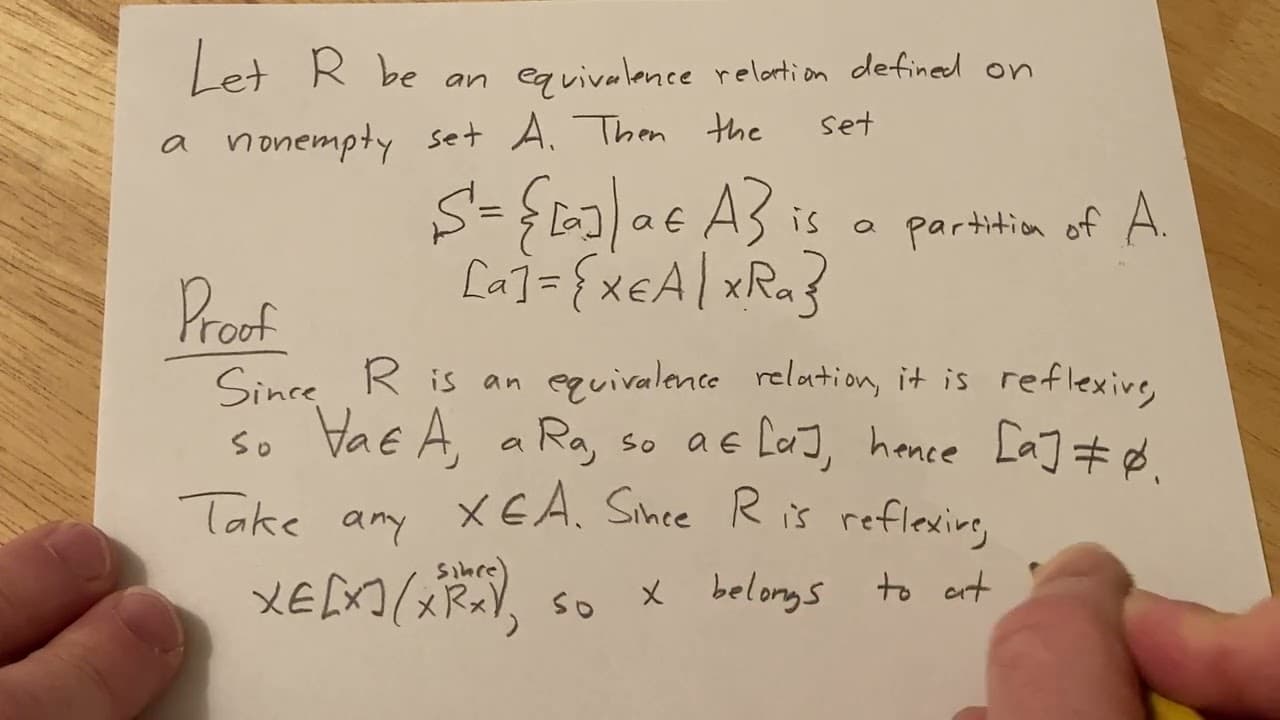
Equivalence classes partition a set under an equivalence relation.
Transcript
hello in this video we're going to do a very important proof we're going to prove that when you have an equivalence relation on a non-empty set that the equivalence classes partition your set so what does that mean that basically means that every element in our set a belongs to exactly one equivalence class and all of these are also not empty so a ... Read More
Key Insights
- 🥺 Equivalence relations lead to the formation of equivalence classes.
- 👍 Reflexivity, symmetry, and transitivity are crucial properties in proving equivalence relations.
- 😫 Equivalence classes are non-empty and form a partition of the set.
- 🏛️ Elements belong to exactly one equivalence class, showcasing the uniqueness of the partition.
- 🏛️ Disjoint equivalence classes ensure each element is only part of one class.
- 👥 Equivalence classes have applications in group theory and topology.
- ❓ Understanding equivalence relations is fundamental in exploring structures in mathematics.
Install to Summarize YouTube Videos and Get Transcripts
Explore YouTube Video Summarizer or Get YouTube Transcript Extractor
Questions & Answers
Q: What is the significance of equivalence classes in set theory?
Equivalence classes group elements based on a relation, allowing for structural analysis and partitioning of the set.
Q: How does reflexivity ensure non-empty equivalence classes?
Reflexivity ensures every element is related to itself, guaranteeing non-emptiness of equivalence classes.
Q: Why is symmetry essential in proving the uniqueness of equivalence classes?
Symmetry allows for relationships between elements to be reversible, crucial in demonstrating the uniqueness of equivalence classes.
Q: How does transitivity help prove that elements belong to a single equivalence class?
Transitivity shows that if two elements are related to a common element, they must also be related to each other, establishing uniqueness of equivalence classes.
Summary & Key Takeaways
-
Equivalence classes in a set result from an equivalence relation.
-
Each element in the set belongs to a unique equivalence class.
-
The proof establishes non-empty, disjoint equivalence classes forming a partition of the set.
Read in Other Languages (beta)
Share This Summary 📚
Summarize YouTube Videos and Get Video Transcripts with 1-Click
Try YouTube Summary with ChatGPT & Claude or YouTube Transcript Generator
Explore More Summaries from The Math Sorcerer 📚


Summarize YouTube Videos and Get Video Transcripts with 1-Click
Try YouTube Summary with ChatGPT & Claude or YouTube Transcript Generator