How Does pH Affect Enzyme Reaction Velocity?
TL;DR
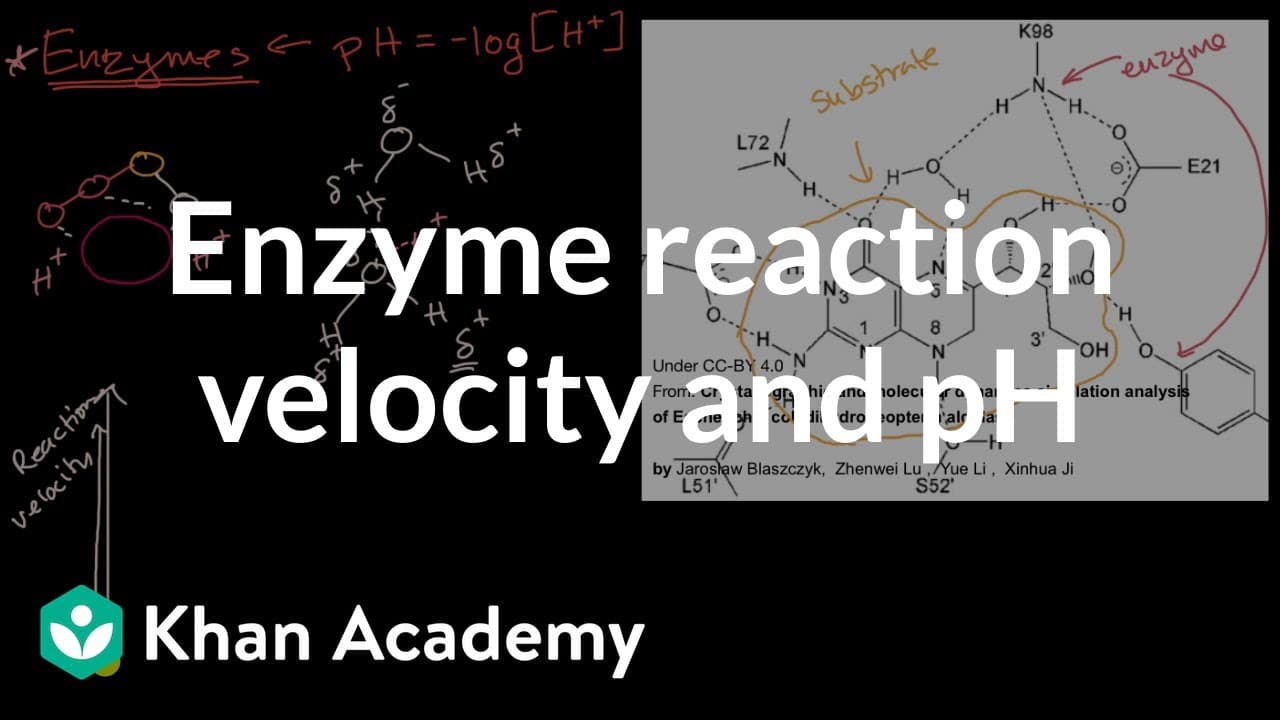
pH significantly influences enzyme reaction velocity by altering enzyme shape and hydrogen bonding interactions. Different enzymes have optimal activity at specific pH levels: some perform best in acidic conditions, while others thrive in neutral or basic environments. Understanding these variations is crucial in biological processes and practical applications.
Transcript
- [Instructor] In this video, we're gonna talk about enzymes. And in particular, we're going to talk about the effect of pH on enzymes, how acidic or basic the environment is, how that affects enzyme activity. So just as a bit of a review, enzymes are molecules that help catalyze various reactions, and they are all throughout biological systems. Mo... Read More
Key Insights
- ❓ Enzymes are crucial for catalyzing reactions in biological systems, and their structure relies on hydrogen bonding.
- 💠 Hydrogen bonds interact with both enzymes and substrates, shaping the enzyme and facilitating substrate binding.
- 🥺 pH levels can alter enzyme activity by affecting hydrogen bonding, leading to differences in reaction velocities.
- 😥 Enzymes can exhibit different optimal activities at different pH levels, depending on their natural environment or function.
- 😥 Understanding pH's effect on enzymes is important for studying biological processes and developing therapeutic interventions.
- 😥 Enzymes like lipase demonstrate varying optimal activities at different pH levels, depending on their location in the body.
- ♻️ Acidic environments may benefit certain enzymes, while neutral or basic environments may favor others.
Install to Summarize YouTube Videos and Get Transcripts
Explore YouTube Video Summarizer or Get YouTube Transcript Extractor
Questions & Answers
Q: What are enzymes, and what is their structure based on?
Enzymes are proteins that catalyze reactions. Their structure is based on chains of amino acids, which form primary and secondary structures through hydrogen bonding.
Q: How do hydrogen bonds interact with enzymes and substrates?
Hydrogen bonds between the enzyme and substrate help define the enzyme's shape and allow it to interact with the substrate, facilitating catalytic reactions.
Q: What is pH, and how does it affect enzyme activity?
pH, the negative logarithm of hydrogen ion concentration, can influence enzyme activity by disrupting or enhancing hydrogen bonds, thereby altering the enzyme's shape and its ability to interact with substrates.
Q: Do different enzymes have different activity levels at different pH levels?
Yes, enzymes exhibit different optimal activities at various pH levels. Some enzymes perform better in acidic environments, while others thrive in neutral or basic conditions, depending on their natural habitat or function.
Summary & Key Takeaways
-
Enzymes are proteins that catalyze reactions in biological systems, with their structure dependent on hydrogen bonding.
-
Hydrogen bonds not only define the shape of the enzyme but also interact with the substrate it acts upon.
-
pH levels affect the enzyme's shape by influencing hydrogen bonding, leading to different enzyme activities at different pH levels.
Read in Other Languages (beta)
Share This Summary 📚
Summarize YouTube Videos and Get Video Transcripts with 1-Click
Try YouTube Summary with ChatGPT & Claude or YouTube Transcript Generator
Explore More Summaries from Khan Academy 📚



Summarize YouTube Videos and Get Video Transcripts with 1-Click
Try YouTube Summary with ChatGPT & Claude or YouTube Transcript Generator