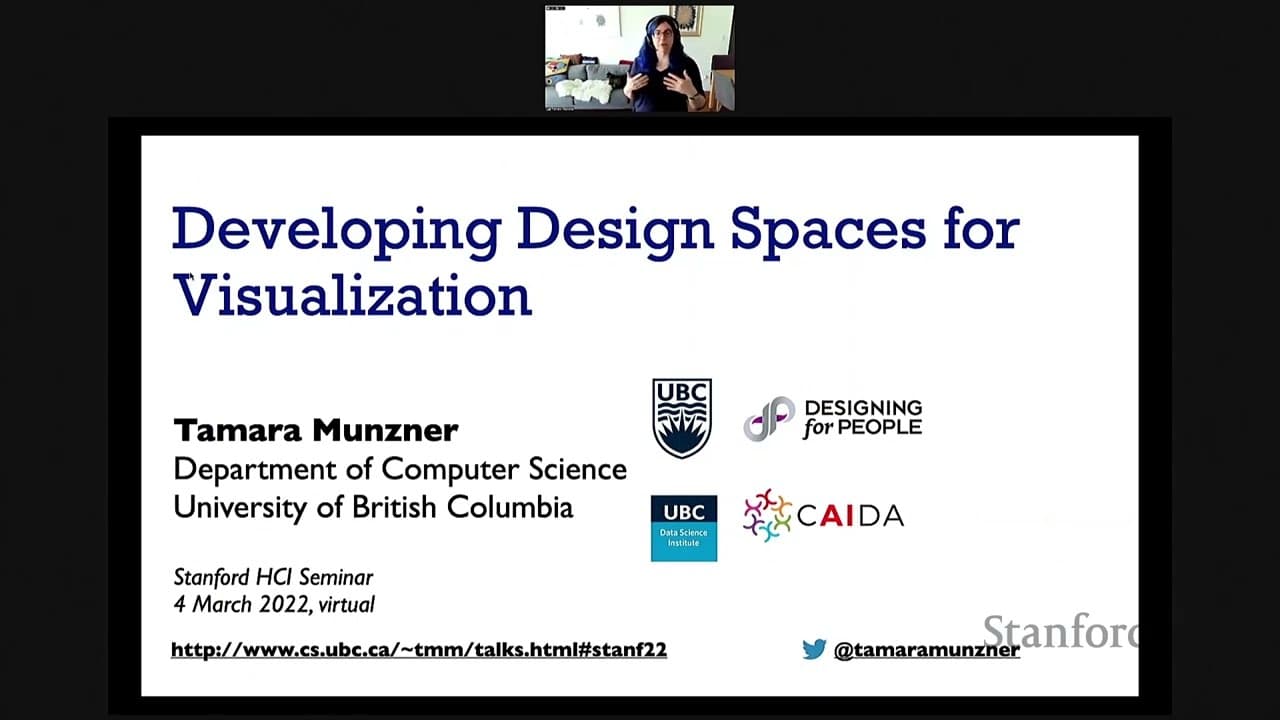
Stanford Seminar - Developing Design Spaces for Visualization - Tamara Munzner
TL;DR
This talk explores the concept of design spaces in visualization, focusing on the creation of taxonomies to classify and analyze different aspects of visual design.
Transcript
all right so thank you so much it's uh pretty fantastic to be back connected at least virtually with stanford when i was a grad student there i went to the pc seminars a lot so it's lovely to be giving one myself um and so today i've decided uh to talk about design spaces for visualization um and how to develop them and this is going to be a fairly... Read More
Key Insights
- 🎨 Design spaces provide a systematic structure for understanding and reasoning about design choices in visualization and HCI.
- 🅰️ There are many different types of design spaces, including those focused on specific data types, domains such as journalism or genomics, and abstract tasks.
- 🤗 Creating design spaces involves open coding of source material, iterative refinement, and reflective synthesis.
- 👾 Assessing design spaces involves considering their descriptive, evaluative, and generative powers.
Install to Summarize YouTube Videos and Get Transcripts
Explore YouTube Video Summarizer or Get YouTube Transcript Extractor
Questions & Answers
Q: What are design spaces in visualization?
Design spaces are systematic structures that impose a structure on the set of possibilities for a design problem. They provide a way to capture the variables central to design and support reasoning about design choices.
Q: How are design spaces created?
Design spaces are typically created through an open coding process, where source material such as research papers or software scripts are analyzed and categorized. The process involves iterative refinement and can also incorporate literature reviews, personal reflection, and reflective synthesis.
Q: What is the purpose of creating design spaces?
Design spaces help understand and differentiate between different design choices. They provide a framework for analysis, evaluation, and generation of new design solutions in visualization and related fields.
Q: How do you assess the utility of a design space?
Design spaces can be assessed based on their descriptive power, evaluative power, and generative power. Descriptive power refers to the precision in distinguishing existing examples, while evaluative power helps in comparing and selecting among alternatives. Generative power enables the creation of new design solutions.
Summary & Key Takeaways
-
The speaker discusses the concept of design spaces and their importance in visualization research, highlighting their application beyond visualization to other areas of human-computer interaction (HCI).
-
Design spaces are systematic structures that capture the variables central to a design problem, enabling reasoning about design choices.
-
The speaker presents examples of design spaces for different data types, including timelines, genomic epidemiology, data wrangling, and abstract tasks.
Read in Other Languages (beta)
Share This Summary 📚
Summarize YouTube Videos and Get Video Transcripts with 1-Click
Try YouTube Summary with ChatGPT & Claude or YouTube Transcript Generator
Explore More Summaries from Stanford Online 📚





Summarize YouTube Videos and Get Video Transcripts with 1-Click
Try YouTube Summary with ChatGPT & Claude or YouTube Transcript Generator