Second example of line integral of conservative vector field | Multivariable Calculus | Khan Academy
TL;DR
Calculate a line integral over a curve that is not closed using vector valued functions.
Transcript
Let's do another problem. Very similar to the last one, but with a subtle difference. And that subtle difference will make a big difference. Let's say we take the line integral over some curve c-- I'll define the curve in a second-- of x squared plus y squared dx plus 2xy dy-- and this might look very familiar. This was very similar to what we saw ... Read More
Key Insights
- 😚 The line integral over a curve that is not closed requires a different approach than a closed line integral.
- 🏑 To determine if a vector field is conservative, we need to find a potential function whose gradient equals the vector field.
- ❓ The potential function can be found by solving the partial differential equations for the partial derivatives of the potential function.
- 🫥 Evaluating the potential function at the endpoints of the curve allows us to calculate the line integral.
- 🫥 If the vector field is conservative, the line integral is path independent and only depends on the endpoints of the curve.
Install to Summarize YouTube Videos and Get Transcripts
Explore YouTube Video Summarizer or Get YouTube Transcript Extractor
Questions & Answers
Q: What is the difference between this line integral problem and the previous one?
The previous problem involved a closed line integral, while this problem involves a curve that is not closed.
Q: Can we apply the same method as before to determine if the vector field is conservative?
No, since the curve is not closed, we cannot use the fact that a closed loop integral is equal to zero.
Q: How can we determine if the vector field is conservative in this case?
By finding the potential function f(x,y) such that its gradient (the vector field) is equal to f(x,y).
Q: How can we find the potential function for this vector field?
To find the potential function, we solve the partial differential equations ∂f/∂x = x^2 + y^2 and ∂f/∂y = 2xy.
Summary & Key Takeaways
-
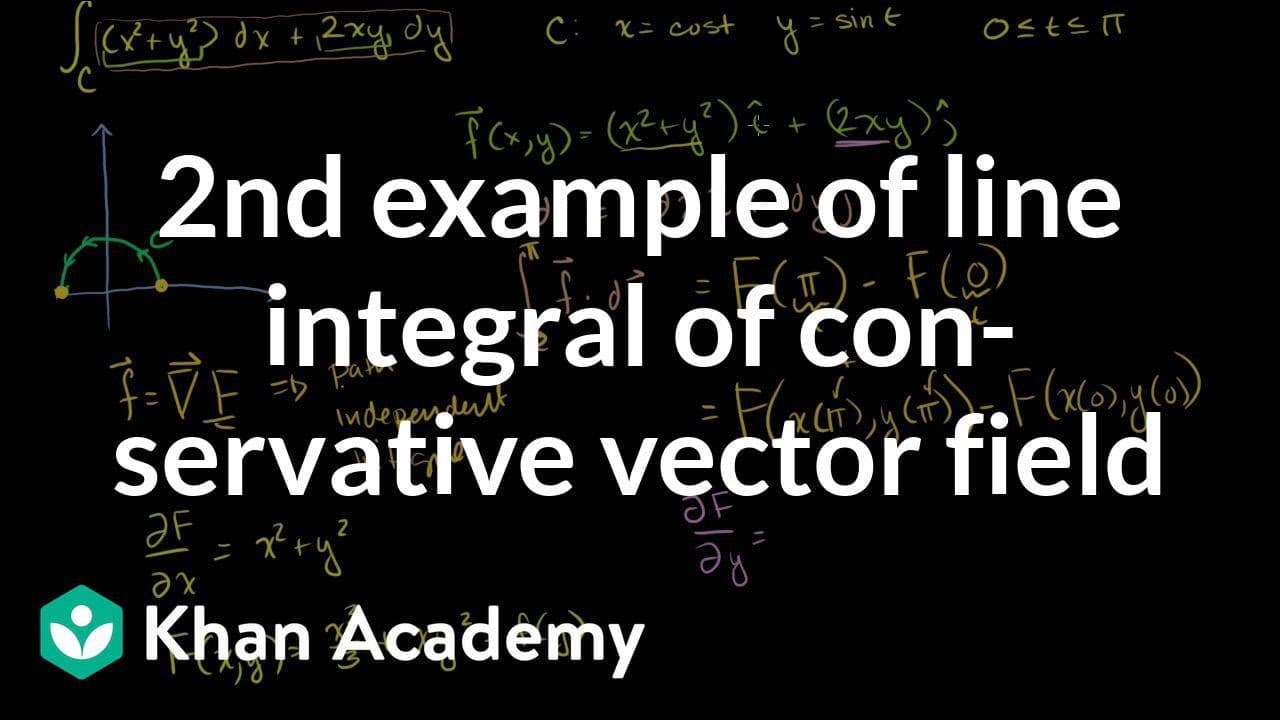
The problem involves calculating a line integral over a curve using the vector field f(x,y) = x^2 + y^2 dx + 2xy dy.
-
The curve, parameterized as x = cosine(t) and y = sine(t), starts at t = 0 and goes to t = pi.
-
The goal is to determine if the vector field is conservative and find the potential function f(x,y).
-
By evaluating the potential function at the endpoints of the curve, the line integral can be calculated.
Read in Other Languages (beta)
Share This Summary 📚
Summarize YouTube Videos and Get Video Transcripts with 1-Click
Try YouTube Summary with ChatGPT & Claude or YouTube Transcript Generator
Explore More Summaries from Khan Academy 📚



Summarize YouTube Videos and Get Video Transcripts with 1-Click
Try YouTube Summary with ChatGPT & Claude or YouTube Transcript Generator