Perimeter and area: the basics | Perimeter, area, and volume | Geometry | Khan Academy
TL;DR
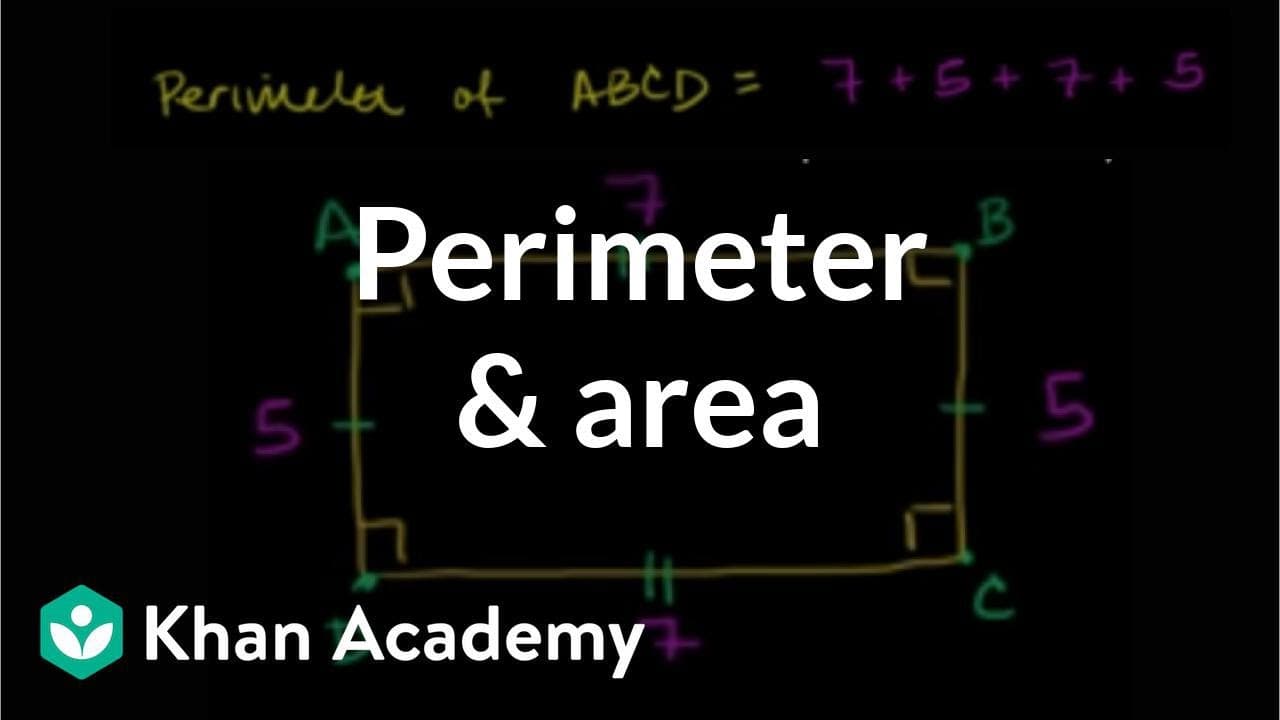
This video explains the concepts of perimeter and area, using examples of rectangles and squares.
Transcript
What I want to do in this video is a fairly straightforward primer on perimeter and area. And I'll do perimeter here on the left, and I'll do area here on the right. And you're probably pretty familiar with these concepts, but we'll revisit it just in case you are not. Perimeter is essentially the distance to go around something or if you were to p... Read More
Key Insights
- 👾 Perimeter is the total length around a shape, while area measures the space it occupies.
- 🍹 The perimeter of a rectangle is the sum of its side lengths, and the area is found by multiplying its length and width.
- ❎ The perimeter of a square is four times the length of one side, and the area is found by squaring the length of one side.
- 🔄 Area can be calculated by counting the number of 1-by-1 squares that can fit on a shape.
- 🙃 The general formula for finding area is multiplying the lengths of two adjacent sides.
- ❎ The area of a square can be found by squaring the length of one of its sides.
Install to Summarize YouTube Videos and Get Transcripts
Explore YouTube Video Summarizer or Get YouTube Transcript Extractor
Questions & Answers
Q: What is the definition of perimeter?
Perimeter is the measurement of the distance around a shape. It can be thought of as the length of a fence around a figure or the total length if a tape were wrapped around it.
Q: How can the perimeter of a rectangle be calculated?
The perimeter of a rectangle is found by adding up the lengths of all its sides. In the video example, the lengths of AB, BC, DC, and AD are added together to find the perimeter.
Q: Can the perimeter of a square be calculated differently from a rectangle?
No, the perimeter of a square can be calculated using the same method as a rectangle. It is four times the length of one of its sides since all sides of a square are equal.
Q: How is area different from perimeter?
Area measures the amount of space a shape occupies in two dimensions, while perimeter measures the distance around it. Area is found by multiplying the lengths of two adjacent sides of a shape.
Summary & Key Takeaways
-
Perimeter is the distance around a shape, while area measures the space it takes up in two dimensions.
-
The perimeter of a rectangle is the sum of the lengths of its sides, while the area is found by multiplying its length and width.
-
The perimeter of a square is four times the length of one of its sides, while the area is found by squaring the length of one of its sides.
Read in Other Languages (beta)
Share This Summary 📚
Summarize YouTube Videos and Get Video Transcripts with 1-Click
Try YouTube Summary with ChatGPT & Claude or YouTube Transcript Generator
Explore More Summaries from Khan Academy 📚



Summarize YouTube Videos and Get Video Transcripts with 1-Click
Try YouTube Summary with ChatGPT & Claude or YouTube Transcript Generator