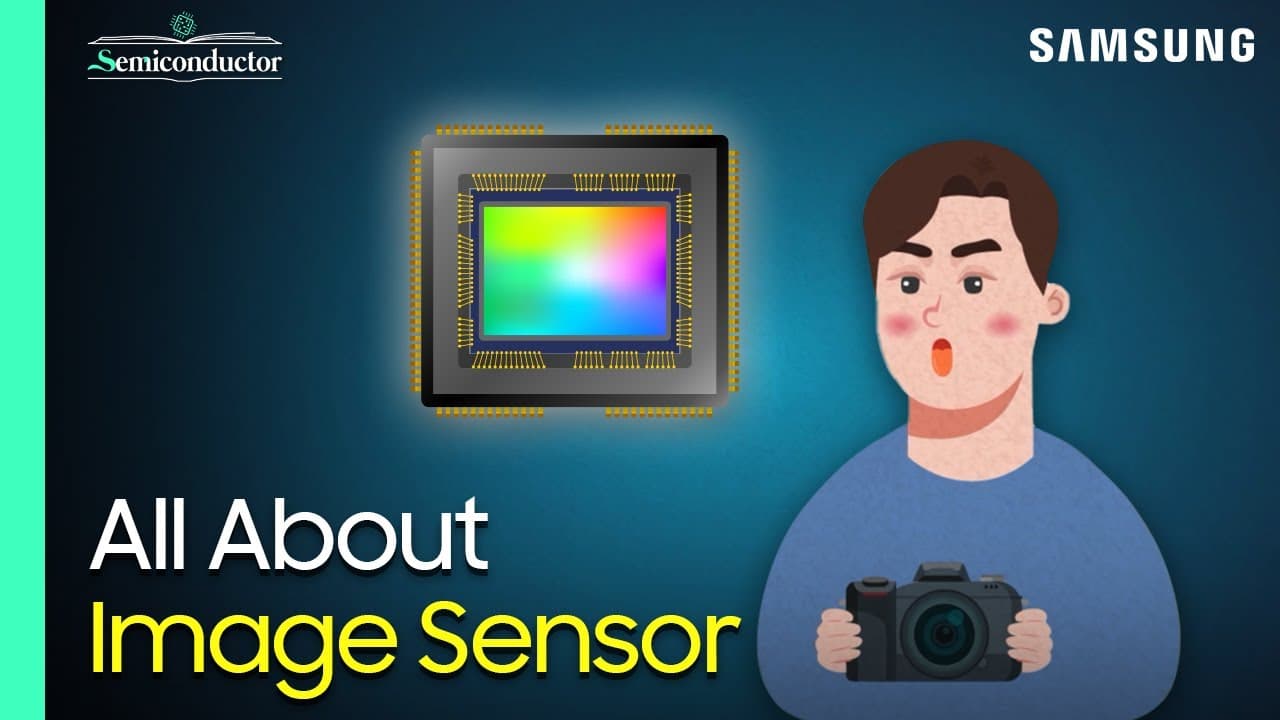
System Semiconductor Image Sensor Explained | 'All About Semiconductor' by Samsung Semiconductor
TL;DR
Image sensors convert light into digital signals for high-quality photos.
Transcript
as time goes by our memories can disappear but they can last forever as photos today we will talk about a semiconductor that helps our memories last forever an image sensor is a semiconductor that stores and transmits image signals to allow for images taken to be viewed through a display device an image sensor converts image data received through a... Read More
Key Insights
- Image sensors are semiconductors that convert image data into digital signals, similar to how the human eye processes visual information.
- The quality of a photo is heavily influenced by the number of pixels in the image sensor, with more pixels resulting in higher resolution images.
- Reducing pixel size to fit more pixels in a limited space presents challenges such as light interference and noise in low light conditions.
- Samsung's ISO cell technology reduces light interference by placing isolated walls between pixels, improving image quality.
- Pixel binning technology allows image sensors to absorb more light, enhancing performance in low light settings.
- Recent innovations have led to image sensors with over 200 megapixels, enabling smartphone cameras to capture DSLR-level photos.
- Image sensor applications are expanding beyond smartphones to include fields like autonomous vehicles and artificial intelligence.
- Samsung aims to continually innovate in pixel technology, potentially surpassing the detail-capturing capabilities of the human eye.
Install to Summarize YouTube Videos and Get Transcripts
Explore YouTube Video Summarizer or Get YouTube Transcript Extractor
Questions & Answers
Q: What is an image sensor?
An image sensor is a semiconductor device that converts image data received through a camera lens into digital signals. It functions similarly to the human eye, processing visual information and transmitting it to a mobile processor. Image sensors are essential for capturing and displaying images on digital devices.
Q: How does pixel count affect photo quality?
Pixel count is a critical factor in determining photo quality. A higher pixel count means that an image sensor has more pixels, which allows for more detailed and precise images. High-resolution images are clearer and more defined, as they contain more information compared to images with fewer pixels.
Q: What challenges arise when reducing pixel size?
Reducing pixel size to fit more pixels in a limited space can lead to several challenges. Smaller pixels may cause light to leak into adjacent pixels, a phenomenon known as interference. Additionally, smaller pixels absorb less light, resulting in higher noise levels in low light conditions, which can degrade image quality.
Q: How does Samsung's ISO cell technology improve image quality?
Samsung's ISO cell technology enhances image quality by reducing light interference between pixels. It achieves this by placing isolated walls between each pixel, preventing light from leaking into adjacent pixels. This technology helps maintain image clarity and reduces noise, particularly in challenging lighting conditions.
Q: What is pixel binning technology?
Pixel binning technology is a technique used to improve image sensor performance in low light settings. It involves combining multiple pixels to function as a single larger pixel, allowing the sensor to absorb more light. This results in brighter, clearer images with reduced noise, even in dimly lit environments.
Q: What recent advancements have been made in image sensor technology?
Recent advancements in image sensor technology include the development of sensors with over 200 megapixels. These high-resolution sensors enable smartphone cameras to capture images with quality comparable to DSLR cameras. Ongoing innovations continue to push the boundaries of image sensor capabilities, enhancing detail and clarity.
Q: What are the future applications of image sensors?
While image sensors are primarily used in smartphones, their applications are expanding into other fields. Emerging areas such as autonomous vehicles and artificial intelligence are expected to benefit from advanced image sensor technologies. These sensors will play a crucial role in enabling machines to perceive and interpret visual information.
Q: What is Samsung's vision for the future of image sensors?
Samsung envisions a future where image sensors continue to evolve, potentially surpassing the detail-capturing capabilities of the human eye. The company is committed to advancing pixel technologies, opening up new possibilities in various fields. Samsung aims to lead in innovation, delivering image sensors that enhance our ability to capture and interpret the world around us.
Summary & Key Takeaways
-
Image sensors are crucial components in cameras, converting light into digital signals to create images. They function similarly to the human eye, transmitting visual data to a processor. The pixel count in an image sensor determines photo quality, with higher counts resulting in clearer images.
-
Challenges in image sensor development include fitting more pixels into limited spaces, leading to smaller pixel sizes. This can cause light interference and increased noise in low light conditions. Samsung's ISO cell and pixel binning technologies address these issues by reducing interference and enhancing light absorption.
-
Recent advancements have pushed image sensor capabilities beyond 200 megapixels, allowing smartphones to achieve DSLR-level image quality. As technology progresses, image sensors are expected to find applications in emerging fields like autonomous vehicles and AI, with ongoing innovations aiming to surpass human eye capabilities.
Read in Other Languages (beta)
Share This Summary 📚
Summarize YouTube Videos and Get Video Transcripts with 1-Click
Try YouTube Summary with ChatGPT & Claude or YouTube Transcript Generator
Explore More Summaries from Samsung Semiconductor Newsroom 📚

Summarize YouTube Videos and Get Video Transcripts with 1-Click
Try YouTube Summary with ChatGPT & Claude or YouTube Transcript Generator