What Are the Steps in Semiconductor Manufacturing?
TL;DR
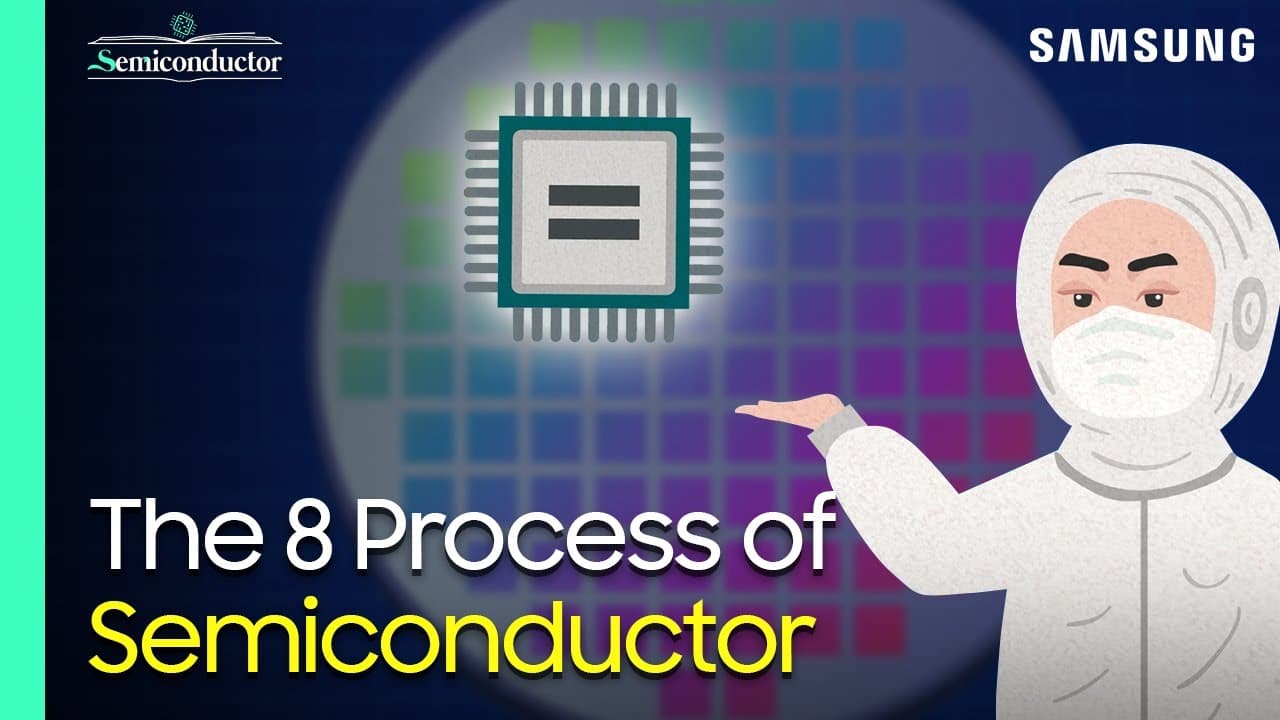
The semiconductor manufacturing process involves several key steps: wafer manufacturing, oxidation, photolithography, etching, deposition, ion implementation, and metal wiring. These processes transform silicon ingots into functional chips, culminating in testing and packaging to ensure quality and readiness for devices.
Transcript
in this video we help you understand the semiconductor industry which is interconnected and constantly evolving in the enormous semiconductor ecosystem today let's learn about the essential semiconductor manufacturing processes in the first episode we talked about silicon the main material which is used to make semiconductors in order for silicon t... Read More
Key Insights
- 🔬 Silicon is the main material used to make semiconductors, and it goes through essential processes such as wafer manufacturing, oxidation, photolithography, etching, deposition, ion implementation, metal wiring, EDS, and packaging.
- 🌍 The semiconductor industry is interconnected and constantly evolving within a vast semiconductor ecosystem.
- 🔒 The surface of sliced wafers is rough and contains defects, which need to be polished to ensure the precision of circuits.
- 🔍 Wafer diameter is increasing to accommodate a greater number of chips per wafer, resulting in higher production capacity.
- 🛠️ The oxidation process forms a protective oxide film on the wafer's surface, which blocks current leakage between circuits.
- 📐 Photolithography involves drawing a circuit design onto the wafer using a photomask, similar to developing a photo taken on a film camera.
- 🧪 Etching selectively removes unnecessary materials from the wafer to create the desired circuit design, using either wet etching or dry etching.
- 🚀 Deposition is the process of applying a thin film coating onto the wafer, requiring precise technology to uniformly distribute the coating.
- 💡 Metal wiring deposits a thin metal film onto the wafer, allowing electricity to flow through the semiconductor and enabling the chip to function properly.
Install to Summarize YouTube Videos and Get Transcripts
Explore YouTube Video Summarizer or Get YouTube Transcript Extractor
Questions & Answers
Q: How are semiconductor wafers made conductive?
Semiconductor wafers are made conductive through the oxidation process, where oxygen or water vapor is sprayed on the wafer surface to form a uniform oxide film that protects the wafer's surface and blocks current leakage between circuits.
Q: What is the purpose of the photolithography process in semiconductor manufacturing?
Photolithography is used to draw circuit patterns onto the wafer by applying a photoresist material that responds to light onto the oxide film of the wafer, then transferring the pattern using a photomask and removing unlit areas through the development process.
Q: What is the significance of the deposition process in semiconductor manufacturing?
Deposition is a crucial process where a thin film is coated onto the wafer, allowing the semiconductor to have electrical characteristics and creating an insulating layer that separates and protects stacked circuits.
Q: Why is the metal wiring process important in semiconductor manufacturing?
The metal wiring process involves depositing a thin metal film on the wafer, which enables the flow of electricity and creates a path for electrical signals to pass through the semiconductor, ensuring proper functionality of the circuit.
Q: What are the final steps in semiconductor manufacturing after the wafer processing stage?
The final steps in semiconductor manufacturing include EDS (Electrical Defect Stabilization), which tests and sorts out defective chips, and packaging, where the wafer is cut into individual chips, bonded to a substrate, and molded into its desired shape for protection and connectivity.
Summary & Key Takeaways
-
Semiconductor manufacturing involves several essential processes, starting with wafer manufacturing where silicon ingots are sliced into thin discs.
-
The wafer then goes through oxidation to form an oxide film that protects the surface and blocks current leakage.
-
Photolithography and etching processes are used to draw circuit patterns on the wafer, while deposition and ion implementation add thin films and impurities to make the wafer conductive.
Read in Other Languages (beta)
Share This Summary 📚
Summarize YouTube Videos and Get Video Transcripts with 1-Click
Try YouTube Summary with ChatGPT & Claude or YouTube Transcript Generator
Explore More Summaries from Samsung Semiconductor Newsroom 📚

Summarize YouTube Videos and Get Video Transcripts with 1-Click
Try YouTube Summary with ChatGPT & Claude or YouTube Transcript Generator