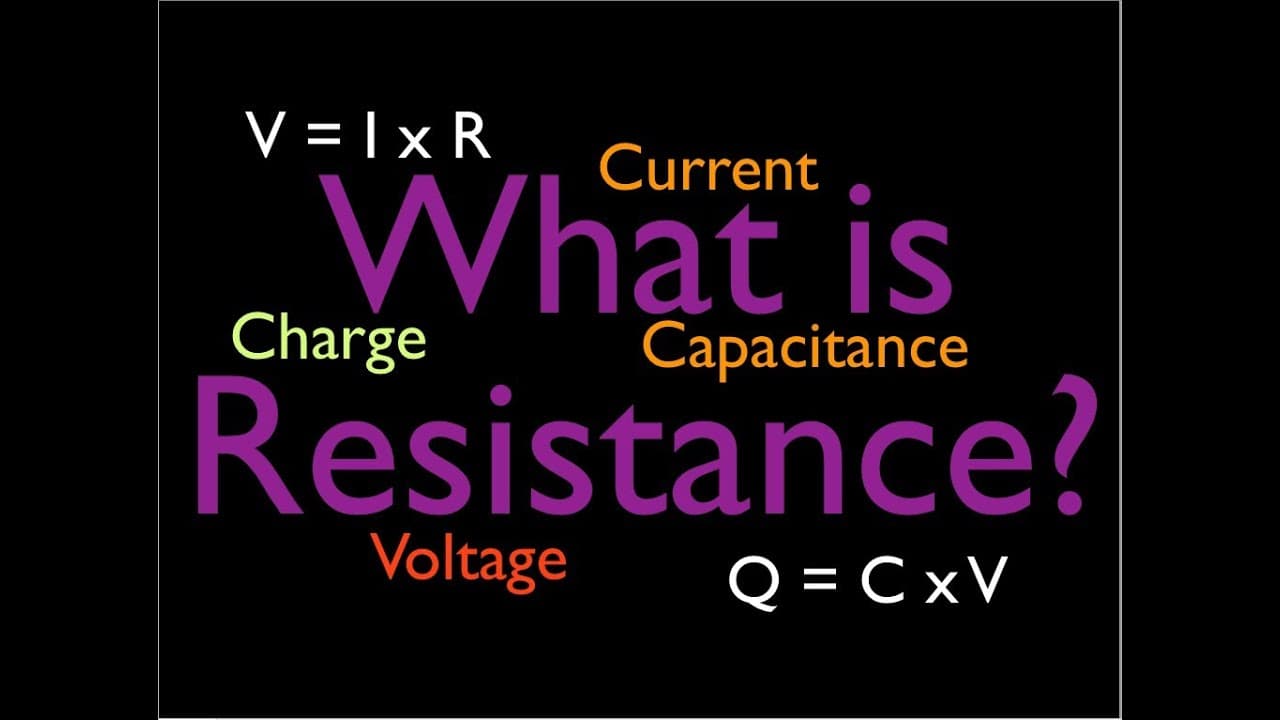
What is Resistance? An Explanation
TL;DR
Resistance is the hindrance to the flow of charge in circuits, affecting current inversely.
Transcript
okay in today's video I'm going to go over what is resistance I'm not going to go into a lot of detail I just want to give you a general conceptual background of what resistance is kind of how we talk about it the symbols we use the units the numbers and the abbreviations because when we deal with circuits with capacitors and resistors in them ther... Read More
Key Insights
- 💐 Resistance impedes the flow of charge in circuits, affecting current.
- ⚡ Ohm's law, V = IR, relates voltage, current, and resistance in circuits.
- 💌 The unit for resistance is the ohm, represented by the Greek letter Omega (Ω).
- 💐 Increasing resistance in a circuit decreases the current flow inversely.
- 🤬 The symbol for resistance is R, distinct from the current symbol, I.
- ❓ Resistance is a crucial concept in understanding circuit behavior and performance.
- 💐 Conceptually, resistance resists the flow of electrons, influencing current flow.
Install to Summarize YouTube Videos and Get Transcripts
Explore YouTube Video Summarizer or Get YouTube Transcript Extractor
Questions & Answers
Q: What is resistance in electrical circuits?
Resistance in electrical circuits refers to the hindrance that reduces the flow of charge, affecting current inversely as it increases or decreases. It is measured in ohms and symbolized as R.
Q: How does resistance impact current in circuits?
Resistance and current in circuits have an inverse relationship - as resistance increases, current decreases. This relationship is governed by Ohm's law, which states that V = IR, where V is voltage, I is current, and R is resistance.
Q: What is the symbol for resistance and its unit of measurement?
The symbol for resistance is R, and it is measured in ohms, represented by the Greek letter Omega (Ω). The abbreviation for ohms is Ω, used to denote the unit in calculations and circuit diagrams.
Q: How can resistance be conceptually understood in circuits?
Conceptually, resistance can be seen as the opposition to the flow of electrons in a circuit. Increasing resistance reduces the current flow, while decreasing resistance allows for a higher current to pass through.
Summary & Key Takeaways
-
Resistance is the hindrance to the flow of charge in circuits, measured in ohms.
-
It is symbolized as R, with the unit being the ohm (Ω).
-
Increasing resistance decreases current, showing an inverse proportional relationship.
Read in Other Languages (beta)
Share This Summary 📚
Summarize YouTube Videos and Get Video Transcripts with 1-Click
Try YouTube Summary with ChatGPT & Claude or YouTube Transcript Generator
Explore More Summaries from Step by Step Science 📚

Summarize YouTube Videos and Get Video Transcripts with 1-Click
Try YouTube Summary with ChatGPT & Claude or YouTube Transcript Generator