Chemical Composition of Raw Material
TL;DR
Understand the composition and effects of the main constituents of cement, such as lime, silica, alumina, iron oxide, magnesia, and others, on its properties.
Transcript
hello everyone now that we have understood the basic idea what cement is let's go into the depth discussion of the constituents of cement this is quite important not only from the exam point of view but also to get a better understanding of the working of cement so to get an idea that how the properties can be modulated by changing the concentratio... Read More
Key Insights
- 📢 Cement consists mainly of lime, silica, and aluminum, with minor components like iron oxide, magnesia, potash, and sulfur trioxide.
- 📢 Modifying the proportions of these constituents results in different types of cement with desired properties.
- 📶 Lime provides soundness and strength to cement, while silica offers strength and influences setting time.
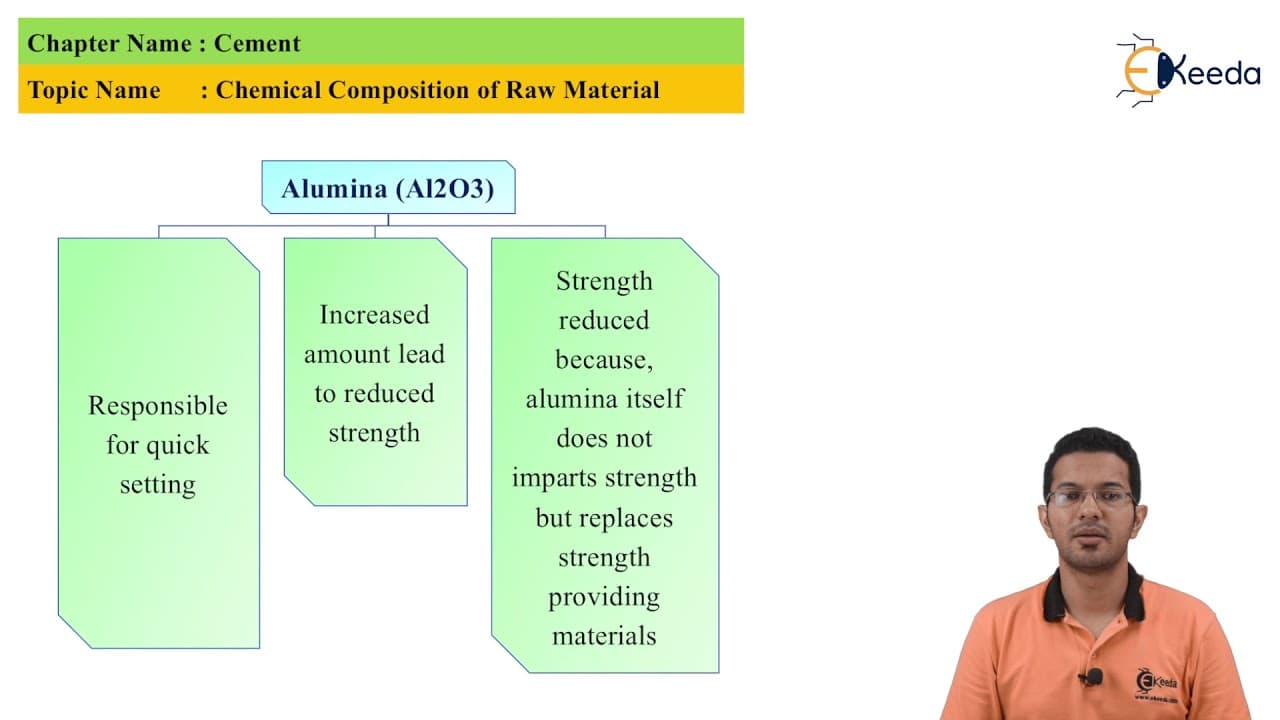
- 🎁 Alumina contributes to quick-setting but should not be present in excess to maintain cement's strength.
- 🧑🏭 Iron oxide acts as a flux and gives color to cement but can harden it when present beyond specified limits.
- 📢 Magnesia imparts hardness and color to cement but excess amounts can cause unsoundness.
- 🎮 Sulfur trioxide and alkalis should be controlled within specified limits to avoid unsoundness and other issues.
Install to Summarize YouTube Videos and Get Transcripts
Explore YouTube Video Summarizer or Get YouTube Transcript Extractor
Questions & Answers
Q: What are the main constituents of cement?
The main constituents of cement are lime, silica, and aluminum. Other minor components include iron oxide, magnesia, potash, sulfur trioxide, etc.
Q: How does lime affect the properties of cement?
Lime is crucial for cement soundness and strength. Too much lime makes the cement unsound, while a scarcity of lime reduces strength and quickens the setting time.
Q: What is the role of silica in cement?
Silica provides strength to cement by forming compounds like dicalcium and tricalcium silicates. Excess silica increases strength but also prolongs the setting time.
Q: How does alumina influence cement properties?
Alumina imparts quick-setting properties to cement and acts as a flux to lower the clinker temperature. However, excess alumina weakens the cement.
Q: How does iron oxide affect cement?
Iron oxide acts as a flux to aid the fusion of cement ingredients and gives color to cement. Beyond a specific limit, iron oxide hardens the cement.
Q: What is the role of magnesia in cement?
Magnesia imparts hardness and color to cement. Excess magnesia causes unsoundness, while lesser magnesia improves soundness.
Q: What is the effect of sulfur trioxide on cement?
Excess sulfur trioxide makes the cement unsound, leading to problems. Therefore, it should be controlled within the specified limit.
Q: How do alkalis impact cement properties?
Alkalis, which are impurities from shale clays or fuel, accelerate setting time and can cause issues like efflorescence and cracking when present in excess.
Summary & Key Takeaways
-
Cement consists of three main constituents: lime, silica, and aluminum, with other minor components like iron oxide, magnesia, potash, sulfur trioxide, etc.
-
The relative proportioning of these constituents determines the properties of cement, such as setting time and fusion ability.
-
Modifying the proportion of the constituents leads to different types of cement with desired properties.
Read in Other Languages (beta)
Share This Summary 📚
Summarize YouTube Videos and Get Video Transcripts with 1-Click
Try YouTube Summary with ChatGPT & Claude or YouTube Transcript Generator
Explore More Summaries from Ekeeda 📚





Summarize YouTube Videos and Get Video Transcripts with 1-Click
Try YouTube Summary with ChatGPT & Claude or YouTube Transcript Generator