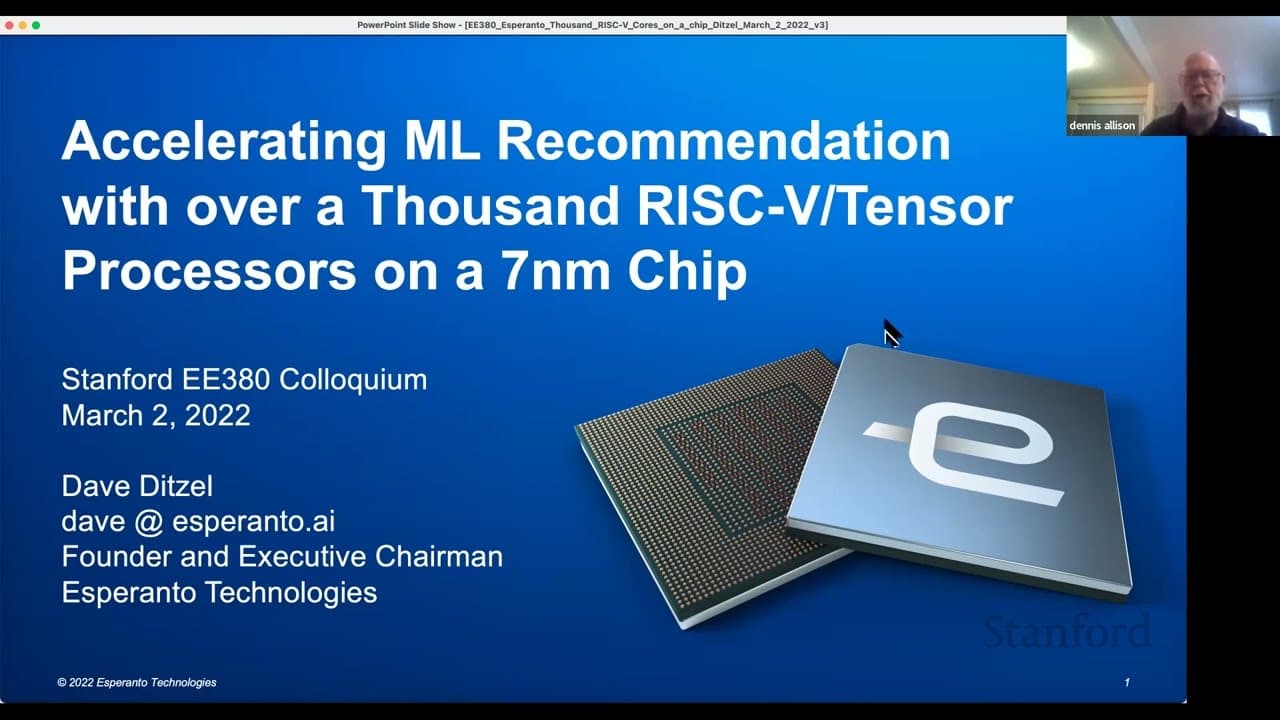
Stanford Seminar - Accelerating ML Recommendation with over a Thousand RISC-V/Tensor Processors...
TL;DR
Esperanto Technologies is developing a new chip with thousands of cores that offers high-performance capabilities for machine learning recommendation tasks.
Transcript
okay welcome to uh ee 380 the stanford uh double the computer systems colloquium uh for march uh uh march 2nd 2022. um the speaker today is dave ditzel from esperanto technologies and he's going to tell us about the new machine that they have in progress with thousands of cores and performance that's amazing um i think uh it should be very interest... Read More
Key Insights
- 💯 Esperanto's chip offers thousands of cores and high-performance capabilities for machine learning recommendation tasks.
- ✊ The chip provides extensive parallel computing power and is programmable, making it suitable for various workloads.
- ✊ It operates at low power and is highly energy efficient, offering impressive performance rates while staying within power limits.
- 🐿️ Esperanto's chip features a unique architecture with a focus on on-chip memory capacity, enhanced interfaces, and a scalable system design.
- 💗 The chip is part of Esperanto's mission to provide innovative solutions for accelerating machine learning tasks and addressing the growing demands of data centers.
- ✊ The company is highly focused on customer requirements and aims to offer flexibility, scalability, and power efficiency in its chip designs.
Install to Summarize YouTube Videos and Get Transcripts
Explore YouTube Video Summarizer or Get YouTube Transcript Extractor
Questions & Answers
Q: What is the main focus of Esperanto's new chip?
The main focus of Esperanto's new chip is to accelerate machine learning recommendation tasks, offering high-performance capabilities.
Q: How many cores does the new chip have?
The new chip from Esperanto features over a thousand risk five processors, providing extensive parallel computing power.
Q: What sets Esperanto's chip apart from other accelerator chips?
Unlike other accelerator chips that focus on specific tasks, Esperanto's chip offers programmability and can be used for a wide range of parallelizable workloads, making it a versatile option for machine learning acceleration.
Q: What is the power consumption of Esperanto's chip?
Esperanto's chip is designed to operate at low power and can typically operate under 20 watts, making it highly energy efficient, especially considering the high-performance capabilities it offers.
Q: What are some of the key features of Esperanto's chip?
Esperanto's chip features a large on-chip memory capacity, interfaces for large external memory, and a full system-on-chip architecture. It also has dedicated vector tensor units and supports multiple processor types for different workload requirements.
Summary & Key Takeaways
-
Esperanto is developing a new chip with thousands of cores for high-performance computing in machine learning recommendation tasks.
-
The chip boasts over a thousand risk five processors on a single seven nanometer chip, offering impressive performance rates.
-
The chip features three different processor types, each with its own dedicated vector tensor unit, and has extensive on-chip bandwidth and memory capacity.
Read in Other Languages (beta)
Share This Summary 📚
Summarize YouTube Videos and Get Video Transcripts with 1-Click
Try YouTube Summary with ChatGPT & Claude or YouTube Transcript Generator
Explore More Summaries from Stanford Online 📚
Summarize YouTube Videos and Get Video Transcripts with 1-Click
Try YouTube Summary with ChatGPT & Claude or YouTube Transcript Generator