Decoding the Balance: Understanding State and Federal Powers in American Federalism
TL;DR
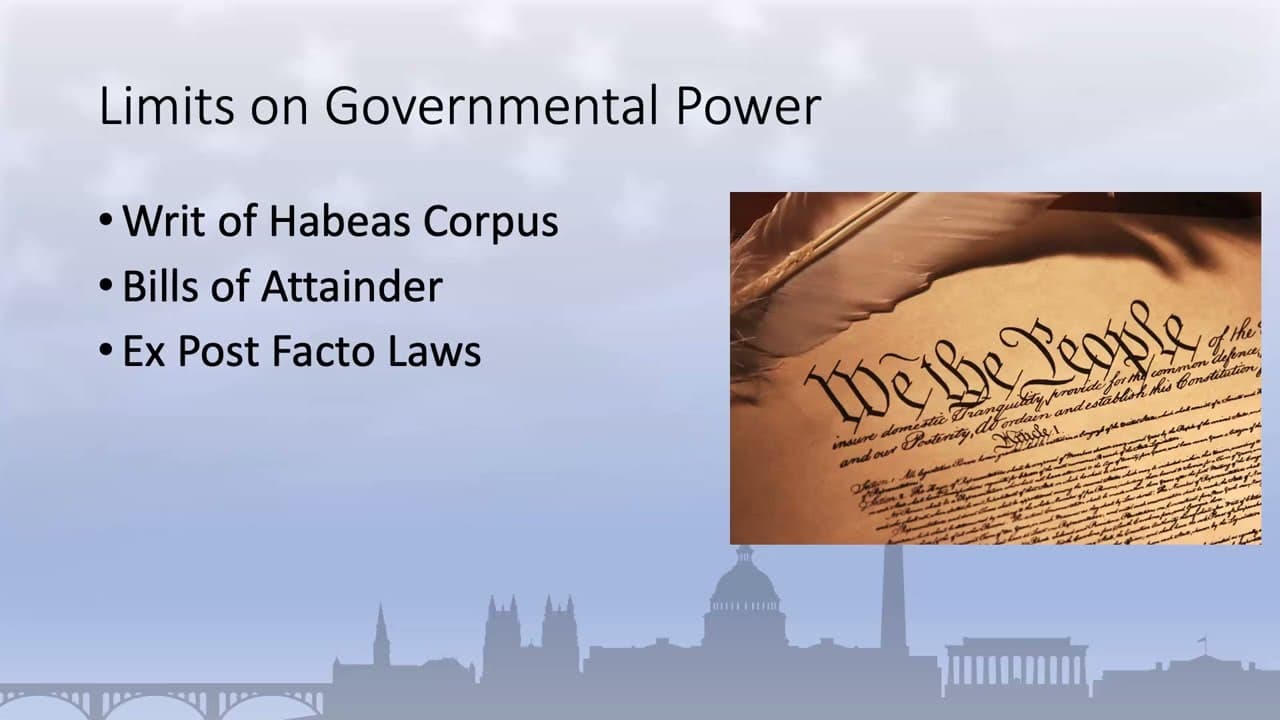
The US Constitution outlines the division of power between the states and the national government under American federalism, including enumerated powers, implied powers, the commerce clause, supremacy clause, 10th amendment, full faith and credit clause, privileges and immunities clause, 11th amendment, and limitations on government power.
Transcript
hey everyone and welcome back this is one of a series of videos looking at Key issues and Concepts in American politics in this video we're going to explore how power is divided between the states and the national government under the American system of federalism in another video we examine the division of power between the national and state gove... Read More
Key Insights
- ✊ The US Constitution grants the federal government enumerated powers, such as levying taxes and maintaining a military.
- ✊ Implied powers, granted by the elastic clause, give the government authority necessary to govern.
- 👻 The commerce clause is a significant source of federal power and allows Congress to regulate economic activity.
- 👮 The supremacy clause establishes that federal law takes precedence over state laws.
- ✊ The 10th amendment reserves powers to the states, ensuring a balance of power and autonomy.
- 📜 The full faith and credit clause promotes unity by requiring states to recognize legal judgments and documents from other states.
- ❓ The privileges and immunities clause prevents states from discriminating against citizens of other states.
- ⛔ The 11th amendment provides sovereign immunity to states, limiting their liability in federal lawsuits.
Install to Summarize YouTube Videos and Get Transcripts
Explore YouTube Video Summarizer or Get YouTube Transcript Extractor
Questions & Answers
Q: What are the enumerated powers granted to the federal government in the US Constitution?
The enumerated powers include the ability to levy taxes, regulate commerce, coin money, establish post offices, declare war, and maintain a military.
Q: What is the commerce clause in the US Constitution?
The commerce clause grants Congress the power to regulate commerce with foreign nations, among the states, and with Indian tribes.
Q: What is the purpose of the supremacy clause in the US Constitution?
The supremacy clause ensures that federal law takes precedence over conflicting state laws, emphasizing the authority of the federal government.
Q: What does the 10th amendment to the US Constitution state?
The 10th amendment reserves powers not delegated to the federal government to the states, ensuring a balance of power and autonomy for the states.
Summary & Key Takeaways
-
The US Constitution grants the federal government enumerated powers, which are specifically mentioned, and implied powers, which are necessary to govern.
-
The commerce clause in the Constitution gives Congress the power to regulate a wide range of economic activities.
-
The supremacy clause establishes that federal law takes precedence over conflicting state laws.
-
The 10th amendment ensures that the states have autonomy, and any powers not granted to the federal government are reserved for the states.
Read in Other Languages (beta)
Share This Summary 📚
Summarize YouTube Videos and Get Video Transcripts with 1-Click
Try YouTube Summary with ChatGPT & Claude or YouTube Transcript Generator
Explore More Summaries from Noah Zerbe 📚




Summarize YouTube Videos and Get Video Transcripts with 1-Click
Try YouTube Summary with ChatGPT & Claude or YouTube Transcript Generator