Estimating subtracting decimals
TL;DR
In this video, the instructor teaches how to estimate and subtract decimals quickly to get a rough answer.
Transcript
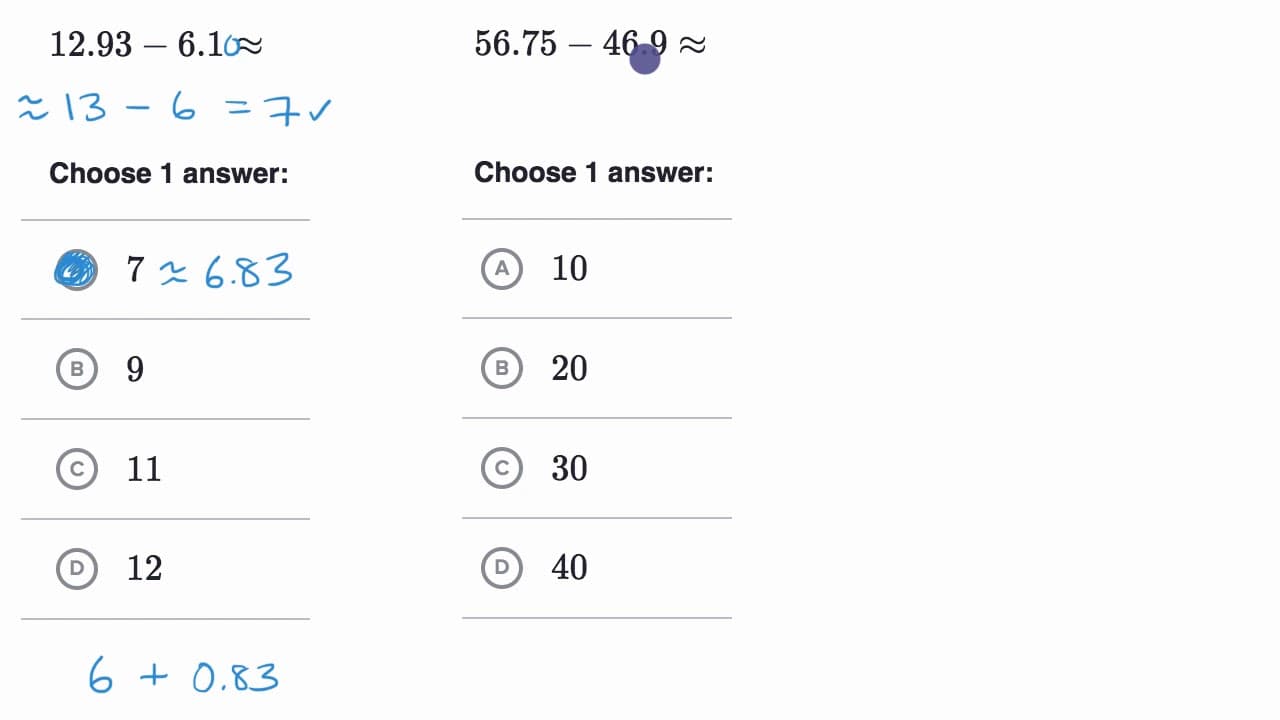
- [Instructor] Alright, now let's get some practice estimating, subtracting decimals. So, over here it says 12.93 minus 6.1 is approximately equal to what? This squiggly-looking equal sign you can view as roughly equal to or approximately equal to. So, pause this video and see if you can figure it out. And, you shouldn't really need paper for it. T... Read More
Key Insights
- 🤲 Estimation is a valuable skill for quickly getting rough answers without precise calculations.
- 🛝 Rounding decimals to the nearest whole number simplifies the subtraction process.
- 🙂 Results may vary slightly when estimating, but as long as they are reasonably close to the actual answer, they are acceptable.
- 🛝 Estimating decimals with different decimal places involves rounding and treating them as whole numbers for subtraction.
- 🥅 The goal of estimation is to get a ballpark sense of the answer rather than the exact value.
- 🛟 Estimation is useful in real-life situations where an approximate answer is sufficient.
- 🪡 Mental calculations can be used to estimate and subtract decimals without the need for paper or extensive calculation.
Install to Summarize YouTube Videos and Get Transcripts
Explore YouTube Video Summarizer or Get YouTube Transcript Extractor
Questions & Answers
Q: What is the purpose of estimation in subtracting decimals?
Estimation allows us to quickly get a rough answer without the need for precise calculations. It helps us understand the ballpark of the solution, which is often sufficient in many real-life scenarios.
Q: How can you mentally estimate the subtraction of decimals?
One approach is to round each decimal to the nearest whole number and then subtract them. This simplifies the calculation and provides an approximation of the actual difference.
Q: Why is it acceptable to have slightly different results when estimating decimals?
Estimation focuses on getting a ballpark sense of the answer rather than an exact value. Different individuals may use slightly different estimation methods, but as long as the result is reasonably close to the actual answer, it is acceptable.
Q: How can you estimate decimals with different decimal places?
You can first round each decimal to the nearest whole number, and then subtract them as if they were whole numbers. After subtracting, add back the decimal part to obtain an approximate decimal difference.
Summary & Key Takeaways
-
The video focuses on practicing estimation and subtraction of decimals. The aim is to be able to quickly estimate and get close to the answer rather than calculating the exact answer.
-
The instructor demonstrates the process of rounding each decimal to the nearest whole number and then subtracting. By doing this mentally, the approximation can be found.
-
Three examples are worked through, showing how rounding and estimation can be used to solve the subtraction problems.
Read in Other Languages (beta)
Share This Summary 📚
Summarize YouTube Videos and Get Video Transcripts with 1-Click
Try YouTube Summary with ChatGPT & Claude or YouTube Transcript Generator
Explore More Summaries from Khan Academy 📚



Summarize YouTube Videos and Get Video Transcripts with 1-Click
Try YouTube Summary with ChatGPT & Claude or YouTube Transcript Generator