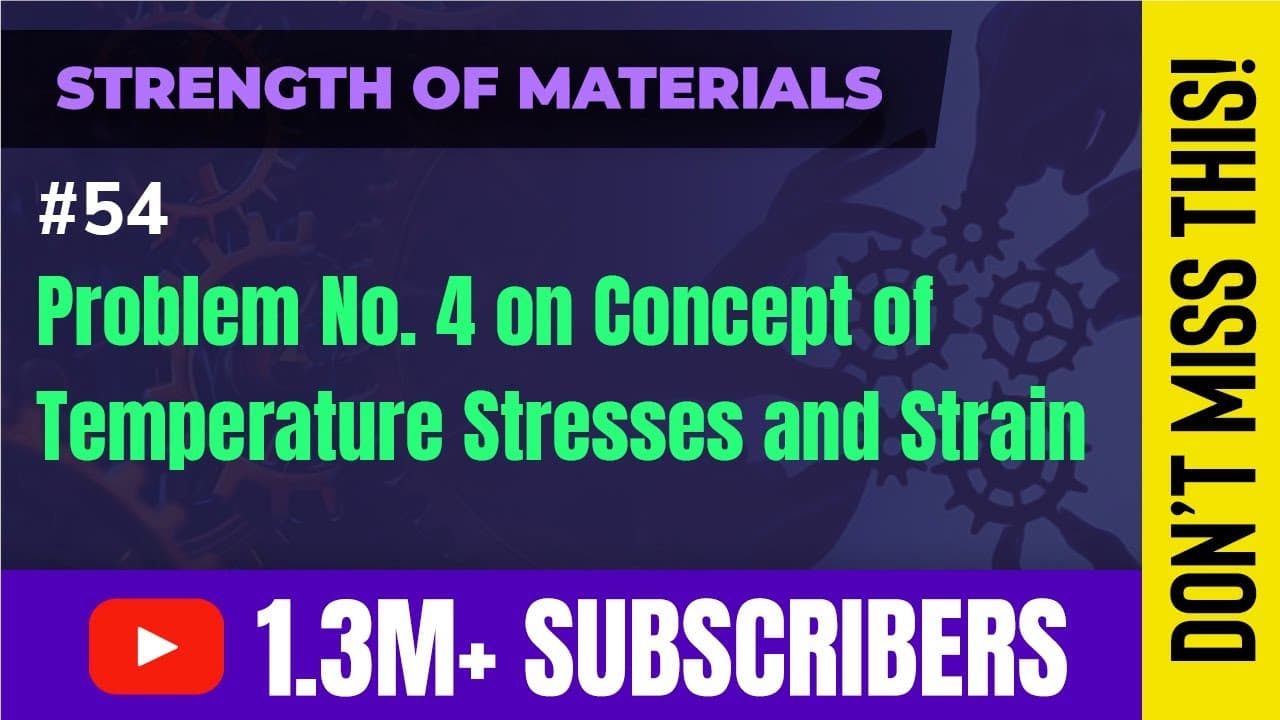
Problem No 4on Concept of Temperature Stresses and Strain - Stress and Strain -Strength of Materials
TL;DR
The video explains how to calculate the end reactions and thermal stress in a square rod due to a rise in temperature.
Transcript
hello friends here in this video we will see a problem on temperature stress and strain for that we have a question i'll write the data what is given here a square rod 10 mm into 10 mm in cross section so i'll draw the diagram here is the square rod 10 mm into 10 mm in cross section so this gives us the area of the square rod which is 10 into 10 an... Read More
Key Insights
- 😮 In this problem, a square rod fixed at both ends is subjected to thermal expansion due to a rise in temperature.
- ❤️🩹 The end reactions developed in the rod help to counteract the expansion forces and maintain stability.
- 👻 The calculation of thermal strain and stress allows engineers to quantify the effects of temperature changes on the rod.
- 🎨 Understanding and accounting for thermal stress is crucial in the design and analysis of structures to ensure their durability and safety.
- 😵 The coefficient of thermal expansion, Young's modulus, and cross-sectional area are essential parameters in determining the end reactions and thermal stress.
- 🥶 The end reactions, in this case, are compressive forces acting on the square rod due to the prevention of free expansion.
- ❤️🩹 The proper calculation of end reactions is imperative to avoid structural failures or deformations in response to temperature changes.
Install to Summarize YouTube Videos and Get Transcripts
Explore YouTube Video Summarizer or Get YouTube Transcript Extractor
Questions & Answers
Q: What are the dimensions and length of the square rod?
The square rod has a cross-section of 10mm x 10mm and a length of 1000mm.
Q: How are the ends of the square rod fixed?
The square rod is fixed at both ends, meaning it is attached to walls or other supportive structures.
Q: What happens to the square rod when it is heated?
Heating the square rod causes it to expand due to thermal expansion. However, because it is fixed at both ends, the expansion is prevented and thermal stresses develop.
Q: How is thermal strain calculated?
The formula for thermal strain is e = alpha * delta t, where alpha is the coefficient of thermal expansion and delta t is the change in temperature. In this case, e = 12 x 10^-6 * 50 = 6 x 10^-4.
Q: What is the formula for thermal stress?
The formula for thermal stress is sigma = stress * Young's modulus. In the given problem, the thermal stress is calculated to be 120 N/mm^2.
Q: How is the end reaction determined?
The end reaction is found using the formula F = stress * area, where stress is the thermal stress and the area is the cross-sectional area of the rod (100 mm^2). In this case, the end reaction is 12 kN.
Q: What is the purpose of the end reaction?
The end reaction offered by the walls helps to reduce the compressive stress in the square rod and prevents its free expansion due to the rise in temperature.
Q: What is the significance of calculating the end reactions?
By determining the end reactions, engineers can assess the structural integrity of the square rod and ensure that it can withstand the thermal stresses induced by temperature changes.
Summary & Key Takeaways
-
The video presents a problem involving a square rod with specific dimensions and length, fixed at both ends.
-
The goal is to determine the end reactions caused by a temperature increase of 50 degrees Celsius.
-
By considering the thermal expansion and contraction of the rod, as well as its material properties, the video demonstrates how to calculate the end reactions and resulting compressive stress.
Read in Other Languages (beta)
Share This Summary 📚
Summarize YouTube Videos and Get Video Transcripts with 1-Click
Try YouTube Summary with ChatGPT & Claude or YouTube Transcript Generator
Explore More Summaries from Ekeeda 📚




Summarize YouTube Videos and Get Video Transcripts with 1-Click
Try YouTube Summary with ChatGPT & Claude or YouTube Transcript Generator