Leetcode - Longest Continuous Subarray With Absolute Diff Less Than or Equal to Limit
TL;DR
This video explains the longest contiguous subarray solution with constraints on absolute difference.
Transcript
hello everyone in this video we are going to solve the problem longest can give a summary with absolute difference less than or equals to limit we are given an array of integers n an integer limit written the size of the longest contiguous array such that absolute difference between any two elements is less than or equals to the limit in case this ... Read More
Key Insights
- 🪘 The problem of finding the longest contiguous subarray requires careful management of absolute differences between elements.
- 🌥️ A naive solution can be inefficient against larger arrays, highlighting the need for optimized algorithms.
- 👻 Utilizing a two-pointer technique allows for tracking the necessary conditions with minimal overhead.
- 💨 Deques provide a robust way to maintain dynamic data regarding maximum and minimum values in subsets of arrays.
- ⌛ The final solution achieves O(n) time complexity, demonstrating the feasibility of efficient algorithms in competitive programming.
- 🧡 Understanding data structures like deques is essential for addressing complex problems that involve dynamic range queries.
- 🫰 Proper handling of indices instead of direct values in algorithms can minimize the complexity of element removal.
Install to Summarize YouTube Videos and Get Transcripts
Explore YouTube Video Summarizer or Get YouTube Transcript Extractor
Questions & Answers
Q: What is the main problem addressed in the video?
The main problem addressed is determining the longest contiguous subarray from a given array of integers such that the absolute difference between any two elements in the subarray does not exceed a specified limit. The video provides a systematic approach to solving this problem efficiently.
Q: Why is a brute force solution insufficient for this problem?
A brute force solution, which checks all possible subarrays, operates in O(n^2) time complexity. Given higher constraints on the size of the input array, this approach becomes impractical and inefficient compared to more optimized methods, such as the two-pointer technique highlighted in the video.
Q: How does the two-pointer technique work for this problem?
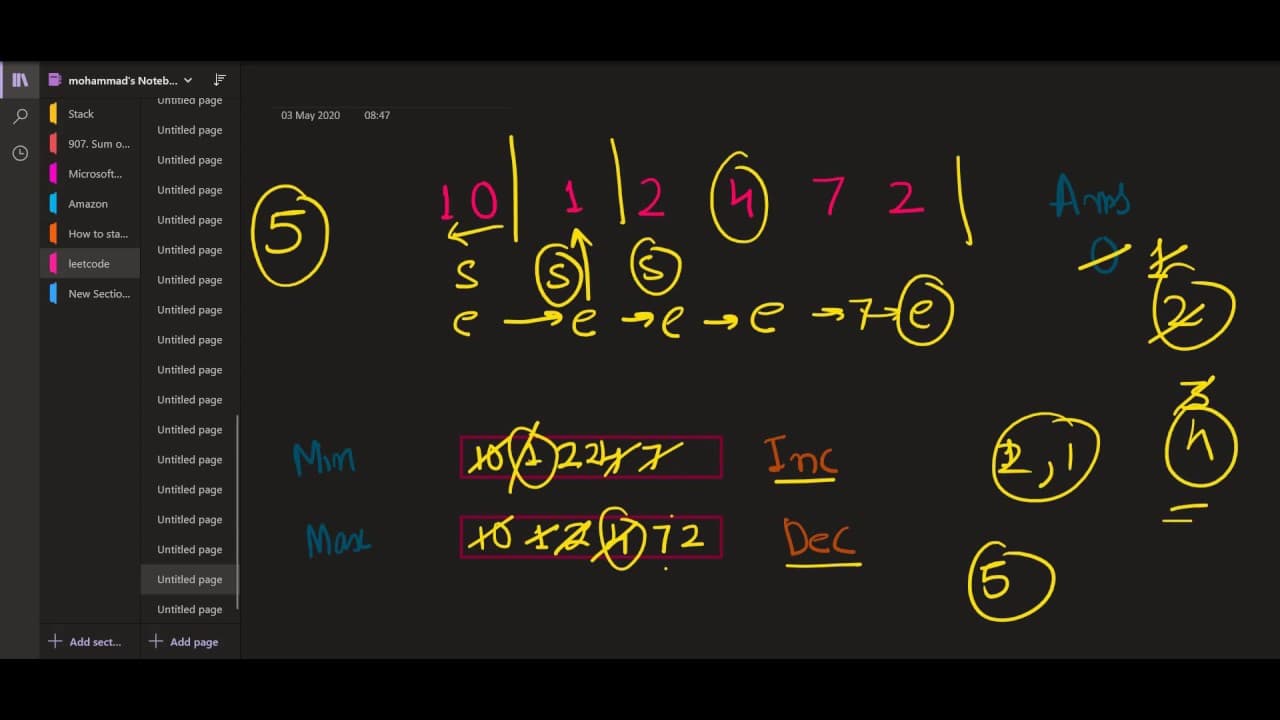
The two-pointer technique involves keeping track of a start and an end pointer. As the end pointer is incremented to expand the current subarray, the algorithm checks the difference between the maximum and minimum elements. If the difference exceeds the limit, the start pointer is incremented until the difference is back within the acceptable range.
Q: What role do deques play in solving this problem?
Deques are used to maintain the maximum and minimum values of the elements in the current subarray efficiently. By using two deques—one for increasing order and another for decreasing order—the algorithm can quickly access and update the minimum and maximum elements, enabling O(1) time complexity for these operations.
Summary & Key Takeaways
-
The content discusses a problem of finding the longest contiguous subarray where the absolute difference between elements is within a specified limit, providing examples for clarity.
-
It introduces a two-pointer approach to solve the problem efficiently in O(n) time complexity, contrasting it with a brute force O(n^2) solution.
-
The video also explains how to maintain maximum and minimum elements using deques to facilitate efficient calculation of valid subarrays.
Read in Other Languages (beta)
Share This Summary 📚
Summarize YouTube Videos and Get Video Transcripts with 1-Click
Try YouTube Summary with ChatGPT & Claude or YouTube Transcript Generator
Explore More Summaries from Fraz 📚


Summarize YouTube Videos and Get Video Transcripts with 1-Click
Try YouTube Summary with ChatGPT & Claude or YouTube Transcript Generator